

In this article
Nearshore development services ROI is easy to understate. Compare only hourly rates, and you’ll miss most of the real value. Cite only a vendor’s headline savings percentage, and you’ll overstate it. The real number sits between those two extremes. It combines direct cost savings, the value of shipping faster, and the cost you avoid by not re-hiring every year. Then it offsets that against real onboarding and management time — the part a rate card never shows.
This guide gives a straightforward way to calculate that number for your own team. It walks through a worked example. And it covers the outcomes worth tracking once the engagement is running, not just projecting them upfront.

What ROI Actually Means for Nearshore Development Services
A rate comparison alone answers the wrong question. The number that matters is total cost of ownership against the value delivered. Value shows up in more places than the invoice. Four categories consistently drive nearshore development services ROI, in either direction:
- Direct cost savings — the gap between a fully loaded domestic hire and an equivalent nearshore engineer.
- Speed-to-market value — what it’s worth to ship a feature, integration, or product weeks earlier than a slower hiring cycle would allow.
- Retention-driven cost avoidance — the re-onboarding cost a stable team avoids that a high-churn team pays repeatedly.
- Quality and defect outcomes — rework avoided when engineers are properly vetted for the actual stack, not just a generic coding test.
Ignore any one of these, and the ROI number you calculate will be wrong in a predictable direction. It’ll usually run too optimistic, because most buyers project the savings and skip the offsetting costs.
The Four Outcome Categories That Drive ROI
Each category above maps to something you can actually measure. None of them are a one-time estimate you set and forget.
Speed-to-market. A domestic hiring cycle for a mid-level engineer commonly runs six to twelve weeks, from requisition to start date. A nearshore provider with an active bench can place a matched engineer in one to two weeks. Multiply that time difference by whatever your product roadmap is worth per week of delay. It’s a rough proxy, but a far better one than ignoring the timeline entirely.
Cost avoidance through retention. Every engineer who leaves mid-project costs weeks of ramp-up for their replacement. That’s on top of the direct cost of vetting and onboarding a new hire. A provider with a strong retention track record turns this into a recurring saving. A provider with weak retention turns it into a recurring tax.
Quality outcomes. Rework from a poorly vetted engineer is a hidden cost. It rarely appears on an invoice, but it shows up directly in sprint velocity and defect rates. Rigorous technical vetting reduces this cost before it happens.
Capacity flexibility. You can scale a team up for a launch and back down afterward, with no severance and no idle payroll. That flexibility has real financial value. A fixed in-house headcount can’t offer the same thing.


A Simple Framework to Calculate Nearshore Development Services ROI
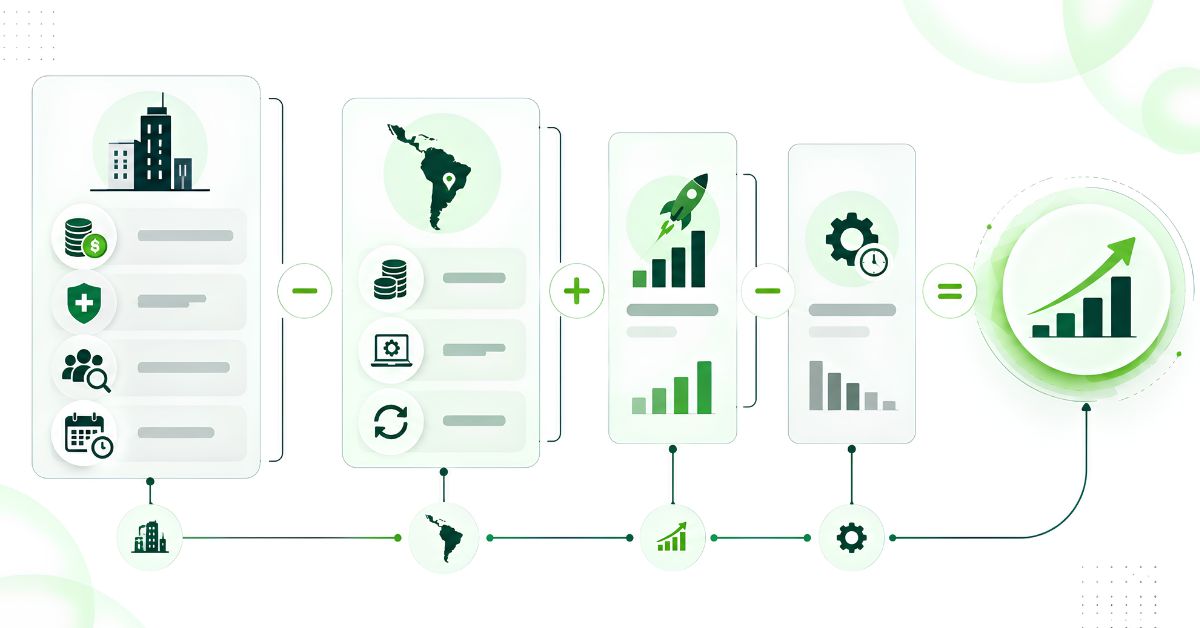
A workable formula doesn’t need to be complicated. Start with total cost of ownership on both sides of the comparison. Then adjust for the outcomes above:
- Domestic TCO = fully loaded salary + benefits + recruiting cost + average time-to-fill cost of an open seat
- Nearshore TCO = provider rate + onboarding time cost + expected re-onboarding cost based on the provider’s retention rate
- ROI adjustment = add the estimated value of shipping faster, and subtract any additional management overhead the engagement requires
The output isn’t a single universal number. It changes based on your provider’s actual retention rate, your team’s time-to-fill for domestic roles, and how much a week of earlier delivery is genuinely worth to your business. That’s the point. A real ROI calculation is specific to your situation, not a percentage lifted from a vendor’s homepage.
Worked Example: A Three-Engineer Nearshore Team vs. Domestic Hiring
Take a mid-market SaaS company adding three senior engineers. Domestic hiring runs a median $135,980 salary each. Add roughly 30% for benefits and payroll overhead. Add a conservative $30,000 for combined recruiting cost and lost productivity during an eight-week vacancy. That puts fully loaded domestic cost at approximately $205,000 per engineer in year one — around $615,000 for three hires, before any of them have shipped a line of code.
A nearshore team at a blended rate for senior LATAM talent, with onboarding costs included and a retention rate above 90%, typically lands between $220,000 and $270,000 total for the same three engineers in year one. That gap commonly runs $250,000 to $400,000 in year one alone. And that’s before counting the weeks of earlier delivery a nearshore provider with an active bench typically enables, versus a domestic search that starts from scratch.
Non-Financial Outcomes That Still Affect ROI
Not every outcome shows up as a dollar figure, but each one still moves the real ROI number. Institutional knowledge retention matters: an engineer who stays two or three years accumulates context a rotating cast of contractors never builds. Delivery predictability matters too. A team that reliably hits sprint commitments lets a roadmap actually function as a planning tool, not a guess. And engineering leadership bandwidth is itself an outcome. A well-run nearshore engagement frees a lead to spend time on architecture and strategy, instead of firefighting vendor issues.
Research from MIT’s Center for Information Systems Research, published through CIO, found that outsourcing engagements built around clear, simple success criteria succeed roughly 90% of the time. Loosely defined strategic partnerships, without that clarity, succeed only about half the time. That gap is itself an ROI factor. A well-structured engagement is measurably more likely to actually deliver the outcomes it was built to produce.

What Can Erode Nearshore Development Services ROI
- High engineer turnover silently converts a projected saving into a recurring re-onboarding cost, often without anyone tracking the connection.
- Weak technical vetting produces rework that eats into sprint velocity in a way that never appears on the vendor’s invoice.
- Undocumented onboarding stretches the ramp-up period for every new engineer, domestic or nearshore, and quietly extends the payback timeline.
- Scope creep with no change-order discipline inflates the “nearshore TCO” side of the formula until it no longer resembles the number in the original proposal.
None of these are inherent to nearshore delivery. They’re structural risks. A well-vetted provider and a disciplined engagement process both reduce them.


How to Track ROI After the Engagement Starts
Calculating ROI once, at the proposal stage, misses the point. Track a handful of metrics on a recurring basis instead: actual retention versus the rate quoted at signing, sprint velocity before and after the team ramps up, time from request to first contributing pull request for any new hire, and the running total cost of ownership against the original projection. A quarterly review of these four numbers catches ROI erosion long before it shows up as a missed roadmap commitment.
Global IT spending will reach $6.37 trillion in 2026, a 14.2% increase from 2025, according to Gartner’s July 2026 IT spending forecast. Software spending specifically is among the fastest-growing categories in that total. More organizations are making this exact calculation at the same time, competing for the same nearshore talent pool. That’s what makes disciplined ROI tracking — not a one-time projection — the difference between an engagement that pays off and one that quietly stops delivering the number it started with.
The talent shortage behind that spending growth is real. The U.S. Bureau of Labor Statistics puts the median software developer wage at $135,980 as of May 2025. Employment is projected to grow 10% through 2035. That gap between demand and domestic supply keeps nearshore’s cost and speed advantage structurally relevant, not a temporary discount.
Why Trust and Structure Matter as Much as the Rate
Deloitte’s Global Outsourcing Survey found that transparency and trustworthiness rank well above favorable contract terms, as the qualities organizations value most in a service provider relationship. That finding lines up with how ROI actually behaves in practice. A cheaper provider with a weak communication standard and thin vetting produces a worse total-cost outcome than a modestly pricier provider with a real retention track record — even though the second option looks less attractive on the rate card alone.
Distributed collaboration itself is no longer the friction point it once was. In Stack Overflow’s 2025 Developer Survey, 32.4% of professional developers reported working fully remote. A nearshore engineer joining daily standups over video fits the operating model most engineering teams already use. It isn’t the ROI drag it might have been a decade ago.
Why ParallelStaff for Nearshore Development Services ROI
ParallelStaff is an ISO 27001-certified nearshore provider with a 94% engineer retention rate. That figure converts directly into the cost-avoidance side of the ROI formula above, since fewer re-onboarding cycles mean the projected savings actually materialize. The company ranked #502 on the 2025 Inc. 5000 list of fastest-growing private companies. It holds a 4.8-out-of-5 Clutch rating from verified client reviews. Enterprise clients including AT&T, AMD, Google, J.Crew, and Whirlpool have used ParallelStaff’s nearshore software development model to close engineering gaps without the ramp-up losses that erode ROI elsewhere.
ParallelStaff’s guides on nearshore outsourcing services and nearshore IT outsourcing cost cover the engagement models and pricing mechanics that feed directly into the TCO side of this calculation. The outsourcing software development guide covers the broader engagement process end to end. And the software development outsourcing services buyer’s guide breaks down what a services contract typically includes, before you model the numbers above.
Frequently Asked Questions
How do you calculate nearshore development services ROI?
Compare total cost of ownership on both sides. Weigh domestic salary plus benefits plus recruiting cost against nearshore rate plus onboarding and expected re-onboarding cost. Then adjust for the value of shipping faster and any added management overhead.
What’s a realistic ROI range for a nearshore engineering team?
A three-engineer nearshore team commonly saves $250,000 to $400,000 in year one versus equivalent domestic hires. The exact figure depends on your provider’s retention rate and your own hiring timeline.
Does nearshore development ROI include speed-to-market value?
It should. A provider with an active bench can typically place an engineer in one to two weeks, versus six to twelve weeks for domestic hiring. That time difference has real value, depending on your roadmap.
What most commonly erodes nearshore ROI after signing?
Engineer turnover is the biggest factor. High churn converts a projected saving into a recurring re-onboarding cost that rarely gets tracked back to the original ROI projection.
How does provider retention rate affect the ROI calculation?
Directly. A provider with a retention rate above 90% avoids the repeated ramp-up cost that a high-churn provider forces you to absorb every time an engineer leaves mid-project.
Should I track ROI only once, at the start of the engagement?
No. Track actual retention, sprint velocity, and time-to-productivity for new hires on a recurring basis. Quarterly reviews catch ROI erosion before it becomes a missed roadmap commitment.
Is nearshore development cheaper than offshore when you factor in ROI?
Not always on rate alone. But nearshore’s time zone overlap typically reduces the rework and communication delay that erode offshore’s lower headline rate.
What non-financial outcomes should I track alongside ROI?
Institutional knowledge retention, delivery predictability, and how much engineering leadership time gets freed up from vendor management rather than technical work.
How much should I budget for onboarding when calculating nearshore ROI?
Plan for two to four weeks of reduced productivity per engineer. Treat any provider who can’t estimate this specifically as a sign their process is less mature than advertised.
Does capacity flexibility count as part of ROI?
Yes. You can scale a team up for a launch and back down afterward, with no severance and no idle payroll. That flexibility has real financial value a fixed in-house headcount structurally can’t offer.
 Verified Author

ParallelStaff