Check our case study
Extending Architecture & Automation Capacity
SOFTWARE DEVELOPMENT OUTSOURCING
Your Project.
Senior Engineers. Delivered.
From discovery and design through development, QA, and launch — we take full ownership of your project so your internal team can stay focused on what only they can do.
Start my project
BENEFITS OF SOFTWARE OUTSOURCING
We own the project. You own the outcome.
From first sprint to final deployment — fully managed, fully accountable.

From signed to shipping in 2-3 weeks.
From signed to shipping in 2-3 weeks.
Tell us what you're building. We'll hand-pick a senior team from 4,000+ vetted engineers and have them productive faster than any traditional hiring process.

Senior engineers, not whoever's available.
Senior engineers, not whoever's available.
Every engineer we place averages 5+ years of tenure with us. Deep experience, proven delivery, and zero learning curve on what good work looks like.

Full-stack, full ownership.
Full-stack, full ownership.
Front-end, back-end, DevOps, QA, data engineering — we cover the entire stack. One team, one point of accountability, no coordination gaps.
Works your hours, in your tools.
Works your hours, in your tools.
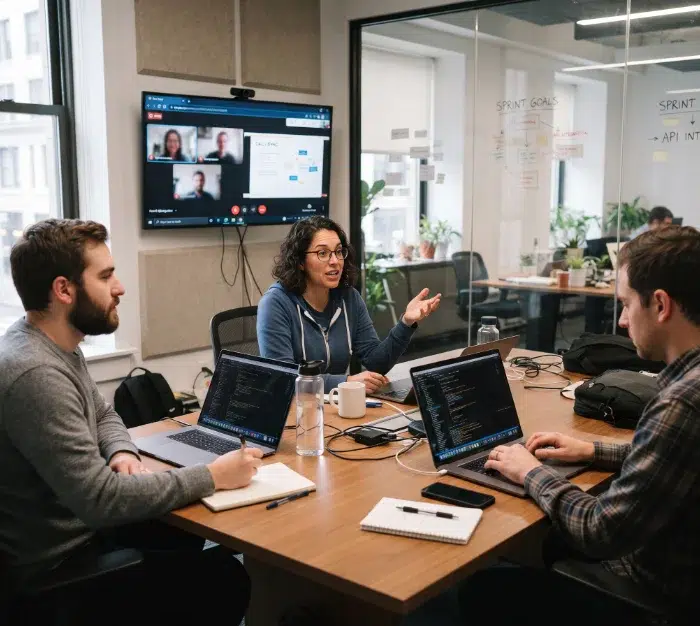
Your outsourced team joins your standups, communicates in fluent English, and collaborates in your existing workflows. They feel like your team because they are.

No language barrier. Ever.
No language barrier. Ever.
Our engineers are Cambridge English certified. Clear communication isn't a bonus — it's a baseline requirement we hold every engineer to before they join your project.
Related articles




REPORT
How top digital transformation firms are structuring their delivery teams in 2026
Enterprise standards are our baseline.
Our delivery model is backed by industry certifications, leading technology partnerships, and recognition from trusted institutions.
Delivery & process standards
Aligned with globally recognized delivery and security frameworks.
Structured service delivery and SLA governance
Information security and data protection controls
Client trust & market validation.
Verified client reviews and third-party market research.
Inc. Power Partner for high-growth companies

Top-ranked service providers worldwide
Business & industry recognition
Independent validation of growth, leadership, and execution.

One of America’s fastest-growing private companies

Recognized technology leadership
Cloud & AI partnerships
Certified expertise across leading cloud and AI platforms.

FIND THE BEST DELIVERY MODEL FOR YOU
Why outsource your software development with ParallelStaff?
Outsourcing your project lets your internal team stay focused on what matters most, while our senior engineers take full ownership of delivery — on time, on scope, no surprises.
|
Staff augmentation |
Dedicated development teams | Recommended Software development outsourcing | |
|---|---|---|---|
|
Scale teams as needed
Adjust headcount on demand
|
|
|
|
|
Integrated into your team
Devs join your workflows & standups
|
|
|
|
|
Dedicated full team provided
Pre-built squad delivered end-to-end
|
|
|
|
|
You retain management control
CTO directs priorities & sprints
|
|
|
|
|
Project management included
PM & delivery handled by vendor
|
|
|
|
|
Time to first developer
Speed of onboarding
|
Fast (days)
|
Medium 1-2 weeks
|
Medium 1-2 weeks
|
|
Full IP & code ownership
Clear client ownership of all output
|
|
|
|
|
Visibility into day-to-day work
Sprint access, standups, reporting
|
|
|
|
Ready to see what your project could look like with us?
Start my project
The best engineering teams don't just deliver, they come back. 4+ year average client tenure. Our partners stay because the work speaks for itself.












Our engagement
process. Clear.
Predictable. Proven.

STEP 1
Intro conversation
We get to know your team, your goals, and your engineering gaps. No commitment — just a quick conversation to see if we're a good fit to work together.
STEP 2
Discovery call
We go deeper into your needs, present our delivery models, and walk you through how we work. You'll have everything you need to make a confident decision.
STEP 3
Define scope & assemble your team
We translate your project vision into a clear delivery scope, milestones, and team structure — then staff it with senior pre-vetted LATAM engineers ready to execute from day one.
STEP 4
Ongoing performance and accountability
Your team delivers with consistency. We maintain performance oversight, run monthly business reviews, and hold biweekly syncs to keep velocity high and results measurable.
Related articles
Resources for engineering leaders Practical insights on scaling tech teams, closing skill gaps, and making smarter staffing decisions.






Frequently Asked Questions
We align on your objectives, team requirements, delivery expectations, timelines, and success criteria to determine the right engagement model.
Software outsourcing is when a company partners with an external team to design, build, improve, or maintain software. Instead of relying only on internal hiring, the business works with a specialized software partner that can provide the technical talent, delivery structure, and execution support needed to move faster and reduce operational strain.
IT software outsourcing is a more specific form of outsourcing focused on software engineering and technology delivery. It can include application development, platform modernization, cloud work, QA, DevOps, integrations, and ongoing support. The goal is to give companies access to technical execution without having to build every capability internally.
Software outsourcing usually starts with discovery: defining goals, scope, priorities, timelines, and the level of ownership needed. From there, the right team is assembled, delivery workflows are aligned, and execution begins through shared planning, reporting, and regular checkpoints. Depending on the model, the partner can either support internal teams or take broader responsibility for delivery outcomes.
Software outsourcing makes sense when internal hiring is too slow, too expensive, or too limited for the roadmap ahead. It is especially useful when a company needs specialized skills, faster time-to-market, additional delivery capacity, or support for a major initiative without expanding permanent headcount too aggressively.
The main difference is ownership. In staff augmentation, external engineers join your existing team and work under your management. In software outsourcing, the partner takes on a broader delivery role, often providing team structure, execution support, and accountability for defined outcomes. Staff augmentation adds capacity; outsourcing adds capacity and takes on additional delivery responsibility.
A dedicated development team is a stable team assigned to your business over time, usually working closely with your product and engineering leads. Software outsourcing can be broader and more outcome-driven, with the partner taking responsibility for larger parts of planning, execution, and delivery. One is deeply embedded; the other is often more managed.
For growing companies, software outsourcing can improve speed, flexibility, and access to specialized expertise. It also helps reduce hiring friction, control delivery costs, and keep internal teams focused on core business priorities. When done well, it gives leaders a way to scale execution without slowing down the broader organization.
Companies outsource a wide range of projects, including custom applications, SaaS platforms, platform rebuilds, system integrations, cloud migrations, QA initiatives, AI-enabled products, DevOps improvements, and ongoing maintenance. It can work for new product delivery, legacy modernization, or continuous improvement programs that need dependable engineering support.
Yes. Software outsourcing can support the full lifecycle of a digital product. It can help launch new platforms, modernize legacy systems, improve infrastructure, add new features, and provide ongoing support after release. The right model depends on whether you need a partner for a specific initiative, long-term execution, or a mix of both.
A software outsourcing engagement can include front-end, back-end, and full-stack engineers, QA specialists, DevOps engineers, cloud experts, UI/UX designers, product roles, and technical leadership. Team shape depends on the scope, but the best engagements are built around outcomes, not just job titles.
Software outsourcing costs vary based on scope, seniority, team composition, engagement model, and the complexity of the work. A small delivery pod will be priced very differently from a multi-role team supporting a larger product roadmap. In general, outsourcing is often more cost-efficient than building the same capability entirely in-house, especially when speed and flexibility matter.
IP protection should be built into the engagement from the start. That includes clear contracts, confidentiality terms, controlled access, secure onboarding, permission-based repository management, and defined ownership of code and deliverables. The goal is simple: your software, your business logic, and your data should remain protected throughout the relationship.
Strong outsourcing teams align with the client's security standards from day one. That can include secure onboarding, access controls, approved tools, infrastructure safeguards, and delivery workflows that respect compliance needs. For companies in regulated industries, the partner should be able to work within existing policies while keeping collaboration practical and efficient.
Yes. For many companies, that is one of the biggest advantages of a nearshore model. Teams with meaningful overlap in U.S. business hours can join standups, planning sessions, reviews, and urgent discussions in real time. That makes communication faster, reduces delivery friction, and helps software work move more smoothly.
Look for a partner with strong technical depth, a clear delivery process, responsive communication, secure operating practices, and a model that fits how your business works. It also helps to choose a team that can scale with you, adapt to your workflows, and speak clearly about accountability, not just talent availability.

Driving RPA Success for a Global Telecom Company
Read Case StudyReady to ship faster with a team that owns it? Let's build something great together.
Schedule a call