

In this article
A staff augmentation ROI pitch built on hourly rate alone falls apart the first time a CFO asks about hidden costs. It should. Rate is only one input. The real business case combines direct cost savings, time-to-productivity, and the cost of turnover — set against the management overhead an augmented engineer still requires.
This guide walks through the calculation, a worked example for a single hire, and the objections most finance leaders raise before they sign off.

What a Staff Augmentation Business Case Needs to Answer
A business case is not a cost comparison. It’s an answer to a specific question: why this model, why now, and what happens if we do nothing instead. Three things need to be true for the case to hold up:
- The cost comparison is honest, including onboarding time and management overhead — not just the rate card.
- The urgency is real. A vacant seat has a cost, and the business case should name it.
- There’s a plan to measure the outcome after approval, not just a projection before it.
Skip any of these, and the case reads like a sales pitch instead of a decision document. Finance leaders notice the difference immediately.
The Core ROI Calculation
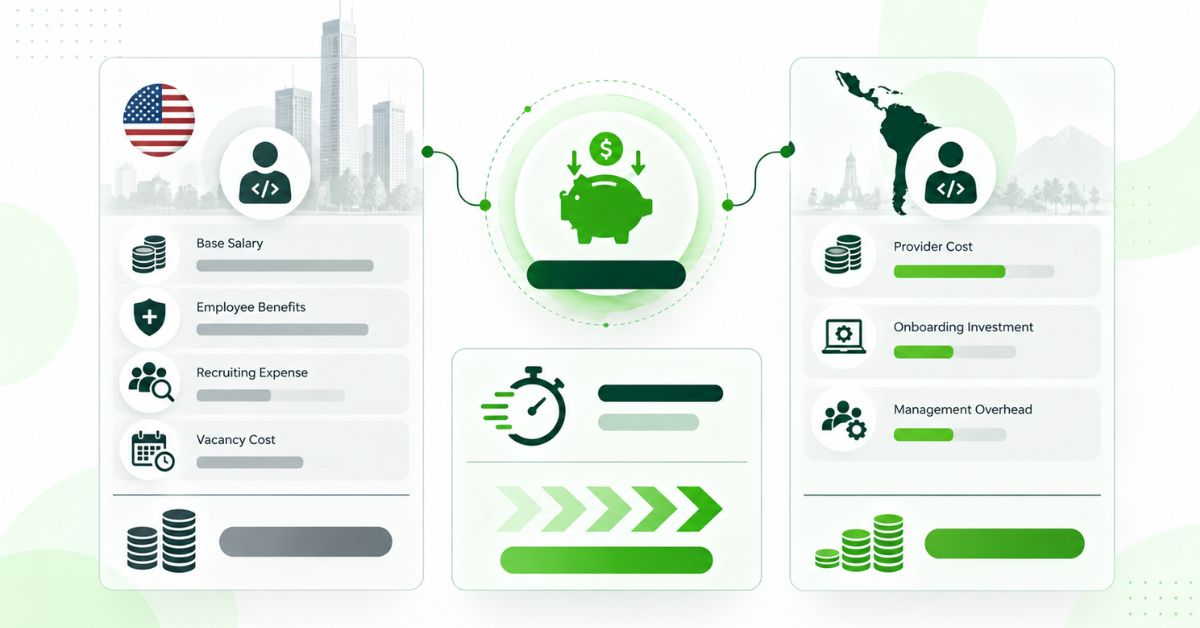
Start with total cost of ownership on both sides. Domestic hiring includes more than salary. Nearshore staff augmentation includes more than the hourly rate.
- Domestic TCO = fully loaded salary + benefits + recruiting cost + productivity cost of the vacancy period
- Augmented TCO = provider rate + onboarding time + management overhead
- Net ROI = Domestic TCO minus Augmented TCO, adjusted for how much faster the augmented engineer starts contributing
The vacancy cost is the piece most business cases skip. A senior engineering role sitting open for two months isn’t free. It’s a roadmap item that doesn’t ship, a teammate covering extra scope, or both.


Worked Example: One Senior Engineer, Year One
A domestic senior engineer at the median $135,980 salary costs roughly $177,000 fully loaded, once benefits and payroll overhead are added at 30%. Add a conservative $15,000 in recruiting cost and lost productivity for an eight-week vacancy. That puts year-one domestic cost near $192,000, before the engineer has shipped anything.
A senior nearshore augmented engineer, onboarded within two weeks through a provider with strong retention, typically lands between $90,000 and $130,000 for the same year. The gap commonly runs $60,000 to $100,000 in year one alone. That’s before counting the six extra weeks of delivery the augmented engineer provides by starting sooner.
Objections a CFO Will Raise — and How to Answer Them
A good business case anticipates pushback instead of reacting to it. Four objections come up almost every time.
“Won’t this cost more once you add management time?” Yes, some. Name the number. A lead spending two or three hours a week on oversight is a real cost, but it’s small next to the savings above. Hiding this cost weakens the case; naming it strengthens it.
“What happens when the engagement ends?” Staff augmentation contracts typically run month-to-month. Say so explicitly. A CFO worried about lock-in wants to hear there isn’t any.
“How do we know the engineer is actually senior?” Ask the provider for their vetting pass rate and average tenure. A number here beats a marketing claim every time.
“Why not just wait and hire domestically?” Put a dollar figure on the wait. Multiply the vacancy period by whatever the delayed roadmap item is worth. Waiting isn’t free; the business case should say what it costs.
Building the One-Page Business Case
Keep the document short. A business case that runs five pages gets skimmed, not read. One page, structured like this, holds up:
- The problem: what’s not getting done because of the current gap.
- The cost of waiting: a dollar figure for the vacancy or delay.
- The comparison: domestic TCO versus augmented TCO, side by side.
- The provider: vetting rigor, retention rate, and security certification in three lines.
- The ask: headcount, budget, and start date.
Gallup’s 2026 span of control research found the median manager leads just five to six direct reports, even as the U.S. average has climbed to 12.1. That’s a useful data point inside a headcount business case. It shows adding capacity through augmentation, rather than stretching an already-overloaded lead further, protects the team’s ability to actually deliver.

What to Track After Approval
A business case that turns out to be wrong makes the next one harder to get approved. Track the numbers you projected. Confirm actual time-to-productivity against the estimate. Confirm the engineer is still on the team ninety days in. Report both back to finance, even if nobody asks. That follow-through is what makes the next business case an easier conversation.
The pressure behind this decision is structural, not seasonal. Gartner’s July 2026 forecast puts worldwide IT spending at $6.37 trillion for the year, a 14.2% jump from 2025. More budget is chasing the same limited engineering talent pool. The U.S. Bureau of Labor Statistics puts the median software developer wage at $135,980 as of May 2025, with demand projected to grow 10% through 2035. That gap between supply and demand is exactly why a well-built ROI case matters more now than it did a few years ago — the alternative to approving it isn’t a cheaper domestic hire, it’s a longer vacancy.

Why the Provider You Pick Changes the ROI
Deloitte’s Global Outsourcing Survey found that transparency and trustworthiness rank well above favorable contract terms as the qualities companies value most in an augmented workforce relationship. That matters for ROI specifically. A cheaper provider with high turnover erases its own rate advantage within a year, once re-onboarding costs are counted. Research published through CIO, from MIT’s Center for Information Systems Research, found that clearly structured engagements succeed roughly 90% of the time, while loosely defined ones succeed only about half the time. A tight, well-scoped business case isn’t just a formality. It’s a real predictor of whether the ROI you project is the ROI you get.
Why ParallelStaff for a Staff Augmentation ROI Case
ParallelStaff is an ISO 27001-certified nearshore provider with a 94% engineer retention rate. That number belongs directly in the business case, since it’s the figure that keeps a projected saving from turning into a re-onboarding cost six months in. The company ranked #502 on the 2025 Inc. 5000 list of fastest-growing private companies and holds a 4.8-out-of-5 Clutch rating from verified client reviews. Enterprise clients including AT&T, AMD, Google, J.Crew, and Whirlpool have built their own internal cases around ParallelStaff’s IT staff augmentation model. ParallelStaff’s guides on staff augmentation services and IT staff augmentation services cover the engagement mechanics that feed into the TCO side of this calculation. The staff augmentation for SaaS startups guide covers a version of this business case for earlier-stage teams, and the nearshore staff augmentation page breaks down the delivery model this ROI math assumes.
Frequently Asked Questions
How do I calculate staff augmentation ROI?
Compare fully loaded domestic cost — salary, benefits, recruiting, vacancy time — against the provider’s rate plus onboarding and management overhead. Adjust for how much sooner the augmented engineer starts contributing.
What’s a realistic ROI for a single augmented engineer?
Commonly $60,000 to $100,000 in savings during year one versus a domestic hire, depending on seniority and the provider’s rate.
What should a staff augmentation business case include?
The cost of the current gap, a side-by-side TCO comparison, the provider’s vetting and retention data, and a specific headcount and budget ask — kept to one page.
What objections does finance usually raise about staff augmentation?
Management overhead, contract lock-in, engineer seniority, and the cost of simply waiting to hire domestically. Each has a direct, specific answer.
How do I answer the “what if the engagement ends” objection?
Point to the contract terms directly. Most staff augmentation engagements run month-to-month, with no long-term lock-in.
Should the business case include the cost of waiting?
Yes. Put a dollar figure on the vacancy period and whatever roadmap item it delays. Waiting has a cost; name it.
How does provider retention affect ROI?
Directly. A provider with high turnover forces repeated re-onboarding, which quietly erodes the savings the original business case projected.
What should I track after the business case is approved?
Actual time-to-productivity against the estimate, and whether the engineer is still on the team ninety days in. Report both back to finance.
How many direct reports can support a staff augmentation ROI case?
Gallup’s research puts the healthy median span of control at five to six. A lead already past that range is a strong argument for augmentation over adding more direct reports.
Does staff augmentation ROI hold up for a single hire, or only larger teams?
It holds up for a single hire. The math scales — recruiting cost, vacancy cost, and retention risk all apply whether you’re adding one engineer or ten.
 Verified Author

Luis Peralta
CEO & Founder
Linkedin Profile