

In this article
TL;DR: Outsourcing software development means hiring an external team to build, extend, or maintain software instead of doing the work in-house. The process runs through a few clear steps: scope the work, pick an engagement model, choose a region, vet providers, structure the contract, and manage delivery. Most delays and cost overruns trace back to a skipped step, not a bad developer. In 2026, buyers who follow a structured process land a working partnership faster than buyers chasing the lowest rate.
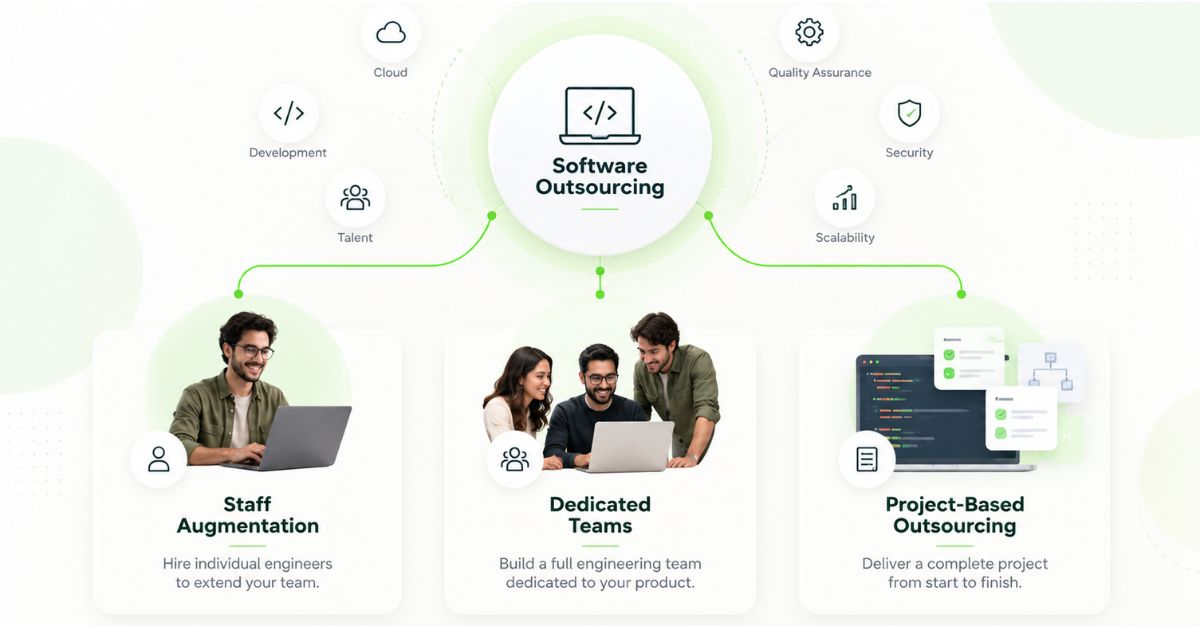
Outsourcing software development means hiring an external company or team to handle part or all of a software project. You skip building it with in-house staff. That can mean a single contractor filling one role. It can also mean a full dedicated team, or an entire project handed off end to end. The right approach depends on your timeline, your budget, and how much control you want to keep over day-to-day decisions.
This guide walks through the process step by step. It covers scoping the work, picking an engagement model, choosing a region, vetting providers, and structuring the contract. Our software outsourcing guide and our software outsourcing services page cover the topic more broadly. This piece focuses on the actual sequence of decisions a buyer needs to make.
What Outsourcing Software Development Actually Means
The phrase covers a wide range of arrangements. On one end, a company hires a single contractor to fill a specific skill gap for a few months. On the other end, a company hands an entire product build to an outside firm and only reviews milestones. Most engagements fall somewhere in between: an external team joins an existing process, working under the client’s direction but staffed and managed by the provider.
What stays constant across every version is accountability. A good outsourcing partner doesn’t just supply bodies. It stands behind delivery quality, security practices, and continuity if someone on the team leaves partway through the project.
A few signals suggest a company is ready to outsource rather than keep pushing through with the current team. A backlog that keeps growing despite reprioritization is one. A hiring pipeline that’s been open for months without a qualified candidate is another. And a roadmap commitment made to a customer or investor that in-house capacity simply can’t hit on time is a third. None of these signals mean outsourcing is mandatory, but they’re worth treating as a prompt to at least run the process below.
Why Companies Outsource Software Development in 2026
Global IT spending will reach $6.37 trillion in 2026, a 14.2% jump from 2025, according to Gartner’s July 2026 IT spending forecast. IT services alone account for roughly $1.57 trillion of that total. Budgets for contracted technology delivery keep expanding, not shrinking.
That growth exists because the talent gap hasn’t closed. A McKinsey global survey found nearly nine in ten companies worldwide already have a skills gap, or expect one within a few years. The Bureau of Labor Statistics projects software developer employment will keep growing 10% from 2025 to 2035, well above the 3% average across all occupations. Median developer salary already sits at $135,980 as of May 2025. That wage floor makes staffing every role in-house expensive for most growing companies.
Remote collaboration is now standard practice, not a workaround. In Stack Overflow’s 2025 Developer Survey, 32.4% of professional developers reported working fully remote. An outsourced team joining a daily standup over video isn’t an unusual arrangement anymore. It’s simply how most engineering teams already work.
Step 1: Define What You’re Actually Outsourcing
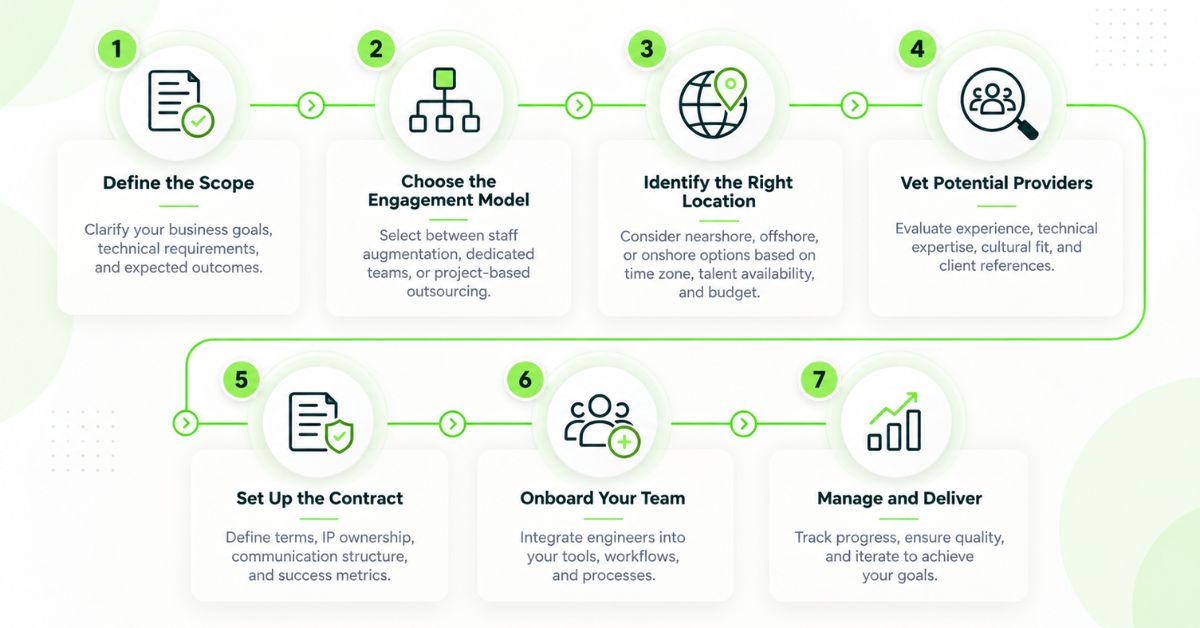
Before you talk to a single provider, write down the actual scope. Are you filling one role, like a specific Golang engineer to rewrite a backend service? Our guide to hiring expert Golang developers shows how narrow that scope can get. Or are you handing over an entire feature or product? A vague scope is the single biggest cause of a disappointing outsourcing engagement. Write down the technical requirements, the timeline, and who owns which decisions before you request a single proposal.
Step 2: Choose an Engagement Model
Three models cover most software development outsourcing arrangements. Staff augmentation adds individual engineers into your existing team, and you keep full control over priorities. A dedicated team gives you a full unit assembled and managed by the provider, suited to a sustained roadmap. Project-based outsourcing hands over a defined scope with fixed deliverables, suited to a one-off build like an MVP or a migration.
Pick the model based on how long you’ll need the work and how much day-to-day control you want to keep. A short, narrowly-scoped build usually fits project-based outsourcing. A multi-quarter roadmap usually fits a dedicated team better.
Step 3: Choose Where to Outsource
Location shapes the daily experience of an engagement more than most buyers expect going in. Nearshore providers in Latin America sit within one to three time zones of a U.S. buyer, so daily standups and code reviews happen inside a normal workday. Our comparison of Colombia vs. Argentina vs. Mexico for software development breaks down how those specific countries differ on talent depth, rates, and time zone overlap.
Offshore regions in South or Southeast Asia typically offer lower hourly rates, but the time zone gap runs 8 to 12 hours. That gap pushes real-time collaboration into a handful of overlap hours, if any exist at all. A well-scoped, loosely-coupled project can still work fine offshore. A team iterating daily alongside your product manager usually needs the nearshore overlap instead.


Step 4: Shortlist and Vet Providers
Once you know the model and the region, build a shortlist. Our roundup of the best nearshore outsourcing companies for U.S. businesses is a reasonable starting point if you’ve settled on Latin America. During vetting, check the following before you sign anything:
- Technical vetting process — ask exactly how the provider tests candidates, not just whether engineers carry a “senior” title
- Security certifications — confirm ISO 27001 or an equivalent standard if the team will touch production data or source code
- Retention data — ask for the provider’s average engineer tenure, since high turnover erodes any savings a lower hourly rate might offer
- Communication standard — confirm English fluency and real-time overlap hours in writing, not as a verbal assurance
- Reference clients — talk to at least one existing client in a comparable industry or company size
If you only need one or two engineers rather than a full team, a narrower search for individual talent can move faster than a full RFP process. Our guide to hiring a software engineer in Latin America covers what that narrower search actually looks like.
Step 5: Structure the Contract and IP Terms
A strong contract states plainly that all code and deliverables belong to you, in full, on delivery. It also names specific milestones rather than vague deliverables, sets a clear communication cadence, and spells out what happens if an assigned engineer leaves the account mid-project. Vague statements of work create most of the disputes that surface later in an outsourcing relationship, and they’re easy to avoid at the contract stage.
Step 6: Onboard and Set a Communication Cadence

The first 30 days determine most of what follows. A provider can hand you technically strong engineers and still produce a rocky first sprint if you treat onboarding as an afterthought. A few practices consistently separate smooth starts from stalled ones:
- Give the outsourced team read access to architecture docs and coding standards before day one, not during it
- Assign a single internal point of contact for the first few weeks so questions don’t get lost across channels
- Run the outsourced engineers through the same code review process as internal staff, from their very first pull request
- Set a 30- and 90-day check-in on delivery pace and communication quality, rather than waiting for a problem to surface
Companies that skip this structure often blame the provider for a slow ramp-up. Missing internal documentation usually causes that slow ramp-up, not the provider.
Step 7: Manage the Engagement Ongoing
Outsourcing isn’t a one-time handoff. Keep a regular cadence of sprint reviews, and track delivery metrics the same way you would for an internal team. Revisit the engagement model periodically. A team that started as staff augmentation to close a short-term gap might make sense as a dedicated team once the workload proves durable.
Set realistic expectations for how long each step actually takes. Scoping and shortlisting usually run two to three weeks for a first-time buyer. Vetting and contract negotiation add another one to two weeks. Providers with an existing vetted talent pool can then place a matched engineer within 1 to 2 weeks of signing. A first-time outsourcing engagement, start to first pull request, typically takes four to seven weeks in total. A repeat engagement with a known provider moves much faster, often inside two weeks.
What Outsourcing Software Development Costs in 2026
Pricing varies by model, region, and seniority. Cost reduction remains the top-cited driver behind outsourcing decisions. Deloitte’s Global Shared Services and Outsourcing Survey found it’s still organizations’ number-one objective, with many actively relocating work to more cost-efficient locations to hit that goal. But the cheapest hourly rate rarely produces the cheapest outcome once you factor in turnover and rework. Weigh total cost across the full relationship, not just the invoice line item.
Common Mistakes to Avoid
A few mistakes show up again and again. Skipping the scoping step and hoping the provider will “figure it out” almost always produces scope creep. Picking a region based on rate alone, without checking time zone overlap against your actual workflow, causes communication friction that outlasts any savings. Signing a contract silent on IP ownership or security controls creates risk that’s expensive to fix after the fact. And treating the first 30 days as a formality, rather than a structured onboarding period, produces a slow ramp-up that gets blamed on the provider when the real cause is missing internal documentation.
Why ParallelStaff for Outsourcing Software Development
ParallelStaff is an ISO 27001-certified nearshore provider built around long-term delivery, not one-off placements. The company holds a 94% engineer retention rate, ranked #502 on the 2025 Inc. 5000 list of fastest-growing private companies, and carries a 4.8-out-of-5 Clutch rating from client reviews. Enterprise clients include AT&T, AMD, Google, J.Crew, and Whirlpool. Every engineer works in U.S. time zones and passes a multi-stage technical and English-fluency vetting process before joining a client team.


Frequently Asked Questions
What does outsourcing software development actually mean?
It means hiring an external company or team to build, extend, or maintain software, instead of using in-house staff. It can range from one contractor to a full project handoff.
What’s the first step in outsourcing software development?
Scope the work clearly before contacting any provider. Write down the technical requirements, timeline, and who owns which decisions.
Is nearshore or offshore better for outsourcing software development?
It depends on how much real-time collaboration your project needs. Nearshore fits teams that need daily overlap; offshore can work for narrowly-scoped, loosely-coupled projects.
How do I vet an outsourcing provider?
Ask exactly how they technically assess engineers, confirm security certifications like ISO 27001, and ask for their average engineer retention rate.
How much does outsourcing software development cost?
Rates vary by model, region, and seniority. Total cost depends heavily on turnover and rework, not just the hourly rate.
What’s the difference between staff augmentation and project-based outsourcing?
Staff augmentation adds individual engineers into your existing team and process. Project-based outsourcing hands over a defined scope with fixed deliverables and less day-to-day oversight.
Who owns the code an outsourced team writes?
In a properly structured contract, you do, in full, on delivery. Confirm this explicitly in the IP ownership clause before signing.
How long does it take to onboard an outsourced team?
Providers with an existing vetted talent pool can typically place a matched engineer within 1 to 2 weeks. A from-scratch search takes considerably longer.
What’s the most common mistake companies make when outsourcing software development?
Skipping the scoping step. A vague statement of work almost always produces scope creep and disputes later in the engagement.
Can an outsourced team work inside our existing Agile process?
Yes. A properly onboarded team joins your existing sprint cadence, standups, and tooling rather than working in isolation.
 Verified Author

Luis Peralta
CEO & Founder
Linkedin Profile