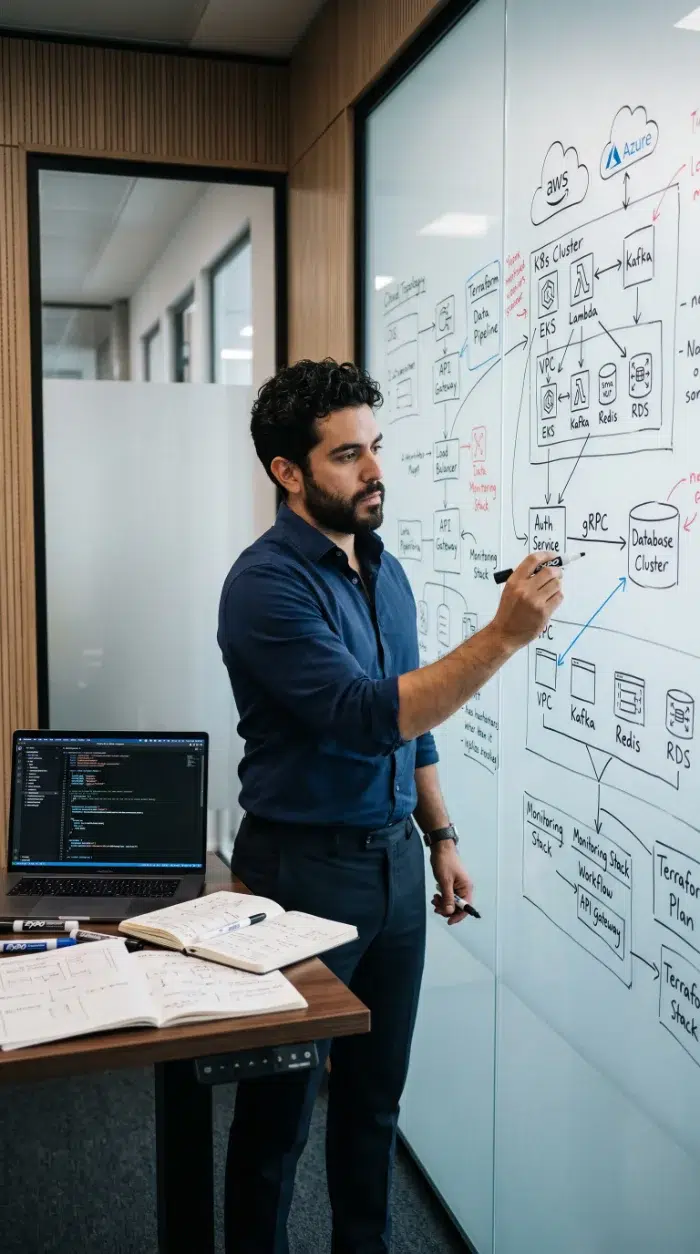
Check our case study
Extending Architecture & Automation CapacityTEAM ARCHITECTURE PLAYBOOK · DIGITAL TRANSFORMATION FIRMS
How to structure a blended onshore / nearshore engineering pod
A Tactical Playbook for CTOs and COOs at Digital Transformation Firms
Most blended pod failures aren't a talent problem. They're a structure problem. This playbook gives you the role split, the collaboration rituals, the tooling stack, and a 30-day launch sequence — so the model works the first time.
30–50%
lower cost on execution-layer engineering — without touching delivery quality
3x
faster time-to-staff new engagements vs. conventional U.S. hiring cycles
Onshore
owns strategy, client relationships, and technical direction
You already know nearshore works. The problem is: most teams implement it wrong.
This playbook breaks down exactly how top digital transformation firms structure blended pods — so they deliver faster, at better margins, without sacrificing quality.
Here's what poor pod design is costing you right now:
Your hiring speed is still constrained
you're leaving 3x faster time-to-staff on the table
You're losing 30–50% on execution-layer costs
by keeping roles onshore that don't need to be
Your senior U.S. engineers are doing execution work
instead of the architecture and client leadership only they can do
Your team structure is creating delivery drag
not because of talent, but because of how it's organized
Your delivery capacity is still tied to headcount
which means it can't scale without a hiring cycle
Built by practitioners, not pundits.
ParallelStaff has placed engineering talent at companies including AT&T, Google, AMD, and Whirlpool. This benchmark report was built from that operational experience — combined with 18 primary data sources — to give digital transformation leaders a model they can actually use, not just read.






The difference between a working pod and a failing one is operational detail.
This playbook gives you the exact structure, rituals, and systems that make blended pods actually work in production environments.
Download and get:
-
The collaboration system — daily, weekly, and sprint rituals that keep teams aligned across time zones
-
The speed advantage — nearshore teams deployed in 2–3 weeks vs 60+ day U.S. hiring cycles
-
The delivery architecture shift — how top firms split onshore strategy and nearshore execution
-
The execution framework — how leading firms audit, redesign, and scale their delivery architecture before the crunch
The firms that get this right don't just deliver faster — they take on engagements their current bench couldn't staff. 15 minutes to understand the structural difference.