

In this article
To evaluate software outsourcing providers rigorously, you need more than a checklist of criteria — you need a repeatable process that produces the same comparison for every vendor on your shortlist. That means one shared requirements document, one scoring rubric applied consistently, one reference-check script, and one pilot structure with a defined pass bar. Skip any of those four pieces and you’re back to comparing sales pitches, which is exactly how a polished vendor with a thin bench ends up winning over a stronger one with a weaker deck.
This guide walks through the mechanics of running that evaluation: how to write the brief, how to build and weight the scorecard, what to actually ask a reference, and how to structure a pilot so it tells you something real before you sign a longer contract.
Why a Structured Evaluation Beats a Sales-Call Gut Check
Research from MIT’s Center for Information Systems Research, published through CIO, found that outsourcing engagements built as ad hoc strategic partnerships fail roughly half the time, while simpler, well-defined engagements with clear evaluation criteria succeed in around 90% of cases. The difference wasn’t the vendor’s technical skill. It was whether the buyer defined what success looked like before signing, then measured the vendor against that definition consistently.
That gap matters more in 2026 than it did a few years ago. Gartner’s July 2026 forecast puts worldwide IT spending at $6.37 trillion for the year, a 14.2% jump from 2025, with IT services alone accounting for a growing share of that total. More budget flowing into contracted engineering capacity means more vendors competing for the same buyers, and a wider spread between providers who can actually deliver and those who are scaling their sales function faster than their bench.
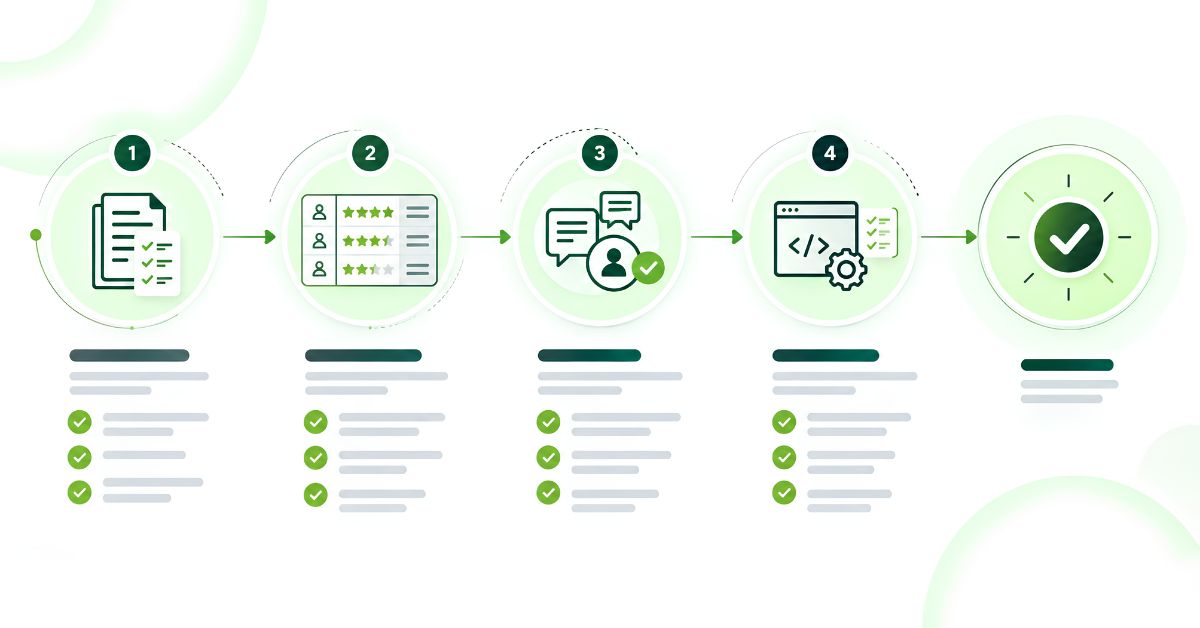
A Four-Step Framework to Evaluate Software Outsourcing Providers
The rest of this guide breaks the process into four concrete steps: a shared requirements brief, a weighted scorecard, a scripted reference check, and a paid pilot with a defined pass bar. Run every finalist through all four in the same order, and the comparison holds up even after the sales calls fade from memory. For the broader landscape these evaluation steps sit inside — engagement models, cost ranges, and where nearshore fits against offshore — ParallelStaff’s complete guide to software development outsourcing covers the wider picture.
Step 1: Write One Requirements Brief, Send It to Every Finalist
Before a single vendor call, write down the scope, the tech stack, the timeline, and who owns which decisions internally. This document becomes the anchor for the whole evaluation. Send the identical brief to every provider on your shortlist, and score their responses against it rather than letting each vendor set the terms of its own pitch.
A brief that does its job includes:
- The specific problem you’re solving — one feature, a platform migration, or ongoing capacity
- Required technologies and any non-negotiable integrations or compliance constraints
- Target start date and expected engagement length
- Who on your side owns sprint priorities, code review, and final acceptance
- The engagement model you’re leaning toward — staff augmentation, a dedicated team, or project-based delivery
Vendors who ask sharp clarifying questions about this brief are usually the ones who’ve actually staffed engagements like it before. Vendors who respond with a generic capabilities deck and skip the specifics of your brief entirely are telling you something too. If you’re still deciding which engagement model the brief should assume, ParallelStaff’s step-by-step guide to outsourcing software development walks through staff augmentation, dedicated teams, and project-based delivery before you write the scope.
Step 2: Score Providers on a Weighted Rubric
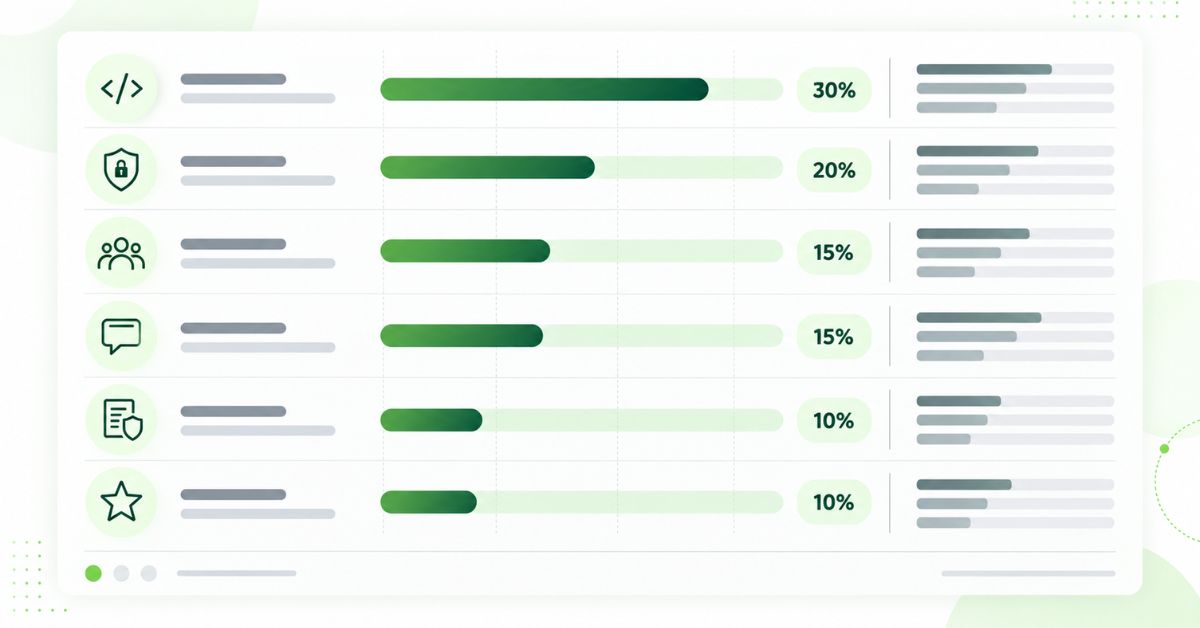
This is the piece most buyers skip, and it’s the one that turns a set of impressions into a comparison you can defend. Build a simple table with six categories, assign each a weight based on what matters most for your engagement, and score every finalist from 1 to 5 in each row using the same definitions.
| Category | Suggested Weight | Score of 5 looks like | Score of 1 looks like |
|---|---|---|---|
| Technical vetting rigor | 25% | Named pass-rate figure, live coding assessment, architecture interview | “We vet everyone rigorously,” no specifics offered |
| Security & compliance | 20% | ISO 27001 or equivalent, written data-handling policy, IP clause in the standard contract | No certification, verbal assurance only, silent contract on IP |
| Retention & continuity | 20% | Published retention rate above 85%, average engineer tenure over 3 years | Won’t share a retention number, or number is company-wide, not account-level |
| Communication & overlap | 15% | Confirmed overlap hours in writing, documented English-fluency standard | Vague “good communication” claim, no overlap-hours commitment |
| Contract & IP terms | 10% | Plain-language IP assignment, defined replacement policy, no long lock-in | Default boilerplate contract, 12+ month lock-in with no pilot option |
| Reference quality | 10% | Named client, comparable project size and industry, direct call arranged | Written testimonial only, no direct client contact offered |
Multiply each score by its weight and total the result for every finalist. A provider scoring consistently in the 4-5 range across all six categories is a safe pick. A provider that scores well on price and communication but drops to a 1 or 2 on security or retention is the profile that looks fine in a sales call and turns into a mid-project surprise.
Step 3: Run the Reference Check With a Fixed Script
A case study is marketing copy the vendor wrote about itself. A reference call is the only step in the process where someone with no stake in winning your business tells you what actually happened. Use the same questions across every reference call so the answers are comparable:
- What was the scope of the engagement, and did it change significantly after signing?
- How many engineers rotated off the account during the engagement, and why?
- How did the provider handle a missed milestone or a quality issue?
- What was the actual overlap in working hours, day to day, not the number quoted in the pitch?
- Would you sign with this provider again, knowing what you know now?
Ask for a name you can reach directly, not a written quote the vendor supplies. A provider unwilling to arrange a real reference call, or one that stalls when asked, has told you something the scorecard alone won’t capture. ParallelStaff’s guide to how to evaluate software outsourcing providers side by side goes deeper on structuring a fair, side-by-side comparison across multiple finalists if you’re running this process for the first time.


Step 4: Structure a Paid Pilot With Pass/Fail Criteria Set in Advance
A pilot only works as an evaluation tool if you define what passing looks like before it starts, not after you’ve already decided you like the team. Structure a two-to-four-week engagement on a real but bounded task, and write down the pass criteria in the brief itself:
- Code quality meets your existing review standard, evaluated by your own engineers, not the vendor’s
- The team hits agreed milestones on the agreed timeline without repeated scope renegotiation
- Communication happens inside the confirmed overlap hours, without chasing responses across time zones
- Security and access practices match what was represented during evaluation
A pilot that passes on all four earns the larger engagement. A pilot that passes on three out of four is a conversation, not an automatic disqualification — but it should reset your expectations rather than get waved through because the team seems nice.

Security and Compliance: What “Evaluated” Actually Requires in 2026
Deloitte’s Global Outsourcing Survey found that 81% of executives now rely on third-party vendors to support their cybersecurity function in some capacity, and that transparency and trustworthiness rank well above favorable contract terms alone as the qualities buyers value most in a service provider. That shift means a security review can’t be a single checkbox. Confirm not just that a provider holds a certification like ISO 27001, but how it handles source-code access, credential management, and incident notification — and get the answer in writing, not as part of the sales conversation.
A provider unwilling to put its security practices in writing, or one that treats the question as an afterthought during the pitch, is signaling how it will treat the question once you’re a signed client and harder to walk away from. For a fuller breakdown of what’s typically included in a services contract — and where security and IP terms fit inside it — see ParallelStaff’s buyer’s guide to software development outsourcing services.
Common Mistakes That Undercut the Framework
A structured evaluation only works if you actually follow it. A few mistakes show up repeatedly:
- Scoring after the decision is already made. If the scorecard consistently confirms whichever vendor you already liked, it isn’t doing its job — build in a step where someone other than the champion of a particular vendor reviews the scores.
- Letting price override the total score. The lowest quote wins the conversation far more often than it should. A cheap provider with a weak retention score routinely costs more once you count re-onboarding and rework.
- Skipping the pilot because the reference calls went well. A strong reference tells you about a past engagement, not this one. The pilot is the only step that tests the actual team you’ll work with.
- Involving only procurement, not engineering. The people who’ll work with the provider day to day should score the technical categories — a pricing-focused reviewer alone will underweight vetting rigor and overweight the hourly rate.
Remote, distributed delivery is no longer a workaround buyers need to be talked into. In Stack Overflow’s 2025 Developer Survey, 32.4% of professional developers reported working fully remote, with many more in flexible or hybrid arrangements. The operating model an outsourcing engagement depends on is already how most engineering teams function — which means the evaluation should focus on delivery discipline, not on whether remote collaboration can work at all.
Why the Evaluation Matters More Given the Talent Market
The pressure behind outsourcing decisions in 2026 is structural, not a passing trend. The U.S. Bureau of Labor Statistics puts the median annual wage for software developers at $135,980 as of May 2025, with employment projected to grow 10% through 2035 — well above the 3% average across all occupations. That wage floor, combined with a hiring pipeline that hasn’t kept pace with demand, is exactly why more companies are evaluating outsourcing partners rather than trying to staff every open role domestically. It’s also exactly why the evaluation itself deserves the same rigor as an internal hire, not less.


Why ParallelStaff Scores Well on This Framework
ParallelStaff is an ISO 27001-certified nearshore provider with a 94% engineer retention rate and an average tenure well above the industry norm for augmentation teams. The company holds a 4.8-out-of-5 Clutch rating from verified client reviews and ranked #502 on the 2025 Inc. 5000 list of fastest-growing private companies. Enterprise clients — including AT&T, AMD, Google, J.Crew, and Whirlpool — are checkable references, not just logos on a homepage. Every engineer passes a multi-stage technical and English-fluency vetting process before reaching a client conversation, and IP assignment is written into the standard contract rather than left to a default template. Run ParallelStaff’s own team through the same rubric on the software outsourcing services page, and the scorecard is exactly how the company expects to be judged.
Frequently Asked Questions
What’s the fastest way to evaluate software outsourcing providers with a small team?
Use a shortened version of the same four steps: a one-page requirements brief, a scorecard with just three or four categories weighted toward what matters most for your project, one reference call per finalist, and a short paid pilot. Skipping steps entirely is riskier than compressing them.
How many providers should I put through the full evaluation?
Three to four finalists is usually the right range. Fewer than that limits your comparison; more than that spreads evaluation time thin enough that the process itself becomes the bottleneck.
Is a pilot really necessary if the references check out?
Yes. References describe a different engagement with a different team composition. A pilot tests the specific engineers who would actually join your project.
What retention rate should I look for in an outsourcing provider?
Industry churn on augmentation teams commonly runs 20-40% annually. A provider publishing a retention rate above 85%, with multi-year average tenure, is a meaningful outlier worth weighting heavily in the scorecard.
Should security certifications be a hard requirement or just a scoring factor?
For any engagement touching production data or source code, treat a recognized standard like ISO 27001 as a pass/fail gate rather than just a weighted category — a provider without it shouldn’t advance regardless of how it scores elsewhere.
How do I know if a vendor’s technical vetting claims are real?
Ask for the actual pass-rate figure and what the screening process includes — live coding assessments, architecture interviews, English-fluency evaluation. A provider that can’t name a specific number is giving you a marketing claim, not a process.
What’s a reasonable length for a paid pilot?
Two to four weeks on a real, bounded task is typically enough to evaluate code quality, communication rhythm, and delivery discipline without committing to a full engagement.
Should procurement or engineering own the vendor evaluation?
Both, with clearly split responsibility. Engineering should score technical vetting, security, and delivery fit; procurement typically owns contract terms and pricing structure. Neither group scoring the whole rubric alone produces a lopsided result.
What’s the single biggest red flag when evaluating a provider?
A provider that won’t connect you directly with a named reference client, or gives vague answers about its technical vetting process with no specific figures behind them. Either one alone is a caution sign; both together are a strong signal to keep looking.
Does a lower hourly rate ever make sense to prioritize in the scorecard?
Only after the security, retention, and vetting categories clear your minimum bar. Comparing price among providers who’ve already passed those gates is reasonable. Letting price outweigh them is how a cheap engagement turns into an expensive one.
 Verified Author

Miguel Hernandez
VP of Operations
Linkedin Profile