

In this article
TL;DR: Nearshore IT outsourcing typically costs less than U.S. domestic hiring, but more than offshore alternatives in Asia. The gap between the cheapest and the best nearshore rate usually comes down to vetting, retention, and time zone overlap, not the sticker price alone. In 2026, buyers who chase the lowest hourly rate often pay more in the end, through turnover and rework. Quality and cost aren’t opposites in nearshore outsourcing. They’re both outcomes of the same vetting process.
Nearshore IT outsourcing cost sits between U.S. domestic hiring and offshore outsourcing in Asia. A domestic senior engineer commonly costs well over $135,000 a year in salary alone, before benefits and overhead. A nearshore engineer in Latin America typically runs 30% to 50% below that domestic figure. Offshore engineers in South or Southeast Asia can run lower still, but the time zone gap often erases part of that savings through slower collaboration and rework.
This guide breaks down what actually drives nearshore IT outsourcing cost, how quality and price interact, and where cutting corners costs more than it saves. Our nearshore software development guide and our nearshore IT outsourcing service page cover the model more broadly. This piece focuses specifically on the cost-versus-quality trade-off.

What Drives Nearshore IT Outsourcing Cost
Four factors set the price for a given nearshore engagement. Seniority matters most. A senior engineer with a specific in-demand skill, like AI or platform engineering, costs meaningfully more than a mid-level generalist. Country matters too. Rates vary across Latin America based on local cost of living and demand from other buyers in the same market. Engagement model matters as well. Staff augmentation, a dedicated team, and project-based work each carry a different billing structure. And provider overhead matters last. A provider with a heavier vetting and security process typically charges more per hour, but delivers a materially different level of reliability. None of these factors work in isolation. A senior AI engineer in a high-demand country, staffed through a heavily-vetted provider, sits at the top of the rate range for good reason.
Why Nearshore Costs More Than Offshore, and Less Than Domestic
The price gap isn’t random. It tracks almost directly with time zone overlap. Nearshore providers in Latin America sit within one to three time zones of a U.S. buyer. Daily standups, code reviews, and incident response happen inside a normal workday. Offshore providers in South or Southeast Asia run an 8-to-12-hour gap. That gap pushes real-time collaboration into a handful of overlap hours, if any exist at all.
Domestic hiring sits at the top of the cost range for a reason too. The Bureau of Labor Statistics puts the median U.S. software developer salary at $135,980 as of May 2025, and that figure doesn’t include benefits, payroll taxes, or recruiting costs. Nearshore outsourcing keeps most of the collaboration benefit of domestic hiring, at a meaningfully lower cost.
Where Quality Actually Enters the Cost Equation

The lowest quoted rate on a proposal rarely reflects the true cost of an engagement. Quality shows up in a few specific, measurable ways:
- Vetting depth — a provider that tests candidates on your actual stack, not a generic coding assessment, places fewer mismatched engineers
- Engineer retention — a provider with high turnover forces you to re-onboard new people repeatedly, which erodes any rate advantage fast
- Communication standard — real, confirmed time zone overlap and English fluency prevent the slow, expensive back-and-forth that shows up when either is missing
- Security certifications — a certification like ISO 27001 signals a provider actually built processes around data protection, not just a compliance claim on a page
The Hidden Cost of Chasing the Cheapest Rate
A cheap contract that turns over every few months costs more than it saves. Re-onboarding a new engineer resets the ramp-up period, and a mid-sprint departure stalls delivery at the worst possible moment. Cost reduction is still the top-cited driver behind outsourcing decisions. Deloitte’s Global Shared Services and Outsourcing Survey found it remains organizations’ number-one objective, with many actively relocating work to more cost-efficient locations to hit that goal. But the same survey data shows the smartest buyers pair that cost focus with real vetting and process discipline, not a race to the lowest number on a spreadsheet. Companies that treat outsourcing purely as a cost lever, without building in delivery resilience, tend to feel the gap first when a project hits real pressure. Our piece on building business resilience strategies covers that idea at a broader operational level.


Why Companies Still Choose Nearshore in 2026
Global IT spending will reach $6.37 trillion in 2026, a 14.2% jump from 2025, according to Gartner’s July 2026 IT spending forecast. That growth exists alongside a real talent shortage. A McKinsey global survey found nearly nine in ten companies worldwide already have a skills gap, or expect one within a few years. Nearshore outsourcing gives buyers a way to close that gap without paying full domestic rates for every open role.
Distributed collaboration is also just how most teams already work. In Stack Overflow’s 2025 Developer Survey, 32.4% of professional developers reported working fully remote. A nearshore engineer joining a standup over video isn’t an unusual arrangement. It’s the same setup most in-house teams already use.
None of that demand disappears just because a buyer is watching costs closely. If anything, tighter budgets push more companies toward nearshore specifically, since it offers most of the collaboration quality of domestic hiring at a materially lower price point. The buyers who get burned aren’t the ones choosing nearshore. They’re the ones choosing the lowest nearshore quote without checking what sits behind it.
A Cost-Effective Example: Mobile App Development
Cost-effective and cheap aren’t the same thing, and nearshore mobile app development is a good place to see the difference. Our guide to building cost-effective mobile apps with nearshore development covers how a well-vetted nearshore team keeps a mobile build on budget without cutting corners on QA or platform-specific expertise. The cost savings come from efficient delivery, not from skipping steps a domestic team would otherwise take.
Country-by-Country Cost Notes
Rates vary meaningfully by country within Latin America, even though the region shares a broad time zone advantage. Mexico sits close to the U.S. both geographically and in business culture, which shapes its cost and talent profile. Our Mexico software development guide breaks down what that specific market looks like for U.S. buyers, including typical rate ranges and talent availability.
How to Evaluate Cost vs. Quality Before You Sign
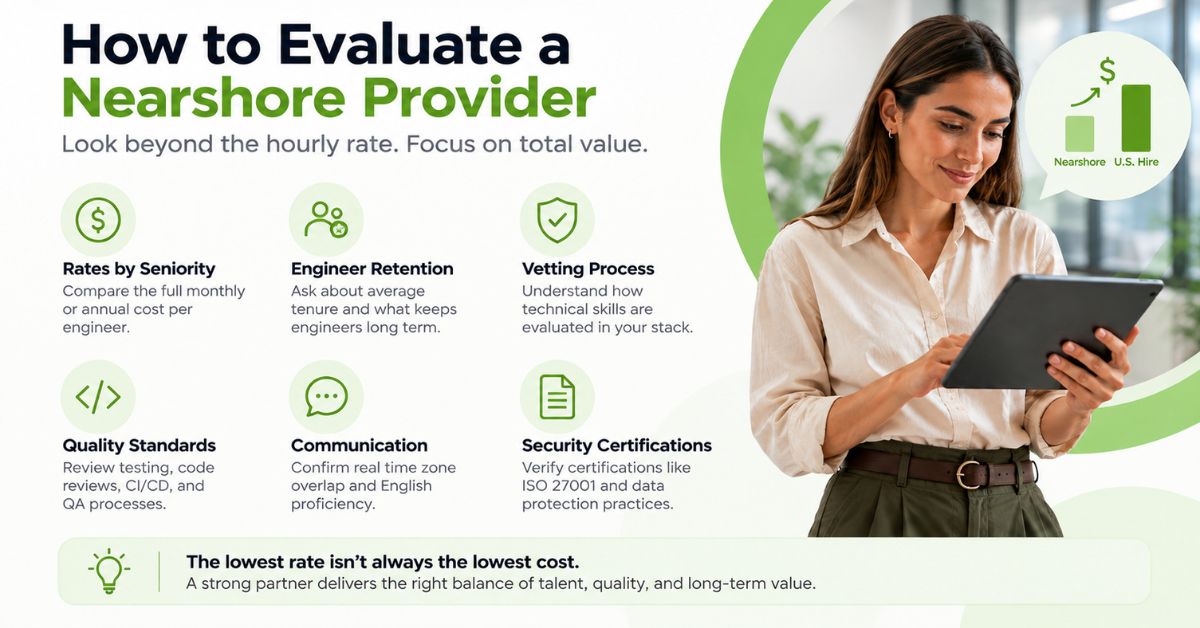
Ask for a rate broken down by seniority level, not a single blended number. Ask for the provider’s average engineer tenure, not just their total headcount. Confirm security certifications in writing. And weigh total cost of the engagement, including onboarding and rework risk, rather than judging providers on the hourly rate alone. A provider unwilling to share any of these specifics is often hiding a weaker vetting process behind a competitive quote.
Why ParallelStaff for Nearshore IT Outsourcing
ParallelStaff is an ISO 27001-certified nearshore provider built around long-term delivery, not one-off placements. The company holds a 94% engineer retention rate and carries a 4.8-out-of-5 Clutch rating from client reviews. The 2025 Inc. 5000 list ranked ParallelStaff #502 among fastest-growing private companies. Enterprise clients include AT&T, AMD, Google, J.Crew, and Whirlpool. Every engineer works in U.S. time zones and passes a multi-stage technical and English-fluency vetting process before joining a client team.


Frequently Asked Questions
How much does nearshore IT outsourcing cost in 2026?
Nearshore rates typically run 30% to 50% below U.S. domestic hiring, though the exact figure depends on seniority, country, and engagement model.
Is nearshore outsourcing cheaper than offshore outsourcing?
Usually not on paper. Offshore rates in Asia often quote lower, but the time zone gap can erase part of that savings through slower collaboration and rework.
Why does nearshore cost more than offshore?
Time zone overlap. Nearshore providers work inside a normal U.S. business day, which supports real-time collaboration that offshore arrangements often can’t match.
Does a lower rate always mean lower quality?
Not always, but a rate well below market for the stated seniority level is a warning sign. It often means the engineer doesn’t match the level advertised.
What’s the biggest hidden cost in nearshore outsourcing?
Engineer turnover. Re-onboarding a new engineer resets the ramp-up period and stalls delivery, which costs more than most buyers expect going in.
How do I compare quality across nearshore providers?
Ask for their vetting process specifics, average engineer tenure, and security certifications, rather than comparing hourly rates alone.
Is Mexico a good choice for nearshore IT outsourcing?
Yes, for many U.S. buyers. It offers strong time zone overlap and a deep talent pool, though rates and availability vary by specific skill set.
What security certifications should a nearshore provider have?
ISO 27001 is the most widely recognized standard for a provider handling client source code, credentials, or production data.
Does nearshore outsourcing work for mobile app development?
Yes. A well-vetted nearshore team can keep a mobile build cost-effective without cutting corners on QA or platform-specific expertise.
How do I calculate the total cost of a nearshore engagement?
Add the hourly or monthly rate to onboarding time and expected rework, rather than judging the engagement on the rate card alone.
 Verified Author

Miguel Hernandez
VP of Operations
Linkedin Profile