

In this article
TL;DR: Nearshore software development in Uruguay gives U.S. teams stable, English-capable engineers in a time zone one to five hours ahead of the U.S., depending on the season and the coast. The talent pool is small next to Mexico or Brazil. Therefore, Uruguay suits teams that value senior skills, written English, and low risk over raw volume. In addition, expect pay at the higher end of the Latin American range. Finally, plan for strong local labor rules, because a nearshore partner can handle payroll and compliance.
Is Uruguay a good place to hire nearshore engineers? Yes, for the right team. Nearshore software development in Uruguay works best when you want a few senior engineers, strong technical English, and a stable operating environment. It works less well when you need dozens of hires in one quarter, or the lowest rate in the region. Overall, this guide covers the talent pool, time zones, English skills, costs, and labor rules you should know in 2026. For the wider model, read our complete nearshore software development guide.
Why Choose Uruguay for Nearshore Software Development?
A Tech Sector Built for Export
Although Uruguay is a small country, it has an outsized software industry. The U.S. Commercial Service calls it one of the largest per-capita software exporters in Latin America. The same guide says U.S. buyers purchase 82 percent of those software exports. In 2023, the U.S. bought about $1.7 billion in Uruguayan IT exports.
Likewise, local industry data shows the same pattern. The national technology chamber, CUTI, reported 2023 sector revenue above $3.38 billion, or about 4.4 percent of GDP. In addition, exports reached $2.168 billion that year. Furthermore, CUTI reported 2024 revenue of $3.681 billion, up 9 percent.
Therefore, that export focus matters to you as a buyer. Many Uruguayan engineers already build products for U.S. clients. As a result, U.S. delivery norms feel familiar. The commercial guide also notes that several Uruguayan companies trade on U.S. stock markets, and that U.S. firms have acquired others.
Stability That Lowers Engagement Risk
Stability is the second draw. According to the U.S. Commercial Service, S&P and Moody’s raised Uruguay’s credit rating to its highest level ever in April 2024. The country has also had 40 consecutive years of democratic governance. The World Bank has classed it as high income since 2012. In addition, about 230 U.S. companies employ more than 25,000 Uruguayans.
Because long engagements suffer most from sudden policy shifts and contract disputes, Uruguay’s record on these points lowers that risk for a team that plans to stay for years.
The Talent Squeeze Behind the Trend
However, the pressure to look abroad is real. A Gartner survey of 437 IT organizations found that talent shortage was the top adoption barrier for 64 percent of emerging technologies in 2021, up from 4 percent in 2020. As a result, U.S. pay reflects that squeeze. The Bureau of Labor Statistics lists a 2025 median pay of $134,040 for its software developer occupation group. Instead, nearshore hiring gives you a way to widen the pool without waiting months for a domestic hire.
Uruguay’s Tech Talent Pool: Size, Skills, and Hubs
How Large Is the Pool?
First, be honest about scale. Uruguay has only about 3.5 million people, so the pool is small by nature. Published estimates of its IT workforce range from roughly 15,000 to more than 30,000 professionals, depending on the source and the definition. However, Deloitte found that Brazil and Mexico together have more than 2.2 million software engineering professionals.
The practical takeaway is simple. Therefore, Uruguay rewards precise searches, not volume hiring. If you need two senior engineers with a defined profile, the pool is deep enough. If you need 40 engineers in a quarter, look at larger markets first. In addition, our guides to Mexico and the top nearshore countries in 2026 show where the bigger pools sit.
Universities and the Talent Pipeline
Computing education in Uruguay runs deep for a country its size. In fact, tertiary computing studies began with a three-year university course created in 1968. Today, the public Universidad de la República, Universidad ORT, and Universidad Tecnológica (UTEC) train most of the pipeline.
The numbers are modest, however. CUTI counted 7,923 new admissions, 24,551 enrollments, and 1,779 graduates across all ICT education levels in 2024. Meanwhile, Deloitte reports that Brazil and Mexico together graduate more than 350,000 new engineering students each year. Consequently, expect competition for the best Uruguayan candidates from local firms, regional firms, and global employers.
Where Engineers Live and Work
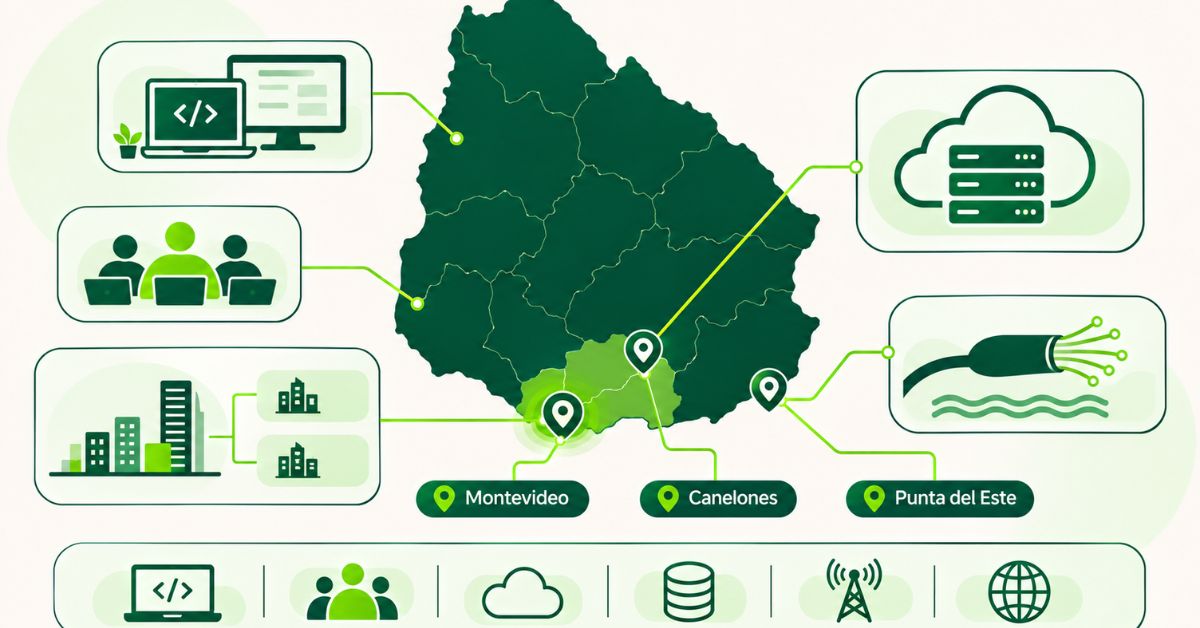
Most of the sector sits in and around Montevideo. For example, free trade zones such as Zonamerica and Aguada Park host many global service and technology firms. Infrastructure also keeps improving. For instance, Google announced an $850 million data center investment in Canelones in 2024. Its Firmina subsea cable, which links South Carolina to Punta del Este, was completed in 2025, according to the U.S. Commercial Service. Overall, these projects signal long-term investment in connectivity and cloud capacity.
Time Zone Overlap Between Uruguay and U.S. Teams
Uruguay runs on UTC-3 all year. It observes no daylight saving time. The U.S. does, so the gap changes twice a year. The table below shows the difference and the shared hours for a typical day.
| U.S. time zone | Uruguay ahead (U.S. standard time) | Uruguay ahead (U.S. daylight time) | Shared hours on a 9-to-5 U.S. day |
|---|---|---|---|
| Eastern | 2 hours | 1 hour | 7 to 8 hours |
| Central | 3 hours | 2 hours | 6 to 7 hours |
| Mountain | 4 hours | 3 hours | 5 to 6 hours |
| Pacific | 5 hours | 4 hours | 4 to 5 hours |
Shared hours assume a Uruguayan team that works 9:00 to 18:00 local time. However, teams can shift start times to widen the window.
For Eastern and Central teams, this overlap works well for standups, code reviews, and pairing. West Coast teams, however, get a shorter window. In that case, ask engineers to start later in the day and keep meetings in the shared block. If you want a deeper comparison with offshore options, see our breakdown of LATAM nearshore versus offshore.
English Proficiency Among Uruguayan Engineers
English is the shared language of nearshore work, so check it early. EF’s English Proficiency Index ranks Uruguay 30th globally. Its national score is 547, while the global average is 485. Also, Montevideo scores higher, at 554.
The skill breakdown deserves attention. Reading scores 586 and listening scores 515. Writing scores 494, while speaking scores 471. In plain terms, Uruguayan engineers tend to read technical English very well. However, spoken English is the weaker skill on average. Therefore, test live conversation during interviews, not just a code exercise.
Keep one caveat in mind. Because EF scores come from people who choose to take the test, treat them as a guide, not a guarantee.
What Does It Cost to Hire Engineers in Uruguay?
Uruguay is not the cheapest nearshore market. Instead, its value comes from quality and stability, not from rate arbitrage. Typical nearshore rates for senior Latin American engineers run about $50 to $90 per hour in 2026, often close to half the equivalent U.S. rate. Additionally, our nearshore software development cost breakdown shows ranges by country and seniority.
Local pay benchmarks give a useful floor. Lemon.io’s July 2026 rate calculator puts contractor pay for Uruguay-based developers between $27 per hour at mid-level and $54 per hour for strong senior contractors. However, salary aggregators publish conflicting figures, so treat any single number with caution. Our report on LATAM software engineer salaries adds regional context.
A partner’s bill rate sits above raw pay figures because it covers recruiting, vetting, payroll, benefits, and compliance. Overall, that is the trade for avoiding the cost and delay of running a local entity. Even at the higher end of the regional range, the savings against a U.S. median above $134,000 stay large.

Labor Rules and Hiring Quirks in Uruguay
Uruguay protects workers strongly. According to published employer-of-record guides, plan for these items before you sign anything:
- Social security: Employers pay about 12.625 percent of gross salary to the BPS and related funds. That includes 7.5 percent for pensions and 5 percent for national health insurance.
- Aguinaldo: This is a 13th salary, paid in two installments in June and December.
- Salario vacacional: This vacation bonus comes on top of paid leave. Employees earn 20 working days of leave after one year of service.
- Severance: Dismissal generally triggers one month of pay per year of service, capped at six months.
- Accident insurance: Employers must carry work accident cover, with premiums that vary by activity.
These rules are standard for local employers. They surprise U.S. teams that hire as contractors, though. Uruguay treats employees and contractors differently, so classification matters. Confirm current rates and rules with local counsel or an employer of record before you hire.
Free Trade Zones and Why They Matter
Uruguay has 12 free trade zones, plus free port and free airport regimes. For example, Montevideo’s investment promotion materials note a full exemption from corporate income tax for free zone users. They also allow IT companies in the zones to hire up to 50 percent foreign staff.
A U.S. buyer does not need a free zone. Still, ask any prospective partner how its Uruguayan operation is structured. As a result, that structure affects contracts, invoicing, and who acts as the legal employer.
How Uruguay Compares With Other Nearshore Countries
Uruguay competes with larger and cheaper markets, so a direct comparison helps. Mexico leads for scale and for proximity, with strong alignment for West Coast teams. Our Mexico guide covers the details. Meanwhile, Costa Rica runs on UTC-6 all year and shares Central time with Dallas, as our Costa Rica guide explains. In addition, Argentina and Colombia lead for senior depth and English skills, according to our review of the top nearshore countries.
Where does Uruguay fit? It offers stability, strong written English, and firms trained on U.S. clients. It does so in a smaller pool, at a higher price point. As a result, that combination favors targeted senior hires over large team builds.


When Uruguay Is the Right Fit (and When It Is Not)
Uruguay Works Well When You Need
- One to five senior engineers with a clearly defined profile
- Strong written English for documentation and async work
- Eastern or Central time overlap for daily collaboration
- A stable country for a multi-year engagement
- A partner that handles payroll, benefits, and compliance
Look Elsewhere When You Need
- A rapid build of 20 or more engineers
- The lowest hourly rate in Latin America
- Deep West Coast overlap without shifted hours
- A niche specialty that requires a very large candidate pool
In many cases, the best answer is a mix. A small Uruguay-based group can anchor senior work while a larger market supplies scale. Therefore, a partner that sources across the region can structure that mix for you.
How to Hire Nearshore Engineers in Uruguay: 5 Steps
1. Define the Profile and Seniority
Write down the skills, seniority, and working hours you need. A tight profile helps in a smaller market. It also shortens the search. Our guide to building a nearshore development team shows how to scope the first hires.
2. Choose Your Engagement Route
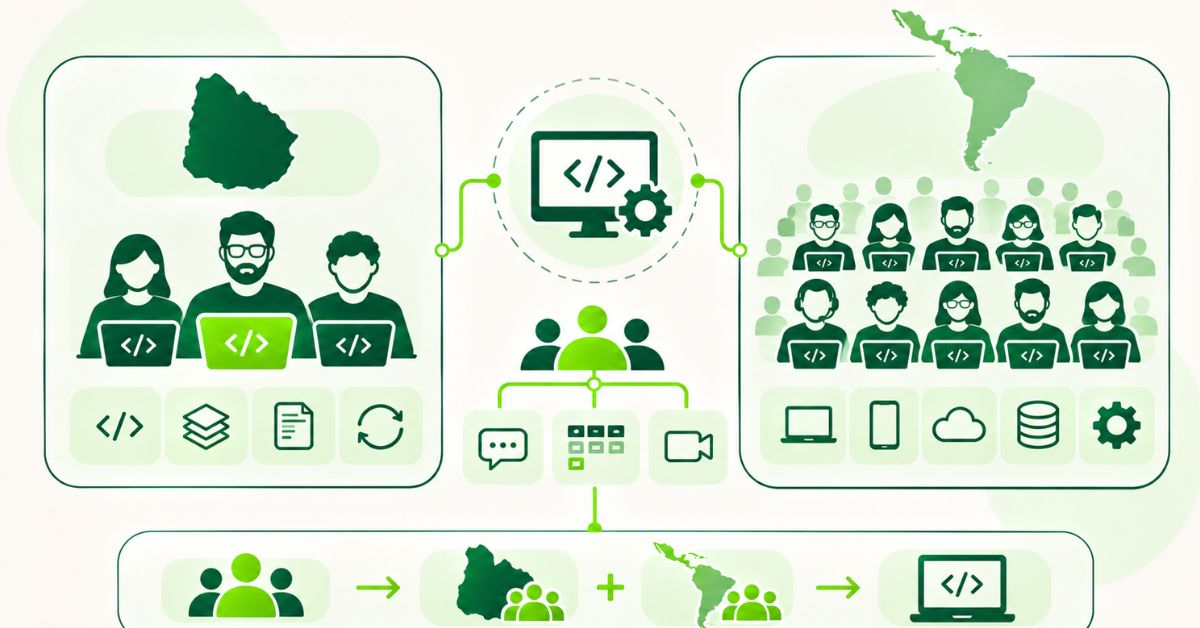
You have two main routes. You can hire directly through a local entity or an employer of record. Alternatively, you can work with a nearshore partner that sources, vets, employs, and pays the engineers. Nearshore staff augmentation suits teams that want to add individual engineers. In contrast, a dedicated development team suits teams that want a persistent pod. Our guide on how to hire nearshore developers in LATAM compares the options in more detail.
3. Test English and Communication Live
Run a live technical conversation, not only a coding test. Given the lower average speaking score, this step protects you from surprises in standups and incident calls.
4. Verify Security and Compliance
Ask for proof of security controls, such as ISO 27001 certification. Also, confirm intellectual property assignment, data handling rules, and device policies in writing. Our checklist for choosing a nearshore software development company lists the questions to ask.
5. Start Small, Measure, and Scale
Begin with one or two engineers. Track delivery, communication, and retention for the first 90 days. Then add capacity as results justify it. Our guide to nearshore agile software development explains how to scale up or down as priorities change. For day-to-day practices, read how to manage a nearshore engineering team.
How ParallelStaff Supports Nearshore Teams
ParallelStaff places senior Latin American engineers with U.S. teams. Our proof points are specific and checkable:
- Ranked #502 on the 2025 Inc. 5000 list
- 94 percent engineer retention
- ISO 27001 certified
- 4.8 out of 5 Clutch rating
- Enterprise clients that have included AT&T, AMD, Google, J.Crew, and Whirlpool
Our model also covers sourcing, vetting, payroll, compliance, and ongoing HR. Because we source across Latin America, the right country depends on your role, hours, and budget. Read how we keep engineers engaged in reducing attrition on nearshore teams. You can also review our nearshore software development services to see the engagement models.


Frequently Asked Questions About Hiring Engineers in Uruguay
Is Uruguay a good country for nearshore software development?
Yes, for teams that value stability, senior skills, and strong written English. Uruguay exports software at a high per-capita rate, and U.S. buyers take 82 percent of it. The main limit is pool size, so it fits targeted hires better than large team builds.
What time zone is Uruguay in, and how much overlap do U.S. teams get?
Uruguay uses UTC-3 all year and skips daylight saving time. As a result, it sits one to two hours ahead of Eastern time and two to three hours ahead of Central time, depending on the season. Therefore, Eastern and Central teams get roughly six to eight shared hours on a standard workday.
How good is the English of Uruguayan software engineers?
Uruguay ranks 30th globally on EF’s English Proficiency Index, with a score of 547. Reading is the strongest skill at 586, and speaking is the weakest at 471. Therefore, test spoken English in a live interview before you commit.
How much does it cost to hire a software engineer in Uruguay in 2026?
Typical nearshore rates for senior Latin American engineers run about $50 to $90 per hour. However, Uruguay sits toward the upper part of the regional range. Lemon.io’s July 2026 calculator shows contractor pay from $27 to $54 per hour, and partner rates add recruiting, payroll, and compliance costs.
How big is Uruguay’s tech talent pool compared with Mexico or Brazil?
In fact, it is far smaller. Published estimates put Uruguay’s IT workforce between roughly 15,000 and 30,000 professionals. Meanwhile, Deloitte reports more than 2.2 million software engineering professionals in Brazil and Mexico combined.
Is Uruguay cheaper than Argentina or Colombia for nearshore development?
Not usually. Uruguay tends to price at the higher end of the regional range. Instead, its advantages are stability, written English, and export experience, not the lowest rate. Compare current ranges in our nearshore cost guide.
What labor law rules should U.S. companies know before hiring in Uruguay?
Employers pay about 12.625 percent of gross salary in social security contributions. They also fund a 13th salary paid in June and December, plus a vacation bonus. Severance generally equals one month per year of service, capped at six months. Therefore, confirm the details with local counsel.
Can I hire engineers in Uruguay without opening a local entity?
Yes. A nearshore partner or an employer of record can act as the legal employer. They handle contracts, payroll, social security, and benefits, while you direct the daily work.
How do I choose a nearshore partner for hiring tech talent in Uruguay?
Check verified retention, security certifications such as ISO 27001, and references from U.S. clients. Also, ask where the engineers sit and how the partner structures its Uruguayan operation. Our guide on choosing a nearshore software development company covers the full checklist.
Do Uruguay’s free trade zones affect how I hire software engineers?
Indirectly. Uruguay has 12 free trade zones, and many service exporters base operations in them. You do not need a zone yourself, but ask your partner how its structure affects contracts and invoicing.
Is Uruguay stable enough for a long-term engineering team?
Evidence points to yes. The U.S. Commercial Service reports record-high credit ratings in April 2024 and 40 consecutive years of democratic governance. In addition, about 230 U.S. companies already employ more than 25,000 people there.
How fast can I get a vetted engineer in Uruguay?
A quality nearshore partner can often place a pre-vetted senior engineer across Latin America in 7 to 10 business days. However, Uruguay’s smaller pool can stretch the timeline for niche profiles, so a precise job profile helps shorten the search.
 Verified Author

Miguel Hernandez
VP of Operations
Linkedin Profile