
In this article
TL;DR
- An AI or machine learning product needs a persistent, multi-role team, because models, data and infrastructure all keep changing after launch.
- A strong core team has six functions: product direction, data engineering, machine learning, application engineering, quality and evaluation, and delivery management.
- Start small (four to six people) and add specialists as the product moves from prototype to production.
- McKinsey reports that 88% of organizations use AI, yet only about one-third are scaling it, so team design matters more than tools.
- An illustrative five-person team costs about $34,400 to $48,000 per month at ParallelStaff’s 2026 nearshore bands.
- Plan for governance from day one, using a framework such as the NIST AI Risk Management Framework.
Planning a dedicated development team AI product build? The short answer is to hire a small, stable, multi-role team that owns the product from first prototype to production support, and to grow it in stages. AI products are different from ordinary software, because they depend on data quality, model behavior and constant evaluation. A team that only writes code will miss half the work. This guide explains which functions you need, how big the team should be at each stage, what it costs and how to run it.
If you are new to the model, start with our complete guide to building a dedicated development team. Then use this article to adapt it for AI and machine learning.
Why AI Products Need a Dedicated Team
Many companies start AI work with a short project or a few contractors, but that approach often stalls after the demo. McKinsey’s 2025 State of AI survey of 1,993 respondents found that 88% of organizations use AI in at least one function, but only about one-third have begun to scale it. Only 39% report any impact on earnings, and most of those say it is under 5%.
The same research points to what separates the leaders: the small group of high performers is nearly three times as likely to have redesigned workflows, and these companies define when model output needs human review. In other words, value comes from the system around the model, not only from the model itself.
A dedicated team fits that need for several reasons, as follows:
- Continuity: the people who build the data pipeline also tune the model and support it in production.
- Context: over months, the team learns your users, your data and your risk tolerance.
- Speed: a stable team iterates faster than a series of short projects.
- Accountability: one team owns quality, cost and reliability end to end.
If you are weighing this against hiring directly, read our comparison of a dedicated team versus an in-house team.
Dedicated Development Team AI Product Roles: The Core Six
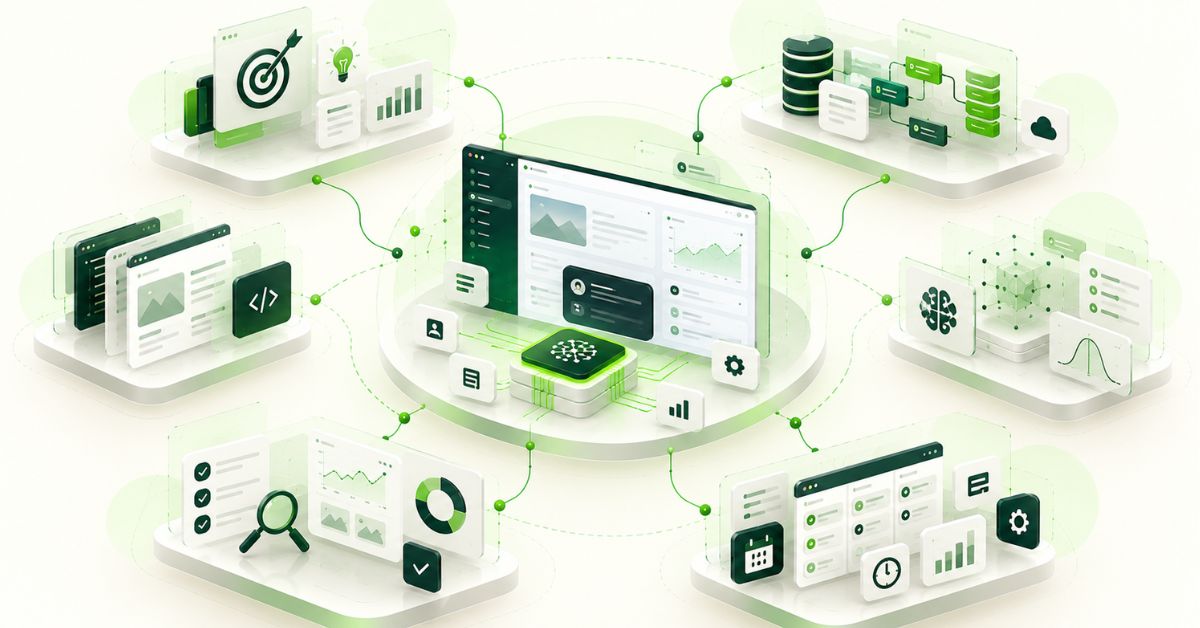
Titles vary between companies, so think in functions. Therefore, a balanced AI team covers these six.
1. Product direction
Someone must decide what problem the model solves and how success is measured. This is usually a product owner on your side, because without this person, teams build impressive demos that nobody uses.
2. Data engineering
Models are only as good as the data behind them, so this function builds the pipelines that collect, clean, version and secure data. It is often the largest hidden cost in an AI project. See our page on how to hire data engineers for more on this profile.
3. Machine learning
This function selects approaches, trains and fine-tunes models, designs prompts and retrieval systems, and runs experiments. Our page on how to hire AI engineers describes the skills to look for.
4. Application engineering
The model has to live inside a real product. These engineers build the services, interfaces and integrations that put model output in front of users, and they handle performance and security.
5. Quality and evaluation
AI features fail in unusual ways, so this function builds test sets, measures accuracy and safety, and watches for drift after release. Traditional testing alone is not enough.
6. Delivery management
A delivery manager keeps sprints on track, reports progress and removes blockers. On research-heavy work, this role also protects the team from scope creep.
Notice that specific job titles appear only as supporting detail. What matters is that every function has a clear owner. A single engineer can cover two functions on a small team, but no function should be left empty.
How Big Should the Team Be?
Team size should follow the stage of the product rather than the ambition of the roadmap.
| Stage | Typical size | Focus |
|---|---|---|
| Discovery and prototype | 3 to 4 | Prove the use case with real data |
| First production release | 5 to 7 | Build reliable pipelines, evaluation and the product surface |
| Scale and optimization | 8 to 12 | Improve cost, latency, coverage and governance |
Discovery and prototype
Keep the team tiny, since a lead with machine learning depth, a data engineer and an application engineer can test an idea in weeks. The goal is evidence, not polish.
First production release
Add quality and evaluation, plus delivery management. This is where many projects fail, because prototypes rarely survive real traffic. Therefore, budget time for monitoring, rollback and cost control.
Scale and optimization
Once the product has users, add specialists for performance, security and governance. In addition, consider a second product squad if the roadmap splits into separate features.


Building the Foundation: Data, Infrastructure and Evaluation
Team composition is only part of the answer, because the team also needs a working foundation.
Data readiness
Before hiring at scale, check what data you have, where it lives and who owns it. Poor access or unclear permissions can delay a project by months. For that reason, a data audit belongs in the first two weeks.
Infrastructure and operations
Production AI needs repeatable deployment, monitoring and cost tracking. Ask the team to set up pipelines for training, testing and release early, so that every change follows the same path.
Evaluation from day one
Define success before building. For example, agree on a test set, accuracy targets, acceptable error types and a review process for risky outputs. Teams that skip this step, however, cannot tell whether a change made the product better or worse.
Human review
Decide which outputs need a person to check them. McKinsey’s high performers have defined processes for exactly this. Start strict, then relax rules only when the data supports it.
Governance and Risk for AI Products
AI products introduce risks that normal software does not, including biased output, privacy leaks and unreliable answers. Because of this, a good team plans for them early.
The National Institute of Standards and Technology published its AI Risk Management Framework in January 2023 as a voluntary guide for organizations that design, develop, deploy or use AI systems. It organizes the work into four functions: Govern, Map, Measure and Manage. You can use these as a simple checklist:
- Govern: assign owners, write policies and define escalation paths.
- Map: document the use case, the users, the data and the possible harms.
- Measure: test accuracy, fairness, security and reliability on a regular schedule.
- Manage: prioritize risks, apply fixes and monitor after release.
Industry rules may add requirements, and healthcare, finance and education products, for instance, often need extra controls for privacy and audit. Raise this with your partner before the first sprint, and choose one with recognized security practices such as ISO 27001.
What a Dedicated AI Team Costs in 2026
Cost depends on seniority, team size and engagement length. Meanwhile, competition for experienced machine learning talent is strong. The U.S. Bureau of Labor Statistics reports a median pay of $120,230 for data scientists and projects 35% employment growth from 2025 to 2035, with about 24,800 openings per year. For software developers, the median is $135,980. Both figures exclude benefits, recruiting and overhead.
Nearshore teams, however, cost less. CBRE reports that average wages in Latin America are about 39% of US levels. Typical 2026 hourly bands are:
| Experience level | Typical hourly rate |
|---|---|
| Junior | $22-35/hr |
| Mid-level | $35-50/hr |
| Senior | $55-75/hr |
As an illustration, consider a five-person team at about 160 hours per month each. It includes a senior machine learning lead, a senior data engineer, a mid-level application engineer, a mid-level engineer for integrations and a mid-level quality engineer. The two senior roles cost $17,600 to $24,000 per month together, while the three mid-level roles add $16,800 to $24,000. Overall, the total is about $34,400 to $48,000 per month.
Treat this as an example, not a quote, because specialized AI skills can sit above these general bands. Your final price depends on the exact skills, English level and engagement length. Compute and tooling costs are separate, so budget for them as well.
How to Run the Team Day to Day
A dedicated team works best when you manage it like part of your company, so follow these habits.
- Share goals, not tasks. Describe the user problem and the metric you want to move.
- Hold weekly demos. Show working software, evaluation results and open risks.
- Keep one product owner. Decisions slow down when several people give different directions.
- Review evaluation results together. Make quality a standing agenda item.
- Give full access. The team needs the repository, the data catalog and the staging environment from week one.
Time zone alignment helps here. Because nearshore teams overlap with US business hours for most of the day, reviews and incident response happen in real time. For more on keeping teams stable, see our post on nearshore engineer retention.
A 90-Day Ramp Plan
Days 1 to 30: align and assess
First, define the use case, success metrics and constraints. Then audit the data, set up environments and agree on the evaluation approach. By the end of the month, the team should have a first working prototype on real data.
Days 31 to 60: build the first release path
Build the pipelines, the core application and the first evaluation suite. Next, run internal tests with a small group of users. Meanwhile, document decisions and risks.
Days 61 to 90: harden and launch
Add monitoring, rollback and cost controls. Then test with a limited audience and fix the biggest issues. After that, release gradually and review results weekly.
For a fuller view of how this model works across product types, see our guides to a dedicated team for a SaaS platform and a dedicated app development team.

Common Mistakes to Avoid
- Starting with the model instead of the problem. A clear use case saves months.
- Underinvesting in data. Weak data limits every model you build.
- Skipping evaluation. Without measurement, progress is a guess.
- Staffing only researchers. Products also need strong application and operations skills.
- Treating launch as the finish line. Because models drift, monitoring and updates continue.
- Ignoring governance. Late fixes for privacy or bias are expensive.
- Choosing only on price. A cheap team that needs constant rework often costs more.
How ParallelStaff Builds Dedicated Teams for AI Products
ParallelStaff is a nearshore software development and staffing firm based in Dallas, Texas. We are ISO 27001 certified, rated 4.8 out of 5 on Clutch and ranked #502 on the 2025 Inc. 5000. Our engineer retention rate is 94%, so your team stays together long enough to build real product knowledge.
Our process has four steps:
- First, we define your use case, stage and success metrics.
- Then we assemble a team that covers all six functions at the right seniority.
- Next, we onboard the team into your tools and run weekly demos.
- Finally, we adjust the team as the product grows, adding or rotating specialists.
Learn more about our dedicated development teams and our nearshore dedicated teams. You can also read what is included in dedicated development team services, or review our case studies.
Frequently Asked Questions
How do I build a dedicated team for an AI product?
Define the use case and success metrics, then staff six functions: product direction, data engineering, machine learning, application engineering, quality and evaluation, and delivery management. Start small and add specialists as the product matures.
How big should an AI development team be?
Three to four people can prove a prototype. Five to seven are typical for a first production release. Eight to twelve are common once the product scales.
What roles are on an AI product team?
Most teams need data engineering, machine learning, application engineering, quality and evaluation, delivery management and a product owner. One person can cover two functions on a small team.
How much does a dedicated AI team cost in 2026?
At ParallelStaff’s nearshore bands, an illustrative five-person team costs about $34,400 to $48,000 per month. Specialized skills, team size and engagement length change the final price.
Is a dedicated team better than freelancers for AI work?
Usually, yes, because AI products need continuity across data, models and operations. Freelancers can fill short gaps, while a stable team keeps knowledge and accountability in one place.
Should I hire in-house or use a dedicated team for AI?
In-house hiring gives long-term control but takes months. A dedicated team, in contrast, starts faster and can transition knowledge to your staff later. Many companies combine both.
How long does it take to build an AI product with a dedicated team?
A first working prototype often takes four to eight weeks. A production release usually takes three to six months, depending on data readiness and integration needs.
What is the difference between a dedicated team and staff augmentation for AI?
A dedicated team is a multi-role group that works only on your product, whereas staff augmentation adds individual engineers to a team you already manage. See our comparison of staff augmentation versus dedicated teams.
Do I need a data scientist, or is an engineer enough?
It depends on the problem. Applied products built on existing models often need strong engineers and evaluation skills, but custom model research needs deeper specialists.
How do I measure whether an AI team is succeeding?
Track product metrics such as user adoption and task success, along with model metrics such as accuracy, latency and cost. Review both every sprint.
What governance does an AI product need?
At a minimum, define owners, document the use case and data, test regularly and monitor after release. The NIST AI Risk Management Framework offers a voluntary structure using four functions: Govern, Map, Measure and Manage.
How do I protect my data when working with an outside AI team?
Use least-privilege access, managed devices, strong contracts and a partner with recognized controls such as ISO 27001. Also, decide which data may never leave your environment.
Can a nearshore team work on AI products in US hours?
Yes. Nearshore engineers typically overlap with most of the US workday, which supports daily standups, live reviews and quick incident response.
What happens if a key team member leaves?
A good partner replaces the person quickly and keeps documentation current, so that knowledge is not lost. High retention also lowers this risk in the first place.
Final Thoughts
The best way to build a team for an AI product is to start small, cover every function and invest early in data, evaluation and governance. If you do those things, the team can grow with the product instead of being rebuilt every few months.
Ready to plan your team? Talk to ParallelStaff and we will share a team proposal and a rate estimate based on your use case.
Sources: McKinsey State of AI 2025, NIST, BLS data scientists, BLS software developers, CBRE.
 Verified Author

Miguel Hernandez
VP of Operations
Linkedin Profile