

In this article
TL;DR: Build in-house when the work is your core, long-term IP and you can afford a hiring cycle of several months. Choose a dedicated team of developers when you need senior capacity in weeks, want to scale up or down without layoffs, or need to own a clear product area without growing permanent headcount. Many U.S. companies in 2026 use both: a small in-house core that owns architecture and a dedicated team that expands delivery capacity.
A dedicated team of developers usually fits better when speed, flexibility, and cost matter most. An in-house team fits better when the work defines your competitive advantage and you plan to own it for years. The right answer depends on your roadmap, your budget, and how much management capacity you already have.
This guide compares the two models side by side. It shows what each one really costs, when each one wins, and how to combine them without losing control of your product.
What Is the Difference Between a Dedicated Team and an In-House Team?
An in-house team is made up of your own employees. You recruit them, pay salaries and benefits, and manage every part of their employment.
A dedicated team of developers is a stable group of engineers that a partner recruits, employs, and supports, but who work only on your product. The team often includes developers, QA, and a delivery lead. It follows your roadmap, joins your standups, and works in your tools. Meanwhile, the partner handles recruiting, payroll, benefits, and retention.
That makes a dedicated team different from staff augmentation, which adds individual engineers to fill specific gaps. For that comparison, see ParallelStaff’s guide to staff augmentation vs. dedicated teams.
Dedicated Team vs. In-House: Side-by-Side Comparison
| Factor | In-house team | Dedicated team |
|---|---|---|
| Time to first contribution | Months of recruiting, then onboarding | Often two to three weeks |
| Cost structure | Salary, benefits, recruiting, equipment, overhead | One monthly rate per engineer or team |
| Flexibility | Low; scaling down means layoffs | High; scale up or down with notice |
| Control of roadmap | Full | Full; team follows your priorities |
| Management load | All on you, including HR | Shared; partner handles HR and retention |
| Knowledge retention | Depends on your own turnover | Depends on the partner’s retention rate |
| Culture and ownership | Strongest by default | Strong if you integrate the team fully |
The Real Cost of an In-House Engineer in 2026
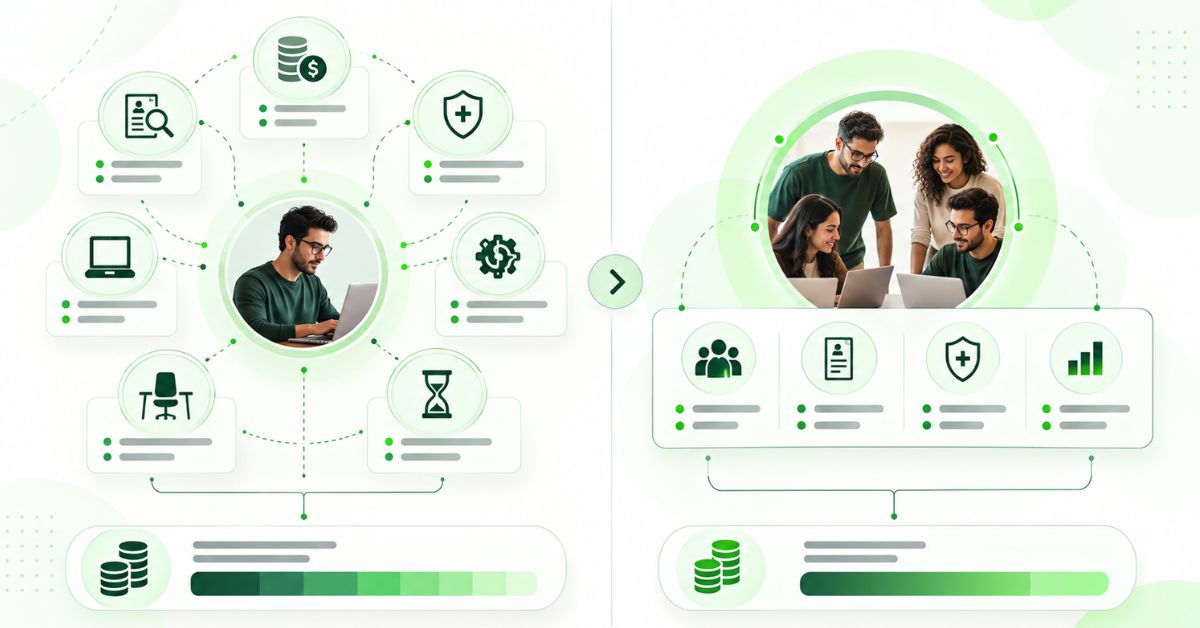
Salary is only the start. The U.S. Bureau of Labor Statistics reports a median software developer wage of $135,980 as of May 2025. On top of wages, employers pay benefits. BLS data on employer compensation costs for June 2026 shows that benefits made up 31.5% of total compensation for full-time private industry workers.
Applying that ratio to the median developer wage puts total compensation near $198,500 per year. That figure still excludes recruiting fees, equipment, software licenses, office space, and the months a seat sits empty. In addition, BLS projects roughly 106,100 openings for developers, QA analysts, and testers each year through 2035, so competition for senior talent will stay intense.
By contrast, a dedicated team replaces most of those line items with one predictable rate. Across ParallelStaff engagements, senior Latin American engineers typically cost 40 to 60% less than equivalent U.S. hires on a fully loaded basis.
When an In-House Team Fits Your Roadmap
In-house hiring is the right call in several situations:
- The work is your core IP. Proprietary algorithms or platform architecture that defines your advantage belong with long-term employees.
- You need technical leadership. Your CTO, principal engineers, and architects should usually be employees who shape culture and strategy.
- Regulation requires it. Some government, defense, or data residency rules require U.S.-based employees.
- You have time and budget. If you can wait several months per hire and absorb fixed costs, in-house builds the deepest ownership.
Notably, even outsourcing-heavy companies are rebalancing. Deloitte’s 2024 Global Outsourcing Survey found that insourcing and global in-house centers are gaining momentum as organizations seek more control over strategic capabilities. The lesson is not “outsource everything.” Instead, keep the strategic core close and source capacity where it makes sense.
When a Dedicated Team of Developers Fits Better
A dedicated team usually wins in these situations:
- Your roadmap cannot wait. You need senior engineers shipping in weeks, not after a long recruiting cycle.
- You are building a defined product area. A new product line, platform rebuild, or major integration benefits from a stable team that owns it.
- Demand will change. You expect to scale capacity up for a launch and back down afterward.
- You lack HR bandwidth. The partner handles recruiting, payroll, benefits, and retention, so your leaders focus on product.
- Budgets are tight. Gartner’s July 2026 forecast notes that inflation, supply shortages, and AI investments are straining technology budgets even as spending grows. A dedicated team stretches each dollar further.
For a full walkthrough of the model, read ParallelStaff’s guide on how to build a dedicated development team that works.


The Hybrid Model: In-House Core, Dedicated Delivery
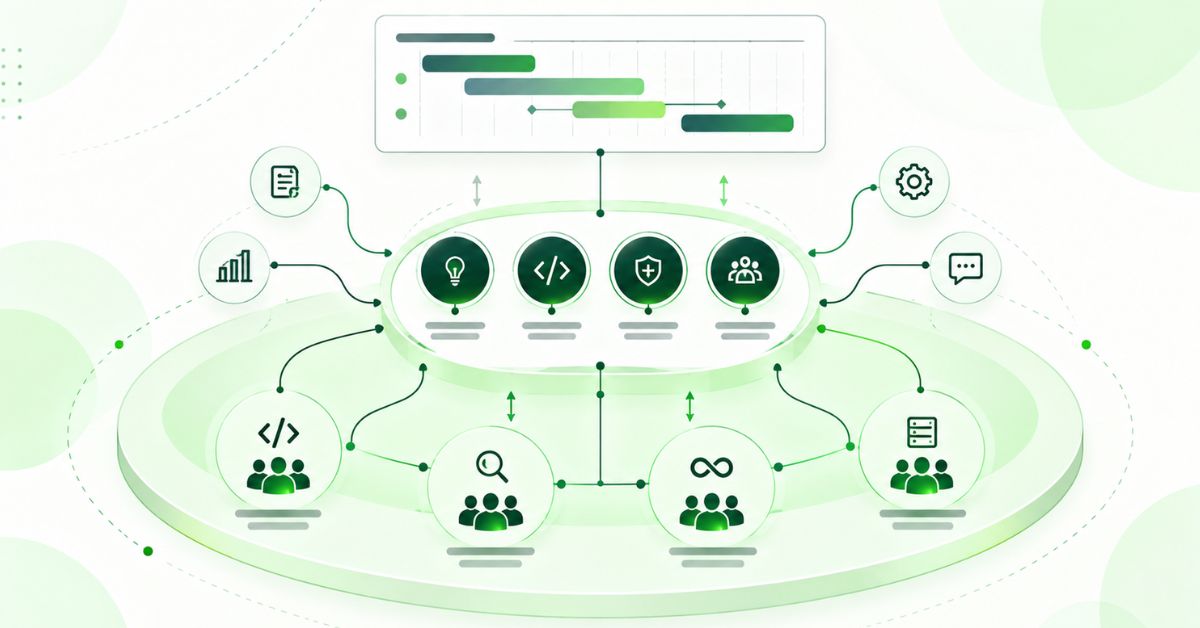
For most growing companies, the answer is not either-or. A common and effective structure looks like this:
- In-house: product leadership, architecture, security ownership, and a few senior engineers who hold critical context.
- Dedicated team: developers, QA, and DevOps who expand delivery capacity and own specific workstreams.
This structure keeps strategic control inside your company while letting you scale execution quickly. It also protects you from overhiring during growth spurts. Want to see how roles fit together? ParallelStaff’s breakdown of nearshore development team structure shows typical configurations and costs.
How to Make a Dedicated Team Feel In-House
The biggest risk with any external team is that it feels external. Two factors make the difference.
First, share working hours. Harvard Business School researchers studied communication across 250 offices of one multinational in 48 countries. They found that losing just one or two shared business hours cut communication by 9.2% on average. As a result, a nearshore team in Latin America integrates far more easily with U.S. staff than one on the other side of the world.
Second, design for integration. A July 2026 Harvard Business Review analysis argues that global collaboration problems usually stem from organizational design rather than culture. So give your dedicated team the same access, rituals, and decision rights as your employees:
- Include them in standups, planning, retrospectives, and company updates.
- Give them direct access to repositories, documentation, and stakeholders.
- Assign clear ownership of a product area, not just a ticket queue.
- Measure them on the same outcomes as your in-house engineers.

A 5-Question Decision Framework
Answer these questions honestly to find your fit:
- Is this work core IP or delivery capacity? Core IP leans in-house. Capacity leans dedicated team.
- How fast do you need results? If you need output this quarter, a dedicated team is faster.
- Will demand stay flat for years? Stable, long-term demand favors in-house. Variable demand favors a dedicated team.
- Do you have HR and recruiting bandwidth? If not, a partner removes that load.
- Can you integrate an external team fully? If yes, a dedicated team can match in-house performance.
If most answers point one way, you have your answer. If they split, the hybrid model is likely your best fit.

How ParallelStaff Builds Dedicated Teams
ParallelStaff builds each dedicated team of developers from senior, pre-vetted Latin American engineers who work U.S. hours and join your existing workflows.
- Speed: teams are matched from a network of 10,000+ vetted engineers, with most going from first conversation to first commit in two to three weeks.
- Continuity: engineers average 5+ years of tenure, backed by a 94% engineer retention rate.
- Communication: engineers pass Cambridge English evaluation and work in U.S. time zones.
- Security: ISO 27001 certification and full IP ownership for clients.
- Flexibility: month-to-month engagements with no minimums and a 30-day money-back guarantee on the first month.
- Proof: ranked #502 on the 2025 Inc. 5000, rated 4.8/5 on Clutch, with enterprise clients including AT&T, AMD, Google, J.Crew, and Whirlpool.
Learn what an engagement includes in ParallelStaff’s guide to dedicated development team services, or explore nearshore dedicated teams and how to hire a dedicated team of developers for your roadmap.
Frequently Asked Questions
Is a dedicated team of developers cheaper than hiring in-house?
Usually, yes. An in-house developer at the U.S. median wage costs about $198,500 a year once benefits are included, before recruiting and overhead. Senior nearshore dedicated team engineers typically cost 40 to 60% less on a fully loaded basis.
Do I lose control of my product with a dedicated team?
No. A dedicated team follows your roadmap and priorities. You set direction, and the partner handles recruiting, payroll, and retention.
How fast can a dedicated team start compared to in-house hiring?
A dedicated team can often start within two to three weeks. In-house hiring typically takes months per role before onboarding even begins.
When should a startup hire in-house instead of using a dedicated team?
Startups should hire in-house for founding engineers and technical leadership who shape architecture and culture. A dedicated team works well for expanding delivery capacity around that core.
Can a dedicated team work alongside my in-house engineers?
Yes. The hybrid model is common. In-house engineers own architecture and critical context, while the dedicated team expands delivery capacity.
Who manages a dedicated development team?
You direct priorities and product decisions. Depending on the setup, a delivery lead from the partner or your own engineering manager runs day-to-day coordination.
What happens to knowledge if a dedicated team member leaves?
That risk depends on the partner’s retention rate and documentation practices. Choose a partner with high retention and require shared documentation from day one.
Is a dedicated team the same as staff augmentation?
No. Staff augmentation adds individual engineers to fill gaps. A dedicated team is a stable group that owns a product area over time.
Does a nearshore dedicated team work in U.S. time zones?
Yes. Nearshore teams in Latin America typically work within zero to three hours of U.S. time zones, so they join standups and reviews in real time.
Who owns the code a dedicated team writes?
Under a proper contract, you do. Confirm that all code, documentation, and IP transfer to your company before work begins.
Can I convert a dedicated team member to a full-time employee?
Policies vary by partner. Ask about conversion terms and fees before you sign so there are no surprises later.
The best model is the one that matches the work. Keep your strategic core in-house, add a dedicated team where speed and flexibility matter, and integrate everyone as one engineering organization. That combination gives your roadmap both ownership and momentum.
 Verified Author

Luis Peralta
CEO & Founder
Linkedin Profile