

In this article
If you need to hire nearshore developers in Latin America, the fastest and lowest-risk path is to partner with an established nearshore staffing firm that already has a vetted bench of engineers in your target countries, rather than sourcing and screening candidates from scratch. Doing it yourself is possible, but it usually takes 45–90 days and shifts the vetting risk entirely onto your team. Below is the full breakdown of why companies are hiring nearshore in 2026, which countries to consider, what it actually costs, and the step-by-step process for getting it right the first time.
What Does It Mean to Hire Nearshore Developers?
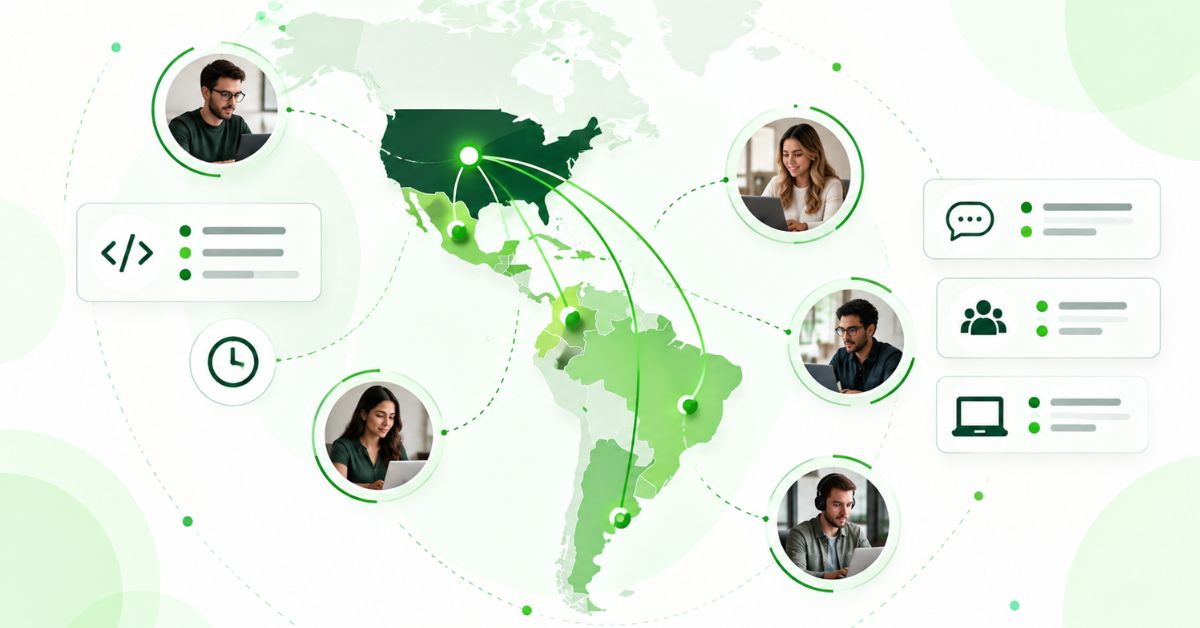
Hiring nearshore developers means bringing on software engineers who live in a country close to your own, instead of hiring locally (onshore) or in a distant region such as India or the Philippines (offshore). For a U.S. company, “nearshore” almost always means Latin America: Mexico, Colombia, Argentina, Brazil, Costa Rica, and a handful of other countries within one to three time zones of the continental U.S.
The appeal is structural, not just financial. Because these engineers work inside U.S. business hours, a nearshore developer isn’t a contractor who hands off code overnight and disappears — they join your standups, sit in your sprint planning, and respond to a Slack message the same afternoon you send it. That single difference is why nearshore has become the default growth lever for U.S. engineering teams facing both a domestic talent shortage and rising compensation costs in 2026.
Why U.S. Companies Are Hiring Nearshore Developers in 2026
Three forces are pushing U.S. tech leaders toward nearshore hiring at the same time.
Domestic talent is scarce and expensive. The median annual wage for a U.S. software developer reached $135,980 in May 2025, according to the U.S. Bureau of Labor Statistics — and that figure doesn’t include benefits, payroll taxes, equity, or recruiting fees, which typically push the fully loaded cost 30–50% higher. Meanwhile, Gartner has found that 86% of CIOs report facing more competition for qualified technical candidates than in prior years, and the firm expects demand for tech talent to keep outstripping supply at least through 2026.
Distributed teams are now the norm, not the exception. Fully in-office engineering teams are shrinking. According to Stack Overflow’s 2024 Developer Survey, only 20% of developers now work fully in-person, while 42% work hybrid and 38% work fully remote. Hiring nearshore developers is simply an extension of a distributed-work model most engineering teams already operate under — it just widens the map.
Skill gaps are pushing companies toward new talent models entirely. McKinsey has documented that 46% of business leaders cite skill gaps as a major barrier to adopting new technology, and its researchers specifically point to building globally distributed teams as one of the clearest ways to close that gap. Nearshore hiring in Latin America is exactly that model, minus the time-zone tax that comes with offshoring to Asia or Eastern Europe.
Best Latin American Countries to Hire Nearshore Developers
Not every LATAM country is an equally good fit, and the right one usually depends on which U.S. time zone your team runs on.
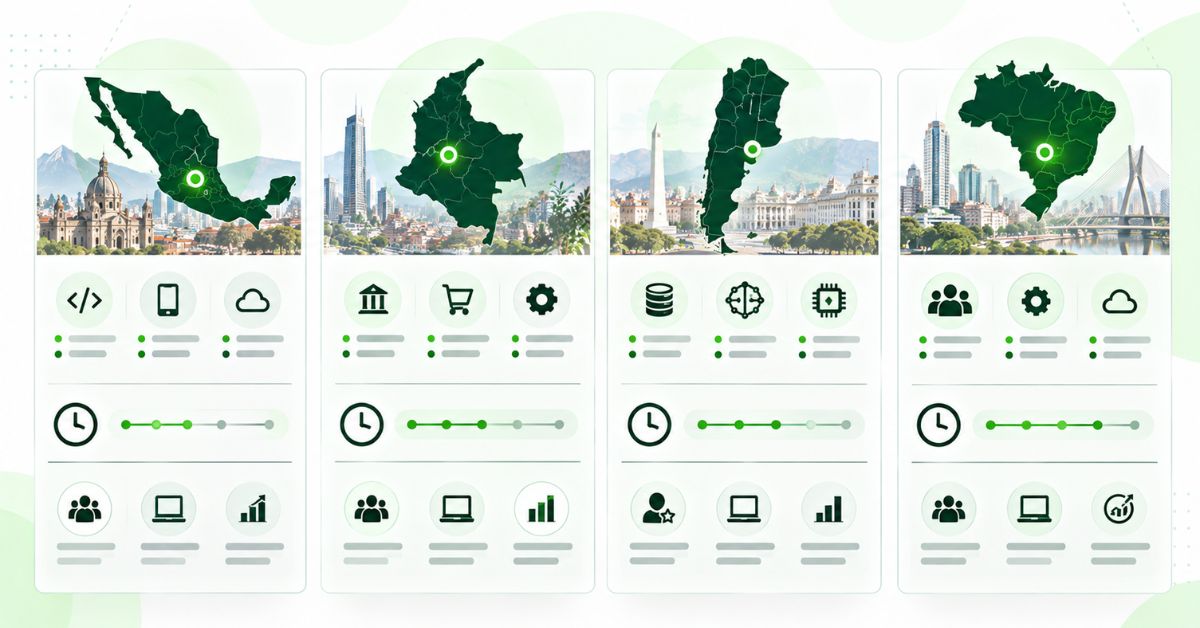
Mexico offers the largest talent pool for U.S. nearshore hiring, with strong overlap for Pacific, Mountain, and Central time zones. Tech hubs in Mexico City, Guadalajara, and Monterrey produce deep benches in full-stack, mobile, and cloud engineering.
Colombia runs on Eastern time year-round, which makes it a strong match for East Coast teams. Medellín and Bogotá have become recognized regional tech hubs with particular strength in fintech and e-commerce engineering.
Argentina sits one hour ahead of Eastern time and has a long-standing reputation for senior back-end, data, and AI/ML talent, though currency volatility has made local cost structures less predictable than a few years ago.
Brazil offers the largest overall engineering workforce in the region, but its eastern cities run three to four hours ahead of Pacific time, which West Coast teams need to plan around deliberately.
How to Hire Nearshore Developers: A Step-by-Step Process
Whether you go the DIY route or work with a partner, the underlying process to hire nearshore developers looks roughly the same:
- Define the role and seniority you actually need. A vague “full-stack developer” req produces vague candidates. Specify the stack, seniority, and whether the role is a standalone add or part of a broader team build-out.
- Choose a sourcing path. Post on LATAM-focused job boards and freelance platforms and screen candidates yourself, or work with a nearshore staffing partner that already maintains a pre-vetted bench in your target countries.
- Run technical and communication vetting. This should include a live technical assessment (not just a take-home test), an English-fluency conversation, and a check on how the candidate has worked with U.S. teams before.
- Confirm the legal and payroll structure. Decide whether you’re contracting the engineer directly, working through an Employer of Record, or engaging a staffing firm that handles this for you (more on this below).
- Onboard for overlap, not just access. Give the new hire the same Slack channels, standups, and documentation access as an in-house engineer from day one — treating a nearshore hire as an external vendor rather than a team member is the single most common reason nearshore engagements underperform.
Nearshore Engagement Models: Staff Augmentation, Dedicated Teams, and Direct Placement
Once you’re ready to hire nearshore developers, you’ll generally choose between three engagement models:
Staff augmentation adds individual engineers into your existing team and workflows. This is the right fit when you have an established engineering org and need to fill specific skill or capacity gaps quickly.
Dedicated development teams give you a full team — engineers, and often a lead — that operates as a self-contained unit against a roadmap you own. This model suits companies scaling a new product line or standing up a parallel workstream.
Direct placement is a one-time recruiting fee model: the partner finds and places a developer, and you own the ongoing employment relationship (and its legal complexity) from there.
Most growth-stage tech companies land on staff augmentation or dedicated teams, since both keep the vetting, payroll, and compliance burden with the nearshore partner rather than on your internal HR and legal teams.

How Much Does It Cost to Hire Nearshore Developers in 2026?
Cost varies by seniority and country, but a reasonable 2026 benchmark for hiring nearshore developers in Latin America through a quality partner looks like this:
- Junior engineers (2–4 years): $35,000–$55,000/year
- Mid-level engineers (4–7 years): $55,000–$80,000/year
- Senior engineers (7+ years): $80,000–$110,000/year
- Tech leads and architects: $95,000–$135,000/year
Set against the BLS’s $135,980 median U.S. software developer salary — before benefits, payroll taxes, and recruiting costs are added on top — the gap for an equivalent senior nearshore hire typically runs 40–60% in total loaded cost. And that median understates what a senior hire actually costs: BLS wage data puts the 75th percentile for U.S. software developers above $167,000 and the 90th percentile above $208,000 — the exact seniority band most nearshore searches are trying to fill. That gap compounds fast once you’re hiring a team of five or ten engineers rather than one.
Payroll, Compliance, and the Employer of Record Question
Once you’re ready to hire nearshore developers, someone has to handle in-country payroll, tax withholding, benefits, and local labor law compliance — this is where most DIY hiring plans stall out. There are three common paths:
- Set up a local legal entity. Full control, but slow and expensive to stand up for a handful of hires.
- Use an Employer of Record (EOR). An EOR legally employs the engineer on your behalf in their home country, handling payroll and compliance while you direct the day-to-day work.
- Work with a nearshore staffing partner. The partner acts as the employer of record for its placed engineers as part of the engagement, so you never touch in-country payroll or labor law directly.
For most companies hiring one to a handful of nearshore developers, the third option removes the most operational risk.
[INSERT-IMAGE-HERE]
How to Vet a Nearshore Development Partner
If you decide to hire nearshore developers through a staffing partner rather than sourcing solo, evaluate the partner itself before you evaluate any individual candidate:
- Ask what their vetting process actually screens for. A credible partner tests technical depth with live assessments, not just résumé review, plus English fluency and communication skills specifically for working with U.S. teams.
- Ask for a real retention number. High turnover on a nearshore team quietly destroys the cost savings, since a departing engineer takes months of codebase context with them. Staff augmentation partners that publish verified retention data (ParallelStaff, for example, maintains a 94% engineer retention rate with average engineer tenure of five-plus years) are giving you a much more honest signal than a sales deck.
- Check third-party reviews, not just testimonials on their own site. Clutch, G2, and similar platforms are harder to manipulate than curated case studies.
- Confirm the integration model. Will the engineer join your Slack, your standups, and your repo as an embedded team member, or operate as an arm’s-length vendor unit?
Common Mistakes to Avoid When You Hire Nearshore Developers
The failures that give nearshore hiring a bad name are almost always structural, not talent-related. Skipping a live technical assessment in favor of a take-home test alone lets weaker candidates through. Treating the new hire as an outside vendor instead of a team member creates exactly the collaboration friction nearshore is supposed to solve. And choosing a partner on price alone, without checking retention data, often costs more in re-hiring and lost context than it saves in year-one rate.
Frequently Asked Questions About Hiring Nearshore Developers
What is the best way to hire nearshore developers in Latin America?
For most U.S. companies, the fastest and lowest-risk path is working with an established nearshore staffing partner that already maintains a vetted engineer bench in your target countries, rather than sourcing and screening candidates independently.
How much does it cost to hire a nearshore developer in 2026?
Expect $35,000–$55,000/year for junior engineers, $55,000–$80,000/year for mid-level, and $80,000–$110,000/year for senior engineers through a quality nearshore partner — typically 40–60% less than the fully loaded cost of an equivalent U.S. hire.
Which Latin American countries are best for hiring nearshore developers?
Mexico, Colombia, Argentina, and Brazil are the four leading destinations. Mexico offers the largest talent pool with Pacific-to-Central overlap; Colombia runs on Eastern time; Argentina has deep senior and data-engineering talent with strong East Coast overlap; Brazil offers scale but requires more deliberate scheduling for West Coast teams.
How long does it take to hire a nearshore developer?
Through a qualified nearshore partner with an established bench, a pre-vetted engineer can start in 7–10 business days. Sourcing and vetting candidates independently typically takes 45–90 days, similar to a U.S. direct hire.
What is the difference between nearshore staff augmentation and a dedicated development team?
Staff augmentation adds individual engineers into your existing team and processes. A dedicated team is a self-contained unit — engineers and often a lead — that operates against a roadmap you own, typically used when scaling a new product line or workstream.
Do I need an Employer of Record to hire nearshore developers?
You need someone to handle in-country payroll, tax withholding, and labor law compliance — that’s either a local legal entity, an Employer of Record, or a nearshore staffing partner that acts as employer of record for its placed engineers. Most companies hiring a handful of developers choose the latter to avoid the compliance burden entirely.
Are nearshore developers in Latin America fluent in English?
Yes, at established nearshore partners. English proficiency is a standard part of the vetting process for engineers who work directly with U.S. clients, alongside technical assessment and communication screening.
Is nearshore hiring better than hiring offshore developers in Asia or Eastern Europe?
It depends on the trade-off you’re optimizing for. Offshore hiring in distant regions can offer somewhat lower rates, but the 8–12 hour time-zone gap forces asynchronous-only collaboration. Nearshore hiring in Latin America gives up a small amount of that cost advantage in exchange for full overlap with U.S. business hours.
Can nearshore developers work in my company’s specific time zone?
Yes. Engineers based in Mexico, Colombia, and Central America typically align with Pacific through Central time, while Argentina and Brazil’s eastern regions align more closely with Eastern time — a nearshore partner should be able to match engineers to your specific working hours.
What retention rate should I expect from a nearshore engineering team?
Ask any partner for their actual retention numbers rather than accepting a general claim. Retention above 90% with multi-year average tenure is a reasonable benchmark for a well-run nearshore program in 2026.
Is hiring a nearshore developer better than hiring a freelancer?
For long-term product work, generally yes. Freelancers work well for short, well-scoped tasks, but a vetted nearshore engineer embedded in your team builds the institutional knowledge and accountability that freelance arrangements typically don’t provide.
Ready to see what a nearshore hire looks like for your team? ParallelStaff places pre-vetted senior engineers from Latin America in 10 days or less, backed by a 94% retention rate and a 4.8/5 Clutch rating. You can also read the full Nearshore Software Development guide for a broader look at the model, or explore nearshore IT outsourcing if you’re weighing a fully managed engagement instead.
 Verified Author

Luis Peralta
CEO & Founder
Linkedin Profile