

In this article
Companies that scale an engineering team with staff augmentation usually get the first hire right and the tenth hire wrong — not because the tenth engineer is weaker, but because nobody restructured management, onboarding, or communication between hire three and hire ten. The engagement model that got you your first augmented engineer in two weeks is not the same model that should still be running unchanged once you have fifteen.
This guide walks through three growth stages, the specific thing that breaks at each one, and the point where staying on pure staff augmentation stops making sense.
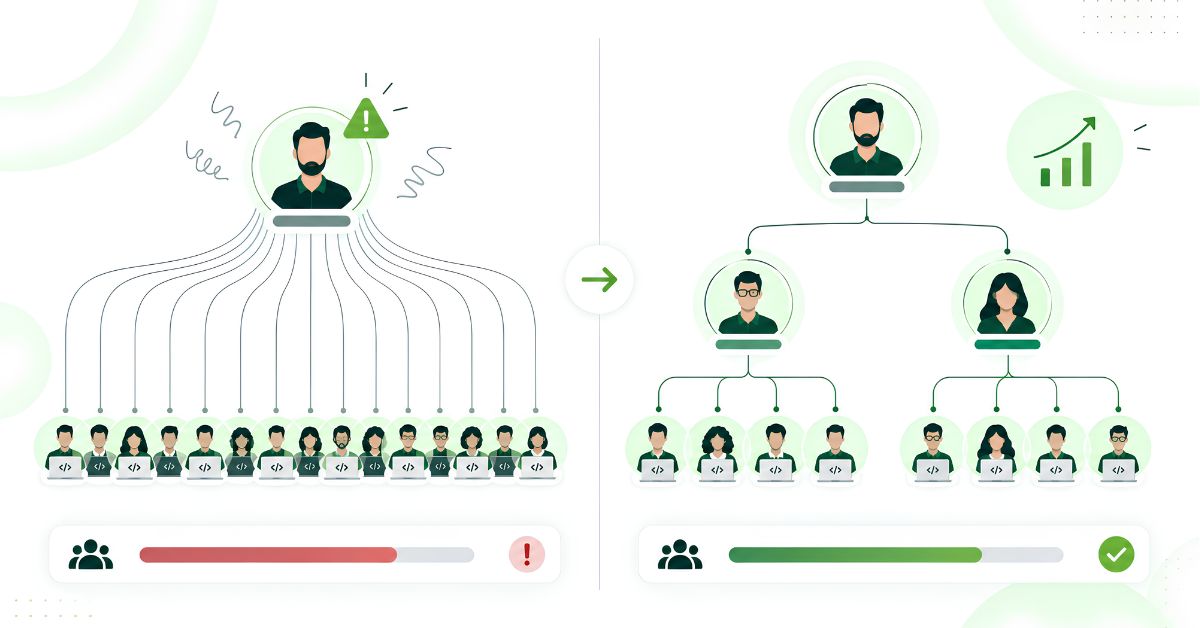
Why Adding Engineers Isn’t the Same as Scaling a Team
Staff augmentation solves a sourcing problem: it gets a vetted engineer in front of your team fast. It does not solve a management problem, and that’s the part most companies discover too late. Gallup’s January 2026 span of control research found the median manager in the U.S. leads just five to six direct reports, even as the national average has climbed to 12.1 — driven by a small share of organizations stretching individual leads far past what the data shows is sustainable. Engineering teams feel this acutely: a lead reviewing code, running standups, and unblocking a growing roster of augmented engineers hits the same wall a manager in any other function hits, just with a compiler attached.
The three stages below aren’t arbitrary. They mark the points where headcount growth typically outruns the structure supporting it.
A Framework to Scale Your Engineering Team with Staff Augmentation
Each stage below names the specific structural change that needs to happen before headcount grows past it — not after.
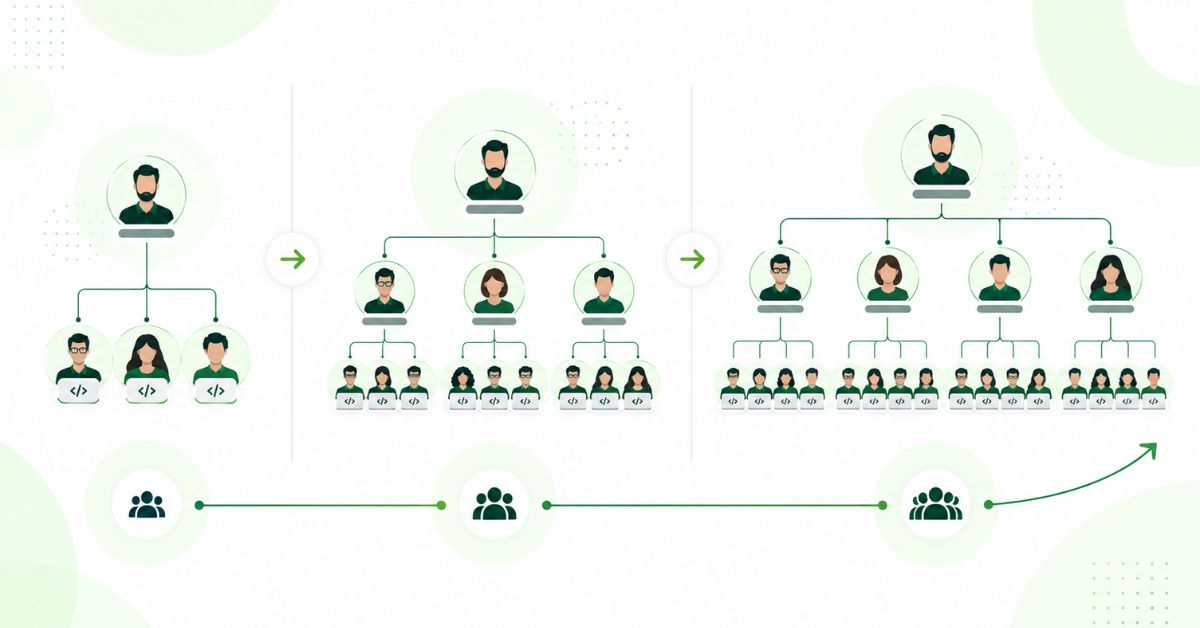
Stage 1: 1 to 3 Augmented Engineers — Validating the Model
At this stage, augmented engineers report to whoever already leads the team, and that’s fine — a lead with three augmented engineers plus their existing core team is well within a healthy span of control. The real work here isn’t management structure. It’s proving the model itself: does an outside engineer actually ramp inside your codebase in the time a provider promised, and does daily standup work across whatever time zone gap exists.
Two things matter more than headcount at this stage. First, documentation quality — a new engineer’s ramp-up speed is a direct readout of how well your onboarding materials actually work, augmented or not. Second, a single clear point of contact for each augmented engineer, so questions don’t scatter across five Slack channels before someone answers them.


Stage 2: 4 to 10 Augmented Engineers — Building Structure Before You Need It
This is where most scaling attempts start to wobble. A single lead absorbing four to ten augmented engineers on top of an existing core team is pushing toward — or past — the healthy span of control Gallup’s research identifies. The symptoms show up before anyone names the cause: code review turnaround slows, standups run long because one person is tracking too many parallel threads, and the lead stops doing the technical work that got them promoted in the first place.
The fix at this stage is almost always structural, not a hiring pause. Split the augmented engineers into two or three sub-teams, each with a named point person — not necessarily a full engineering manager yet, but someone accountable for that group’s delivery and unblocking. Gallup’s research is specific on this point: manager talent and workload matter more than the raw headcount number, but even talented leads lose effectiveness once individual-contributor work and management work compete for the same hours in the day.
This is also the stage to formalize what Stage 1 left informal. A documented onboarding checklist, a defined code review SLA, and a weekly sync cadence across sub-teams keep the team from fragmenting into silos that only the original lead can see across.

Stage 3: 10 to 25+ Engineers — When Augmentation Should Hand Off
Past roughly ten to twelve augmented engineers, the question shifts from “how do we manage more people” to “should this still be staff augmentation at all.” Gallup’s data shows only 13% of managers nationally carry 25 or more direct reports, and the teams that do tend to need dedicated management infrastructure — engagement tracking, structured feedback cadences, sub-team leads with real authority — that a single growing augmentation roster rarely has by default.
At this scale, a dedicated development team model often fits better than continuing to add individually augmented engineers one at a time. The distinction matters: staff augmentation adds engineers who report into your management structure; a dedicated team comes with its own internal lead and delivery accountability, built by the provider, so your organization isn’t solely responsible for absorbing every additional layer of coordination. ParallelStaff’s IT staff augmentation services page covers where that line sits in more detail, including how the model compares to a fully managed team at scale.
The Management Ratio That Breaks Most Scaling Attempts
If there’s one number worth pinning to a wall during a scaling push, it’s this: Gallup’s meta-analysis of more than 92,000 teams found that engagement and performance hold up in teams of four to nine employees under an engaged, well-supported manager, while teams of twenty or more show performance results that vary heavily by how well-managed they actually are — not simply by size. Translated to engineering: adding augmented engineers without adding management capacity doesn’t just slow delivery, it actively erodes the quality control that made the first few hires successful.
A rough but useful planning rule: every time you cross roughly six to eight augmented engineers under one lead, budget for either a new sub-team lead or a shift toward a model — like a dedicated team — that brings its own management layer with it.
Signals You’ve Outgrown Pure Staff Augmentation
- Your lead can no longer name what every engineer is working on without checking a tracker first — a sign the span has outgrown direct oversight.
- Onboarding time is creeping up even though the process hasn’t changed — usually a symptom of fewer people available to actually do the onboarding.
- Code review turnaround has doubled since your third or fourth augmented hire, with no corresponding process change to explain it.
- You’re hiring augmented engineers reactively, one at a time, without a plan for who they report to once they join.
Any one of these is manageable. Two or more together is usually the moment to restructure rather than keep adding headcount to the same flat reporting line.

Common Mistakes When Scaling with Staff Augmentation
- Treating every hire as an isolated placement. The fifth augmented engineer needs a different onboarding conversation than the first — who they report to, which sub-team they join — not the same process run five times in parallel.
- Waiting for a crisis to add management structure. Splitting a growing roster into sub-teams before code review backs up is far cheaper than doing it after delivery has already slowed.
- Confusing headcount growth with capability growth. Ten engineers under one overloaded lead often ship less reliably than six engineers under two properly supported leads.
- Staying on staff augmentation past the point where a dedicated team would reduce your management burden, simply because the model worked well at a smaller scale.
Why This Matters More in 2026
Software spending keeps climbing even as the talent behind it stays scarce. Gartner’s July 2026 forecast puts worldwide IT spending at $6.37 trillion for the year, a 14.2% increase from 2025, with software spending among the fastest-growing categories. That growth means more companies scaling engineering headcount at the same time, competing for the same pool of experienced talent. The U.S. Bureau of Labor Statistics puts the median software developer wage at $135,980 as of May 2025, with demand projected to grow 10% through 2035 — a gap that makes disciplined, structured scaling more valuable than opportunistic headcount growth.
Distributed collaboration is no longer the exception that makes scaling harder. In Stack Overflow’s 2025 Developer Survey, 32.4% of professional developers reported working fully remote, which means a growing roster of augmented engineers spread across sub-teams is managing the same distributed-collaboration challenge most engineering orgs already face internally. Deloitte’s Global Outsourcing Survey found that trustworthiness and transparency rank well above favorable contract terms as the qualities companies value most in an augmented workforce relationship — a sign that the soft structure around an engagement, not just the raw headcount, is what determines whether scaling actually works.
Why ParallelStaff for Scaling an Engineering Team
ParallelStaff is an ISO 27001-certified nearshore provider with a 94% engineer retention rate — a meaningful advantage when scaling, since re-onboarding a churned engineer costs a growing team more than it costs a stable one. The company ranked #502 on the 2025 Inc. 5000 list of fastest-growing private companies and holds a 4.8-out-of-5 Clutch rating from verified client reviews. Enterprise clients including AT&T, AMD, Google, J.Crew, and Whirlpool have scaled engineering capacity through ParallelStaff’s nearshore staff augmentation model, moving between individual placements and larger team structures as their roadmaps grew. ParallelStaff’s guides on staff augmentation services and staff augmentation for SaaS startups cover the engagement model in more depth for teams earlier in this scaling curve, and the IT staff augmentation services guide covers how to speed up an individual placement once you know the structure you’re scaling into.
Frequently Asked Questions
How do I scale an engineering team with staff augmentation without losing quality?
Add management structure ahead of headcount, not after. Split a growing roster into sub-teams once you approach six to eight augmented engineers under one lead, rather than waiting until delivery quality visibly drops.
What’s the ideal ratio of augmented engineers to managers when scaling?
Gallup’s research puts the healthy median span of control at five to six direct reports. For engineering teams balancing code review and technical oversight alongside people management, staying at or below that range preserves quality better than stretching a single lead further.
When should a company move from staff augmentation to a dedicated team?
Once a growing group of augmented engineers approaches ten to twelve people under a single reporting line, a dedicated team model — which comes with its own internal management layer — usually reduces the coordination burden more than continuing to add individual placements.
Does staff augmentation work for scaling a team past 20 engineers?
It can, but rarely as a single flat structure. Past that size, successful teams typically split into managed sub-teams or shift part of the roster to a dedicated team model with its own delivery leadership.
What breaks first when scaling too fast with staff augmentation?
Code review turnaround and onboarding quality are usually the earliest symptoms, since both depend directly on a lead’s available time — the first thing that erodes as a reporting line grows past a healthy span of control.
How many augmented engineers can one engineering lead manage effectively?
Research points to five to six as the healthy median, with some well-supported, highly talented leads sustaining more. Treat higher numbers as an exception that needs active support, not a default target.
Should each augmented engineer have a different point of contact as the team grows?
Yes, once the group splits into sub-teams. A single point of contact for every engineer works at three or four hires; past that, unclear ownership is usually what causes questions to go unanswered.
Does nearshore staff augmentation scale differently than offshore?
The scaling mechanics are similar, but nearshore’s time zone overlap makes it easier for a growing number of sub-team leads to run real-time standups and reviews, which offshore’s wider time gap makes harder to sustain as headcount grows.
How does engineer retention affect scaling plans?
Heavily. A provider with high turnover forces repeated re-onboarding, which consumes exactly the management bandwidth a growing team needs for structural work like splitting sub-teams or documenting processes.
Is it cheaper to scale with staff augmentation or direct hiring?
Staff augmentation typically reduces near-term cost and time-to-hire, but the real cost driver at scale is management overhead, not headcount pricing — a well-structured augmented team often outperforms a larger, unstructured one on total cost.
 Verified Author

Paola Araujo
Account Manager
Linkedin Profile