In this article
TL;DR: To outsource Ruby on Rails development well, hand off a clearly scoped project, pick a pricing model that fits your scope risk, and keep a steady review cadence. Most buyers choose time and materials for evolving work and fixed price for small, defined builds. A strong outsourced team has a lead, one or more Rails engineers, and QA. In 2026, Rails 8 makes deployment simpler, so vetted partners can ship faster than before.
To outsource Ruby on Rails development, start by deciding what you want to hand off: a new build, a legacy upgrade, an integration, or ongoing maintenance. Then choose a partner, a pricing model, and a review rhythm. This guide covers each step so you can brief a partner clearly, compare quotes fairly, and stay in control after the handoff.
Outsourcing means a partner owns the delivery of a defined project, with its own team and process. If you only need to add a person to your existing team, that is a different model. Our comparison of staff augmentation and project outsourcing explains the difference. For the broader topic, see our complete guide to software development outsourcing.
Why Do Companies Outsource Ruby on Rails Development in 2026?
Rails remains a practical choice for web products. The official Rails site describes it as a full-stack web application framework, and lists companies such as GitHub, Shopify, Airbnb, Zendesk, Coinbase, and Instacart among its users (Ruby on Rails). Many long-lived products run on it, so demand for skilled maintainers stays steady. The New Stack notes, for example, that GitHub’s primary codebase is still a Rails monolith of more than 4.2 million lines (The New Stack).
At the same time, the talent pool is narrower than for broader frameworks. The 2025 Stack Overflow Developer Survey shows that 6.2% of professional developers used Rails in the past year (Stack Overflow Developer Survey). That is a real community, but a small slice of the market. As a result, local hiring for Rails can take months.
Companies usually outsource Rails work for four reasons.
- Speed: a partner can staff a team in weeks instead of months.
- Specialist depth: experienced Rails engineers are hard to find locally.
- Cost control: a partner converts a fixed payroll into a project cost.
- Focus: your internal team keeps its attention on the core roadmap.
What Can You Hand Off in a Rails Project?
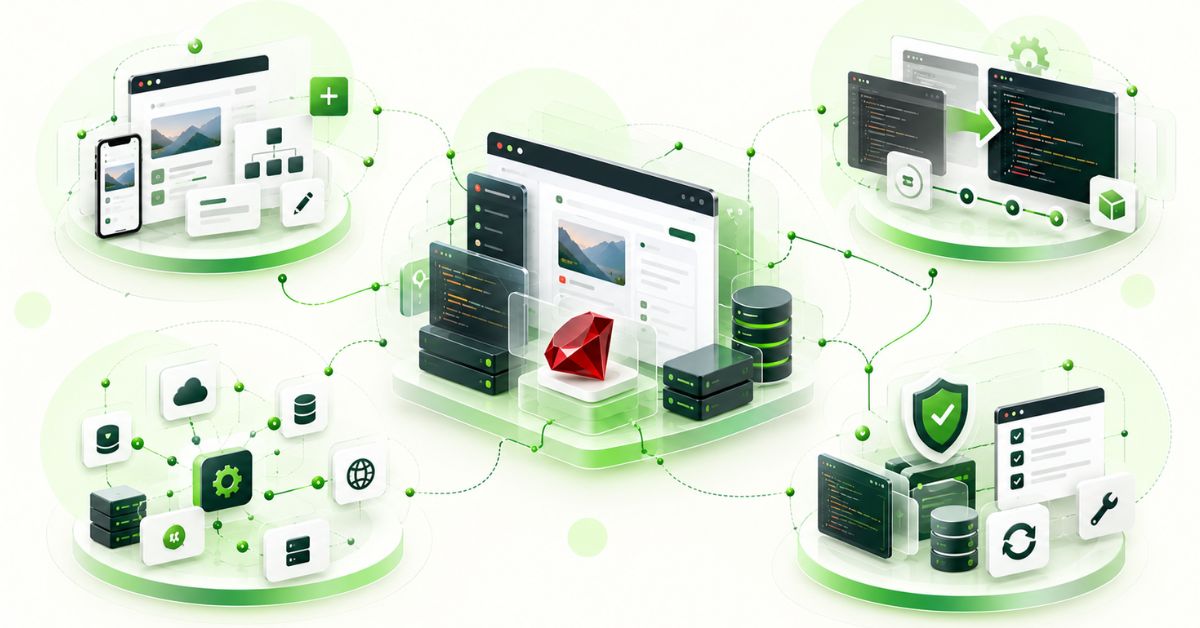
Rails projects fall into four common types. Each one needs a slightly different brief.
New product builds
Founders and product teams hand off a full build, from data model to launch. Rails suits this work because its conventions speed up the first version. The brief should include user stories, key integrations, and launch criteria.
Legacy upgrades and modernization
Many companies run older Rails apps that sit several versions behind. Upgrading takes careful, step-by-step work. A good partner audits the app first, then upgrades one version at a time with tests at each stage.
Integrations and API work
Rails apps often connect to payment systems, CRMs, and data tools. This is well-suited to outsourcing because the scope is clear and the result is testable.
Ongoing maintenance and support
Security patches, gem updates, and small fixes add up. A partner can take this over on a monthly plan, so your team avoids the interruptions.
What Has Changed in Rails 8, and Why Does It Matter for Outsourcing?
Rails 8 arrived in late 2024. InfoQ reports that it ships Kamal 2 for deployment, a built-in authentication generator, and the Solid Queue, Solid Cache, and Solid Cable libraries, which remove the need for separate job and cache services in many apps (InfoQ). The current release line is Rails 8.1.
This matters for three reasons.
- Simpler hosting: fewer moving parts means lower infrastructure cost and fewer failure points.
- Faster setup: a new project reaches production sooner.
- A clear upgrade target: legacy apps have a modern version to aim for.
Therefore, ask every candidate partner which Rails versions they have shipped. Experience with Rails 7 and 8 is a good sign.
How to Outsource Ruby on Rails Development: A Step-by-Step Process
A simple process lowers risk. Follow these eight steps.
Step 1: Define the outcome
Write down what success looks like in plain terms. Include the users, the deadline, and the metrics that matter. For example, “cut checkout errors by half” is stronger than “improve checkout.”
Step 2: Gather current assets
Collect repositories, documentation, test coverage reports, and hosting details. For legacy apps, list the Rails and Ruby versions in use. Partners price more accurately when they see real code.
Step 3: Shortlist partners
Look for proven Rails delivery, not just general software skills. Ask for case studies and client references. Our guide on how to evaluate software development services offers a scoring checklist.
Step 4: Run a paid discovery sprint
A one- or two-week discovery sprint shows how the team thinks. It also produces a plan, an estimate, and a risk list. Treat it as a low-cost audition.
Step 5: Pick the engagement model
Match the model to your scope risk. The next section covers this in detail.
Step 6: Agree on definition of done
Define what “finished” means for each milestone. Include test coverage, code review, documentation, and deployment steps. Vague definitions cause most disputes.
Step 7: Set up access and communication
Create shared channels, a ticket board, and a staging environment before work begins. Give the partner the same visibility your own engineers have.
Step 8: Plan the exit
Choose your handoff terms now. Require code ownership, clean documentation, and a transition period. This protects you if the relationship ends.


What Pricing Models Work for Outsourced Rails Projects?
Four models cover most deals. Each one moves risk between you and the partner.
| Model | Best for | Main risk |
|---|---|---|
| Fixed price | Small, well-defined builds | Change requests add cost fast |
| Time and materials | Evolving scope, upgrades | Budget can drift without limits |
| Dedicated team (monthly) | Long roadmaps | Paying for idle capacity |
| Outcome-based | Clear milestones | Needs precise definitions |
What drives the price of a Rails project?
Five factors move the quote more than any other.
- Seniority mix: more senior engineers cost more per hour but need less rework.
- Scope risk: unclear requirements and old code raise the estimate.
- Team size and duration: longer projects often earn a better monthly rate.
- Region: nearshore teams usually cost less than U.S. firms.
- Extra services: design, QA, and DevOps add to the total.
For a sense of regional pay, ParallelStaff’s published ranges show mid-level engineers in Latin America earning about $40,000 to $70,000 a year, and seniors about $55,000 to $105,000 (LATAM software engineer salaries). A partner adds its margin on top. To plan your budget around these factors, read our notes on software budgeting and when outsourcing makes sense.
What Does a Good Outsourced Rails Team Look Like?
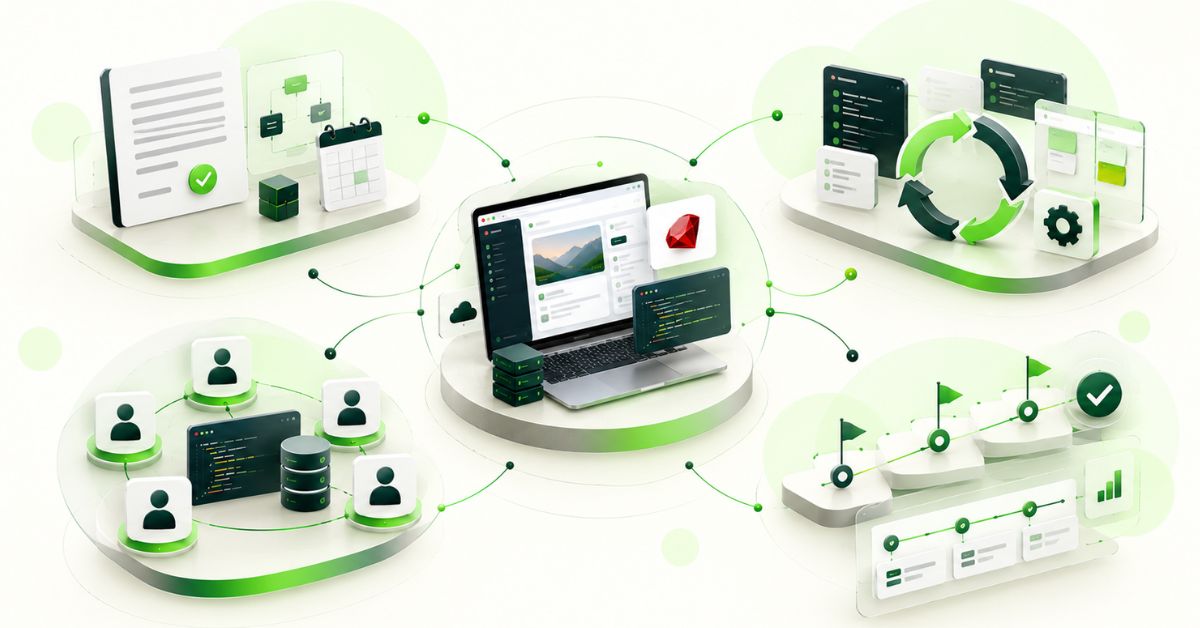
Team structure should match the size of the project. A typical setup includes:
- Technical lead: owns architecture, code review, and standards.
- One to three Rails engineers: build features and fix defects.
- QA engineer: writes and runs automated and manual tests.
- Delivery manager: tracks scope, risks, and communication.
- Designer or DevOps support: added as needed.
Smaller projects can combine roles. For example, a senior engineer can serve as both lead and builder. However, never skip review and testing. They protect you after the partner leaves.
How Should You Manage the Handoff After You Outsource?
Outsourcing does not mean stepping away. A steady cadence keeps the work on track without heavy meetings.
- Daily: a short written update on progress and blockers.
- Weekly: a demo of working software and a backlog review.
- Every two weeks: a sprint review and planning session.
- Monthly: a check on budget, risks, and roadmap.
- Quarterly: a review of the partnership itself.
Time zones matter here. A Rice Business study of more than 12,000 employees at a Fortune 100 company found that each added hour of time difference cut synchronous communication by 11% (Rice Business). For that reason, many U.S. buyers choose nearshore partners whose workdays overlap with theirs. Our software outsourcing best practices cover communication habits in more depth.
How Do You Vet a Rails Outsourcing Partner?
Ask these questions before you sign.
- Which Rails and Ruby versions have you shipped in the last 12 months?
- Can you share a sample of your test suite and review process?
- How do you handle upgrades on apps that lack tests?
- Who owns the code and the infrastructure accounts?
- What is your replacement policy if an engineer leaves?
- Can I speak with two current clients?
Also check security practices. Look for certifications such as ISO 27001 and clear rules for access to your code and data.


What Mistakes Should You Avoid When You Outsource Rails Work?
- Choosing on price alone. Low rates often hide slow delivery and rework.
- Skipping discovery. Without it, estimates are guesses.
- Ignoring test coverage. Weak tests make future changes risky.
- Leaving code ownership unclear. Put it in the contract.
- Hiding context. Share the business goals, not only the tickets.
- Waiting too long to review. Frequent demos catch problems early.
Why Do Teams Outsource Rails Development With ParallelStaff?
ParallelStaff places senior engineers from Latin America with U.S. companies. Several facts support the process.
- Growth: ParallelStaff ranked #502 on the 2025 Inc. 5000 list.
- Reviews: We hold a 4.8 out of 5 rating on Clutch.
- Retention: 94% of our engineers stay on their placements.
- Security: We are ISO 27001 certified.
- Enterprise trust: Our engineers have supported AT&T, AMD, Google, J.Crew, and Whirlpool.
Our teams work in time zones that overlap with U.S. hours, and you can review every engineer before work begins. Learn more about our software outsourcing services. If your needs look more like adding one person than handing off a project, see our IT staff augmentation option. For a comparable guide on another stack, read how to outsource Java development or how to outsource .NET development.
Frequently Asked Questions About Outsourcing Rails Development
How do I outsource Ruby on Rails development safely?
Run a paid discovery sprint, agree on code ownership in writing, and require regular demos. These three steps catch most problems early.
How much does it cost to outsource Ruby on Rails development?
Cost depends on scope, seniority, and region. A small build costs far less than a multi-year platform. Ask for a discovery estimate before you compare quotes.
Is Ruby on Rails still a good choice in 2026?
Yes. Rails 8 simplified deployment, and major products still run on it. It suits web apps that need fast development and clear conventions.
Should I outsource a Rails upgrade or hire someone in-house?
Outsource it if your team lacks upgrade experience. Upgrades are a bounded project, so a specialist can finish them faster than a new hire can ramp up.
What is the best pricing model for a Rails project?
Time and materials suits evolving scope. Fixed price suits small, defined work. A dedicated team suits a long roadmap.
How long does it take to start a Rails outsourcing project?
With a prepared brief, a partner can often begin discovery within one to two weeks and start building soon after.
What is the difference between outsourcing and staff augmentation for Rails?
With outsourcing, the partner owns delivery of the project. With staff augmentation, you add a person who works under your direction.
Who owns the code when I outsource Rails development?
You should. State this in the contract, and require access to all repositories and hosting accounts from day one.
How do I check the quality of a Rails partner’s work?
Review a sample of their code, their test coverage, and their pull request process. Speak with past clients about delivery and communication.
Can an outsourced team maintain my existing Rails app?
Yes. Many partners offer monthly maintenance plans covering security patches, dependency updates, and small fixes.
What time zone overlap do I need for an outsourced Rails team?
Aim for at least four hours of daily overlap. Nearshore teams in Latin America usually meet this need without effort.
Is it safe to outsource Rails work outside the United States?
Yes, with the right controls. Look for ISO 27001, signed IP assignment, and limited access to production systems.
What should I prepare before I contact a Rails outsourcing partner?
Prepare a short brief with goals, users, current assets, deadline, and budget range. A clear brief speeds up every later step.
Final Thoughts
To outsource Ruby on Rails development successfully, brief the work clearly, match the pricing model to your risk, and keep a steady review rhythm. In 2026, Rails 8 and nearshore teams make it easier than ever to ship quickly at a fair cost. If you want a second opinion on scope or budget, our team can help you shape the brief.
 Verified Author

Miguel Hernandez
VP of Operations
Linkedin Profile