
In this article
TL;DR: U.S. companies choose the Dominican Republic for nearshore software development because it shares U.S. working hours, offers solid English skills, and has a free trade agreement with the United States. The country sits on Atlantic Standard Time all year, so it matches New York in summer and runs one hour ahead in winter. English proficiency is moderate overall and stronger in IT roles and in Santo Domingo. Risks include rule-of-law concerns and a smaller talent pool than larger regional markets, so vetting matters. In 2026, it works best for teams that want real-time collaboration at nearshore cost.
Nearshore software development Dominican Republic teams give U.S. companies live collaboration, a stable trade relationship, and a growing pool of engineers. Therefore, the country deserves a place on your shortlist, especially if you work on East Coast hours. However, it is not the right fit for every project. This guide covers time zones, English skills, the legal setting, costs, risks, and a step-by-step hiring plan. For the full model, read our nearshore software development guide.
Why U.S. Companies Choose the Dominican Republic
Demand for engineers keeps outrunning supply. A Gartner survey of 437 IT organizations found that 64 percent of IT executives named talent availability as the top barrier to adopting emerging technologies. Meanwhile, the U.S. Bureau of Labor Statistics reports that the median pay for computer and IT occupations was $109,470 in May 2025. As a result, many teams look nearby for skilled talent at a lower total cost.
Nearshoring answers both problems. According to Deloitte, time-zone-aligned resources enable more collaboration and help teams avoid the fatigue of end-of-day handovers. In addition, Deloitte describes nearshoring as offering both cost savings and access to a broad talent pool.
The Dominican Republic adds three specific advantages. First, its time zone lines up with the U.S. East Coast. Second, English skills in IT are stronger than the national average. Third, a free trade agreement gives U.S. companies a clear legal framework. The sections below cover each one.
Time Zone Overlap: Atlantic Standard Time All Year
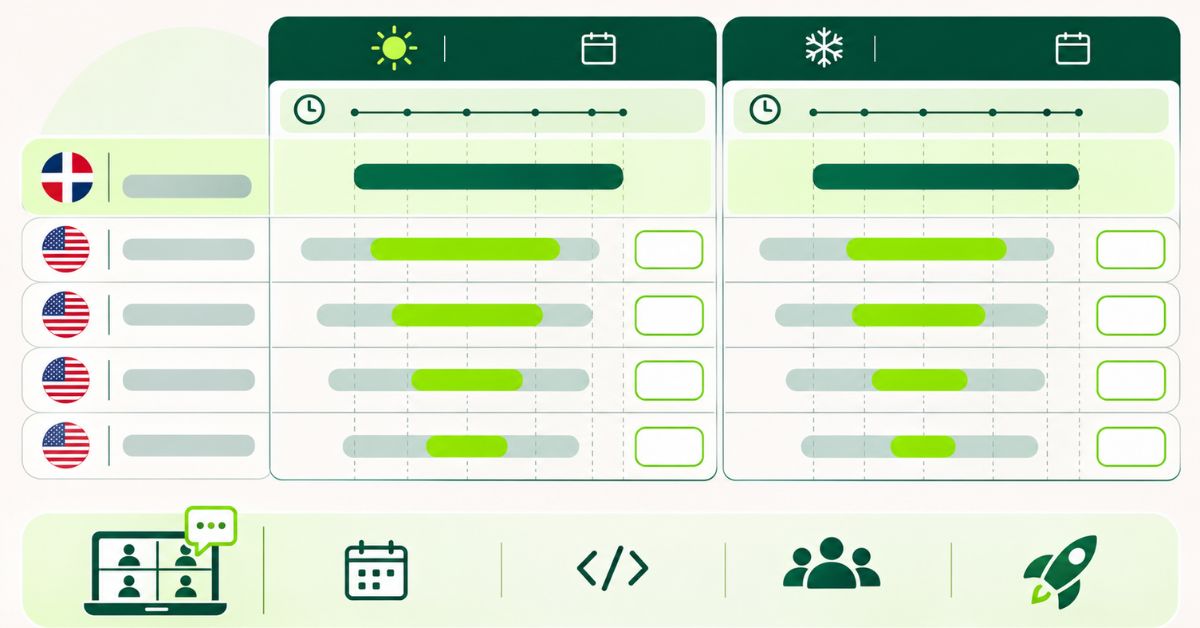
The Dominican Republic uses Atlantic Standard Time, which is UTC-4. According to timeanddate.com, Santo Domingo observes no daylight saving time. Therefore, the country never changes its clocks. Because the U.S. does change its clocks, the gap shifts twice a year.
In summer, U.S. Eastern time is also UTC-4, so a Dominican engineer and a New York manager share the same hour. In winter, the Dominican Republic runs one hour ahead of Eastern time. The table below shows the approximate overlap on a standard 9-to-5 schedule.
| U.S. time zone | Summer overlap | Winter overlap |
|---|---|---|
| Eastern | 8 hours (same time) | 7 hours (DR is 1 hour ahead) |
| Central | 7 hours (DR is 1 hour ahead) | 6 hours (DR is 2 hours ahead) |
| Mountain | 6 hours (DR is 2 hours ahead) | 5 hours (DR is 3 hours ahead) |
| Pacific | 5 hours (DR is 3 hours ahead) | 4 hours (DR is 4 hours ahead) |
East Coast teams get the best fit. Central and Mountain teams still share most of the day. Pacific teams get a shorter window, so they should plan standups and reviews for the morning. Our guide on nearshore teams and U.S. time zones explains how to schedule around the overlap.
English Proficiency in the Dominican Republic
English skills decide how smoothly a team works with you. The EF English Proficiency Index 2026 fact sheet ranks the Dominican Republic #56 with a score of 500, against a global average of 485. The same sheet reports an IT job function score of 548, which is higher than the national score.
City scores vary. Santo Domingo scores 522 and Santiago scores 512, while some smaller cities score lower. As a result, the capital and Santiago are the safest places to source engineers who must communicate with U.S. stakeholders daily.
Still, an index score is not a hiring test. The index measures adults who took the EF test, so test takers are self-selected. Therefore, run your own live interview in English with every candidate. Ask the person to explain a past project, walk through a design choice, and respond to a follow-up question.
Trade Agreements and the Legal Setting
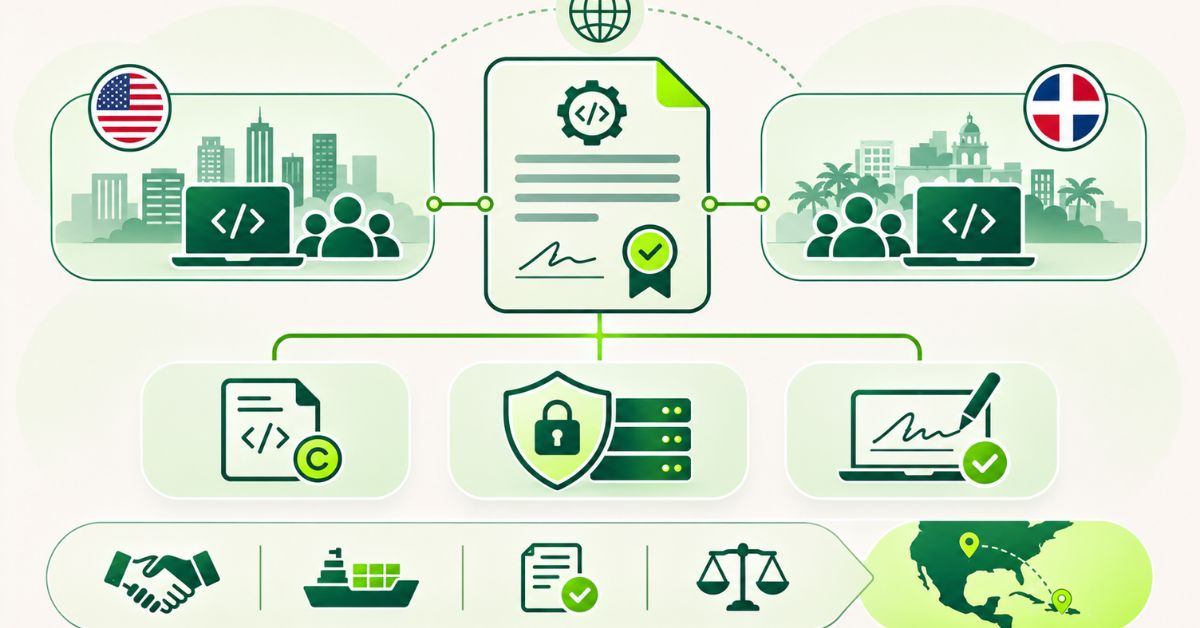
The Dominican Republic is a party to CAFTA-DR, the free trade agreement with the United States and five Central American countries. The U.S. Trade Representative says the agreement significantly liberalizes trade in goods and services, and it includes disciplines on intellectual property rights and electronic commerce. The agreement entered into force for the Dominican Republic on March 1, 2007.
The economy gives some context. According to the U.S. Commercial Service country guide, real GDP grew 5.1 percent in 2024, and trade in goods and services between the two countries reached about $33.6 billion. In addition, the guide describes Dominican business leaders as familiar with U.S. business practices.
Contracts, Signatures, and Data
Digital contracts are workable. The Commercial Service reports that Law 126-02 regulates electronic commerce, digital documents, and signatures, and it gives electronic signatures legal force. A separate Data Protection Law, Law 172-13, safeguards user data. Even so, you should still use a written contract that assigns intellectual property to your company, and you should have a U.S. attorney review it.
Where the Legal Setting Needs Care
The same country guide notes that concerns over corruption and weak rule of law continue for U.S. companies. For software teams, this matters mostly for dispute resolution and enforcement. Therefore, a reputable partner that holds the employment relationship and carries clear security controls reduces your exposure.
Talent Pool, Hubs, and Specializations
Santo Domingo is the main hub. Santiago is the second major center, and several smaller cities have growing communities. ParallelStaff tracks a pool of roughly 20,000 developers in the country, and it lists software development, fintech, cloud, and IT services as common areas. Compared with the largest regional markets, the pool is smaller. Consequently, senior and niche skills can take longer to find.
The local technology market is still maturing. The Commercial Service reports that cloud adoption among Dominican businesses is at an early stage, and that local companies are wary of storing sensitive data in the cloud. For U.S. teams, this has two effects. Local engineers who work on U.S. products often gain cloud experience through client work. At the same time, a project with heavy cloud needs should include a short skills check in the vetting process.
What Projects Fit Best
- Product development for East Coast teams: The time zone fit makes daily collaboration easy.
- Fintech and payments work: Fintech is among the areas where the local market is active.
- Customer-facing applications: Strong English in IT roles helps with product feedback loops.
- Ongoing maintenance and platform support: Steady hours and live handoffs reduce delays.
What Nearshore Software Development in the Dominican Republic Costs
Cost depends on seniority, skills, and the engagement model. Typical nearshore rates for senior engineers in Latin America run roughly $50 to $90 per hour in 2026, which is often about half of comparable U.S. rates. Dominican engagements generally fall inside the regional range, but exact bands vary by skill and seniority. Therefore, ask any partner for a band by seniority level, not a single number.
The hourly rate is only part of the picture. A fair comparison should include these items:
- Recruiting, vetting, and onboarding costs
- Payroll, benefits, and compliance handled by the partner
- Management time from your own team
- Equipment, tools, and security controls
- Replacement terms if a fit does not work out
For a deeper breakdown, read our guide to nearshore software development cost. Also, our overview of LATAM software engineer salaries compares pay across the region.
Risks to Plan For and How to Manage Them
No country is perfect. Plan for these risks before you sign a contract:
- A smaller talent pool: Start the search early, and keep a backup candidate for senior roles.
- Rule-of-law concerns: Use a partner that holds the employment relationship and signs clear intellectual property terms.
- Uneven English levels: Run your own live interview, and test written communication too.
- Winter time gap for Pacific teams: Schedule shared meetings early in the day.
- Attrition: Ask for verified retention numbers, because turnover drives hidden cost.
Our guide on how to reduce engineer attrition in nearshore teams covers the habits that keep engineers engaged.
How to Hire Engineers in the Dominican Republic: A Step-by-Step Plan
- Define the need. Write down the product goal, the stack, the seniority, and the hours you need covered.
- Pick the engagement model. Choose staff augmentation for one or two hires, or a dedicated team for a long roadmap.
- Choose a partner. Check retention, security certifications, and references before you compare rates.
- Review candidates. Run a live technical interview and a live English conversation.
- Sign clear terms. Assign intellectual property to your company, and agree on replacement terms.
- Onboard with structure. Set up access before day one, then pair each new engineer with a buddy.
Most teams reach a start date in about two to four weeks with a partner. In contrast, direct hiring often takes much longer. For more on the process, read our guide on how to hire nearshore developers and our overview of nearshore developer onboarding.


How the Dominican Republic Compares With Other Nearshore Countries
Each country has trade-offs. Larger markets offer more senior talent. Others offer different time zone fits. The Dominican Republic stands out for its East Coast alignment and its trade framework. Costa Rica, for example, offers a Central Time match, as shown in our guide on nearshore software development in Costa Rica. Likewise, our overview of the best nearshore software development countries compares the full region.
If you also want to compare nearshore with offshore, see our guide to LATAM nearshore vs offshore.
How ParallelStaff Helps You Hire in the Dominican Republic
ParallelStaff places senior Latin American engineers with U.S. teams, and our proof points are specific and checkable:
- Ranked #502 on the 2025 Inc. 5000 list
- 94 percent engineer retention
- ISO 27001 certified
- 4.8 out of 5 rating on Clutch
- Enterprise clients that have included AT&T, AMD, Google, J.Crew, and Whirlpool
Our process starts with your brief. First, we define the role and the seniority you need. Then we match engineers to your stack and your working hours. After that, we handle payroll, compliance, and onboarding, so your team can focus on the product. Explore our nearshore software development services, our nearshore staff augmentation model, and our dedicated development teams. In addition, our overview of nearshore development services explains what a full-service partner provides.


For more on choosing a partner, read our guide to a nearshore software development company.
Frequently Asked Questions About Nearshore Software Development in the Dominican Republic
Is the Dominican Republic a good place for nearshore software development?
Yes, for many U.S. teams. The country shares East Coast working hours, offers strong English in IT roles, and has a free trade agreement with the United States. However, the talent pool is smaller than in the largest regional markets, so vetting matters.
What time zone does the Dominican Republic use?
It uses Atlantic Standard Time, which is UTC-4, all year. The country does not observe daylight saving time. As a result, it matches U.S. Eastern time in summer and runs one hour ahead in winter.
How good is English among Dominican developers?
The 2026 EF English Proficiency Index ranks the country #56 with a score of 500. Its IT job function score is 548, which is higher. Still, you should run your own live English interview with every candidate.
How much does it cost to hire a developer in the Dominican Republic?
Typical nearshore rates for senior engineers in Latin America run roughly $50 to $90 per hour in 2026. Dominican engagements generally fall in that range. However, exact rates depend on skills, seniority, and the engagement model, so ask for bands by level.
Does the Dominican Republic have a free trade agreement with the United States?
Yes. It is a party to CAFTA-DR, which entered into force for the country on March 1, 2007. The agreement includes disciplines on intellectual property rights and electronic commerce.
Are electronic contracts valid in the Dominican Republic?
Yes. Law 126-02 regulates electronic commerce, digital documents, and signatures, and it gives electronic signatures legal force. Even so, you should have a U.S. attorney review your contract.
What are the biggest risks of hiring engineers in the Dominican Republic?
The main risks are a smaller talent pool, rule-of-law concerns, and uneven English levels. In addition, Pacific teams get a shorter overlap in winter. A reputable partner and a strong vetting process reduce all of these risks.
Which cities have the strongest technology talent?
Santo Domingo is the main hub, and Santiago is the second major center. Both score higher on English than several smaller cities in the 2026 EF data. Therefore, most U.S. teams start their search there.
How long does it take to hire engineers in the Dominican Republic?
Most teams reach a start date in about two to four weeks with a partner. In contrast, direct hiring often takes far longer. A clear brief and a quick interview schedule shorten the timeline.
Is the Dominican Republic better than other nearshore countries?
It depends on your needs. East Coast teams value the time zone fit, while others may prefer larger talent pools elsewhere. Therefore, compare two or three countries against your stack, your hours, and your budget.
Do I need a local entity to hire engineers in the Dominican Republic?
Not when you work through a nearshore partner. The partner employs the engineers, so it handles payroll, benefits, and compliance. As a result, you avoid setting up your own entity.
How do I protect my intellectual property when I hire nearshore?
Sign a contract that assigns all work product to your company. Also, keep control of your repositories and cloud accounts. Finally, choose a partner with documented security controls, such as ISO 27001.
Is the Dominican Republic safe for software projects?
Software work happens remotely, so physical travel risk matters little. The country had an orderly and peaceful election in 2024, according to the Commercial Service. Even so, you should review the partner’s security controls and continuity plans.
 Verified Author

Paola Araujo
Account Manager
Linkedin Profile