

In this article
TL;DR
- To hire a backend developer well, define the system they will own, then test for reliability, data design and communication, not only coding speed.
- Staff augmentation lets you add one proven backend engineer to your team in weeks, with your managers setting priorities.
- US median pay for software developers is $135,980 per year (BLS, May 2025). Nearshore bands run about $35-50/hr for mid-level and $55-75/hr for senior engineers.
- Use a structured interview with the same questions and a written rubric. Google’s hiring research backs this approach.
- Plan a 30, 60, 90 day ramp so the new engineer ships real work in the first month.
If you are working out how to hire a backend developer, the short answer is this: decide what the engineer will own, vet them on how they design and operate systems, and add them to your team through a model that lets you start fast. A backend developer builds the part of your product that users never see but always depend on: the services, data stores, integrations and APIs behind every screen. Because of that, a weak hire there shows up as outages, slow pages and expensive rewrites.
This guide is written for engineering leaders who want to add one backend engineer to an existing team in 2026. It covers what the role does, which skills matter, how to interview, what it costs and, finally, how to onboard. If you are still comparing hiring models, read our complete guide to staff augmentation first.
What a Backend Developer Actually Owns
Job titles hide big differences. Before you write a requisition, be clear about which of these jobs you need done.
- Service and API design: building the endpoints that web and mobile clients depend on.
- Data modeling: choosing how information is stored, indexed and migrated safely.
- Integrations: connecting payment, identity, messaging and third-party systems.
- Performance and reliability: keeping response times low and recovering fast when something fails.
- Security basics: authentication, authorization, secrets handling and safe data access.
- Operations: logging, monitoring, deployment and on-call support.
A person who is excellent at the first two may be average at the last two. Therefore, decide which areas are critical for your first ninety days and weight your interview accordingly.

When Adding a Backend Engineer Through Staff Augmentation Makes Sense
Staff augmentation means you add an individual engineer to your existing team. They join your standups, use your tools and report to your lead. Meanwhile, the partner handles sourcing, vetting, local employment and payroll. This is different from handing a whole project to a vendor. However, if that second option interests you, see our comparison of staff augmentation versus project outsourcing.
Adding a backend engineer this way fits best when:
- You already have technical leadership that can set priorities and review code.
- The roadmap is ahead of your capacity, and a permanent hire would take months.
- You need a specific skill set for a defined period, such as a platform migration.
- You want to test a role before committing to a full-time headcount.
It fits less well when nobody on your side can guide the work. In that case, a dedicated team or a managed project is usually safer.
How to Hire a Backend Developer: Step by Step
1. Write the problem, not the job ad
Describe the outcome. For example: “Cut checkout API latency in half and move billing to an event-driven design.” Outcomes attract serious candidates, and they also make interview questions easier to write.
2. Choose the seniority you really need
Mid-level engineers deliver well-scoped work with light guidance. Senior engineers shape architecture, mentor others and make trade-offs without supervision. If your team lacks design leadership, hire senior. If your team has it, however, mid-level is often better value.
3. Pick the engagement model
Most companies add one engineer full time, aligned to their working hours. Others start part time or with a fixed term. Our guide to staff augmentation engagement models explains the trade-offs.
4. Source from a vetted bench
Starting with pre-screened talent cuts the slowest part of hiring. Instead of a stack of resumes, a good partner shows you a short list with technical evidence, not a stack of resumes.
5. Run a structured interview
More on this below. It is the single biggest lever for hiring quality.
6. Check references that matter
Speak with engineers or leads who worked with the candidate, not only managers. Then ask what happened when something broke in production.
7. Onboard with a clear plan
Give the engineer access, context and a first task on day one. Also, our nearshore developer onboarding timeline shows what a realistic first month looks like.
Skills to Vet in a Backend Developer
The best signal is how a candidate reasons about trade-offs. Therefore, look for depth in these areas.
Data design
Ask how they would model a feature with relationships, history and reporting needs. Strong candidates talk about constraints, indexing, migrations and what happens when volume grows tenfold. The Stack Overflow 2025 Developer Survey shows how widely relational databases are used: PostgreSQL is used by 55.6% of respondents. Your candidate should be comfortable with relational thinking, even though your stack may differ.
API design and integration
Look for clear contracts, versioning habits and careful error handling. Then ask about a time an integration failed and how they made the system tolerate it.
Reliability and debugging
Ask them to walk through a real incident. You want to hear how they found the cause, what they changed and how they prevented a repeat. However, candidates who can only describe the fix, and not the diagnosis, are weaker.
Security habits
Basic questions reveal a lot. For example, ask how they store secrets, check permissions and handle personal data. Good engineers answer without hesitation.
Operational awareness
Container tooling is now routine. The same survey reports that Docker is used by 71.1% of respondents. Therefore, expect candidates to understand deployments, logs, metrics and rollback plans, not only code.
Communication
An augmented engineer works inside your team, so written clarity matters. For that reason, ask for a short design note on a sample problem. Also check English proficiency early. EF’s English Proficiency Index publishes country and city results, which help you set expectations for each hiring market.


How to Interview a Backend Developer
Unstructured conversations favor confident talkers, while a structured process favors capable engineers. Google’s re:Work guide defines structured interviewing as using uniform methods to assess everyone who applies for the same job. It cites research linking the approach to higher predictive validity and smaller differences between demographic groups.
You can apply the same idea to engineering:
- First, ask the same core questions of every candidate for the role.
- Next, write a rubric. Define what a strong, acceptable and weak answer looks like.
- Then use a work sample. A small, realistic exercise beats trivia puzzles.
- Also add a design conversation. Let the candidate draw a simple system and defend choices.
- Score independently. Each interviewer rates before the group discusses.
- Finally, refresh the questions. Google notes that questions leak, so rotate them.
Sample scorecard
| Area | Strong signal | Weak signal |
|---|---|---|
| Data design | Explains constraints, indexes and safe migrations | Only describes tables |
| Reliability | Describes diagnosis and prevention | Describes only the quick fix |
| Trade-offs | Compares two options with costs | Defends one option by habit |
| Communication | Clear, concise, asks good questions | Vague or defensive |
| Ownership | Talks about outcomes and users | Talks only about tasks |
Keep the process short. Three focused rounds are enough for most roles, because long loops lose strong candidates to faster offers.

Red Flags When Hiring a Backend Developer
- The candidate cannot explain a past design in their own words.
- Every outage is someone else’s fault, and no personal role is described.
- Tests, monitoring or documentation are dismissed as “extra”.
- Complex solutions are proposed for simple problems.
- Questions about security or data privacy get avoided.
- The candidate cannot say what they would do differently on a past project.
One red flag is a prompt for follow-up. However, several together are a clear no.
What It Costs to Hire a Backend Developer in 2026
Cost depends on location, seniority and hiring model. The U.S. Bureau of Labor Statistics reports a median pay of $135,980 per year for software developers in May 2025. That figure excludes benefits, payroll taxes, recruiting fees and equipment, which add a large share on top.
Nearshore engineers in Latin America cost less. CBRE reports that average wages in Latin America are about 39% of US levels. ParallelStaff’s typical 2026 hourly bands for the region look like this:
| Experience level | Typical hourly rate |
|---|---|
| Junior | $22-35/hr |
| Mid-level | $35-50/hr |
| Senior | $55-75/hr |
These ranges are guidance, not a quote. Your rate depends on the exact skills, English level and engagement length. For a full breakdown, see our report on LATAM software engineer salaries versus U.S. rates.
Compare the whole picture, not only the hourly number. A permanent hire takes months to recruit and carries long-term obligations. In contrast, an augmented engineer can start in weeks, and you can scale the engagement up or down.
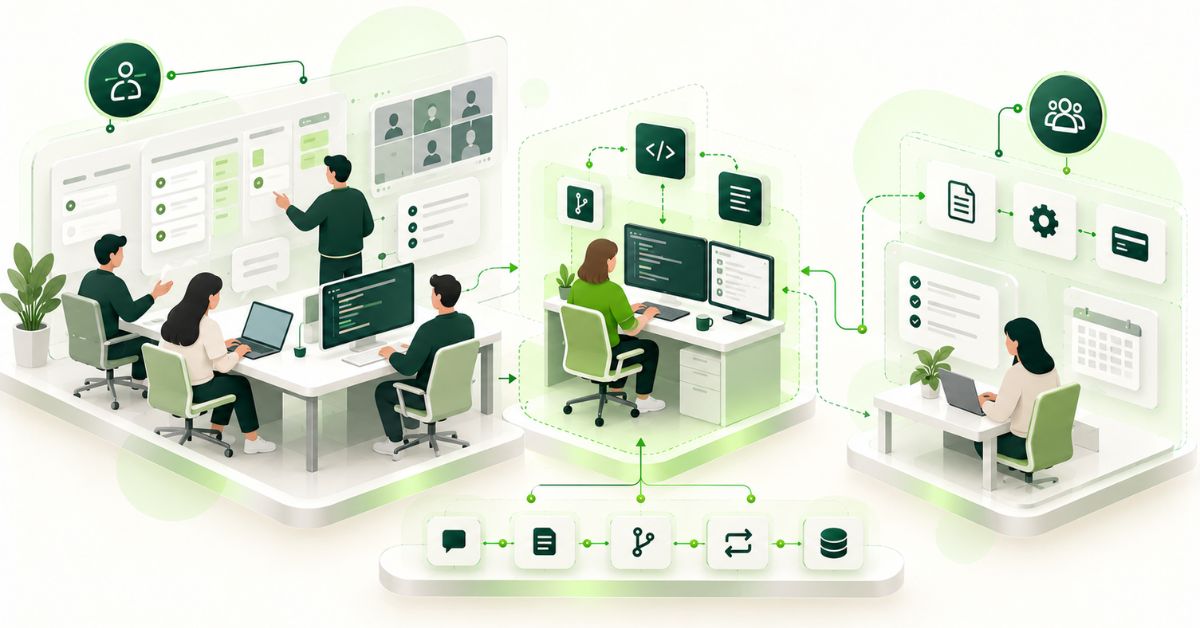
Where a Backend Engineer Sits on Your Team
Augmented engineers work best when reporting lines are clear.
- Day-to-day direction: your engineering manager or tech lead.
- Code review: a named senior engineer on your side.
- Employment and payroll: the staffing partner.
- Performance feedback: shared, with regular check-ins.
Treat the engineer as part of the team. For example, invite them to planning, retrospectives and chat channels. Teams that keep augmented engineers out of the loop get worse results and higher turnover. Meanwhile, if you also need delivery leadership, see our guide on how to hire a project manager. If you need someone who covers both layers of the product, read how to hire a full stack developer.
A 30, 60, 90 Day Ramp Plan
Days 1 to 30: learn and ship small
Provide access, architecture context and a mentor. Then assign a small, well-defined task that goes to production in the first two weeks, because early wins build trust.
Days 31 to 60: own a component
Give the engineer a bounded service or feature. Before the work begins, ask for a short design note. Review code quickly so that momentum stays high.
Days 61 to 90: lead and improve
Expect proposals for improvements, such as monitoring gaps or slow queries. By this point, the engineer should work independently with normal review.
Hold a short review at day 30, 60 and 90. During each one, ask what is blocking them and what you could do better.


Common Mistakes to Avoid
- Hiring for tools instead of thinking. Tools change, but sound design habits last.
- Skipping the work sample. Conversations alone overrate good talkers.
- Overloading day one. Give context first, then tasks.
- Ignoring time zone. Real overlap makes pairing, reviews and incident response far easier.
- Choosing only on price. A cheaper engineer who needs constant rework often costs more.
How ParallelStaff Places Backend Engineers
ParallelStaff is a nearshore staffing and software development firm based in Dallas, Texas. We place senior Latin American engineers with US technology teams. In addition, we are ISO 27001 certified, hold a 4.8 out of 5 rating on Clutch and were ranked #502 on the 2025 Inc. 5000. Our engineer retention rate is 94%.
Our process is simple, and it has five steps:
- We define the outcomes, seniority and working hours with you.
- We screen candidates on technical depth and communication.
- You interview a short list using your own questions.
- We handle local employment, equipment and payroll.
- We stay involved after the start date to keep the engagement healthy.
You can read more about our IT staff augmentation service or our nearshore staff augmentation model. If you already know the profile you want, see how ParallelStaff handles how to hire a backend developer for your team. You can also browse our case studies to see results for other teams.
Frequently Asked Questions
How do I hire a backend developer?
Define the outcome the engineer must deliver, choose the right seniority, source from a vetted pool, run a structured interview with a work sample, check references and onboard with a 30, 60, 90 day plan.
What skills should a backend developer have?
Look for strong data modeling, API design, debugging, security habits, operational awareness and clear communication. Specific tools matter less than how the person reasons about trade-offs.
How much does a backend developer cost in 2026?
US median pay for software developers is $135,980 per year according to the BLS, before benefits and overhead. ParallelStaff’s typical nearshore bands are $35-50/hr for mid-level and $55-75/hr for senior engineers.
How long does it take to hire a backend developer?
A permanent in-house hire often takes two to four months. With a partner that has a vetted bench, many clients meet candidates within days and start within a few weeks.
Should I hire a mid-level or senior backend developer?
Hire senior if nobody on your team can lead design decisions. Hire mid-level when you already have strong leadership and a clear backlog of well-scoped work.
Is staff augmentation a good way to hire a backend developer?
Yes, when you have technical leadership in place and need to add capacity quickly. The engineer joins your team, follows your processes and works under your direction.
How do I interview a backend developer?
Use the same core questions for every candidate, score them against a written rubric, include a small work sample and hold a short design conversation. Moreover, Google’s research on structured interviewing supports this approach.
What is a good coding test for a backend developer?
Use a small, realistic task that takes one to two hours, such as designing and building a simple service with tests. Then judge clarity, correctness and trade-offs, not speed.
How do I check a backend developer’s references?
Talk to engineers or leads who worked directly with the person. Then ask about a production incident, how they handled feedback and how they communicated under pressure.
Can a nearshore backend developer work in my time zone?
Yes, because Latin American engineers usually overlap with US business hours for most or all of the workday, which supports pairing, code reviews and fast incident response.
How do I make sure a remote backend developer stays engaged?
Include them in planning, give clear goals, review work quickly and hold regular one-on-ones. Retention is highest when engineers feel like part of the core team.
What is the difference between a backend developer and a full stack developer?
A backend developer focuses on services, data and infrastructure. A full stack developer also builds the user interface. Choose backend depth for complex systems and full stack range for small, fast-moving teams.
What security checks should I make when onboarding a remote engineer?
Use least-privilege access, managed devices or secure environments, multi-factor authentication and a clear policy for secrets. Choose a partner with recognized security controls such as ISO 27001.
Final Thoughts
The best way to hire a backend developer is to be specific about the problem, rigorous in the interview and generous in onboarding. If you do those three things, the model you choose matters far less than the person you pick.
Ready to add a backend engineer to your team? Talk to ParallelStaff and we will share vetted profiles and a rate estimate based on your needs.
Sources: BLS, Stack Overflow Developer Survey 2025, Google re:Work, CBRE, EF EPI.
 Verified Author

Luis Peralta
CEO & Founder
Linkedin Profile