
In this article
TL;DR: A dedicated development team suits a platform migration because the work runs for months and depends on deep knowledge of your systems. A persistent, cross-functional team keeps that knowledge from walking out the door at each milestone. Plan for a small core team, migrate in waves, run old and new systems in parallel, and review progress every month. Expect nearshore costs of roughly $34,400 to $48,000 per month for a five-person team, based on typical rates.
A dedicated development team platform migration pairs a long-running migration with a stable group of engineers who work only on your systems. The team learns the old platform, builds the new one, and stays through cutover and cleanup. For most U.S. companies in 2026, that continuity is what separates a calm migration from a stalled one.
This guide covers why the model fits, what a migration includes, who sits on the team, the six phases, cost, and the risks to plan for. For the model itself, read our complete guide to building a dedicated development team.
Why a Platform Migration Needs a Dedicated Team
First, migrations are hard to estimate. McKinsey’s cloud migration research found that the average company spends 14 percent more on migration than planned each year. It also found that 38 percent of companies saw migrations delayed by more than one quarter. Those figures come from a 2021 survey, but the lessons still apply.
The same research names two common missteps: weak coordination, and heavy reliance on integrators paid for time spent instead of outcomes. In contrast, the companies that finished on schedule were 57 percent more likely to hire for advanced skills such as DevOps and FinOps. In short, coordination and the right skills matter more than headcount.
Fortunately, a dedicated team addresses both problems. It gives you three advantages that a short project crew cannot match:
- Continuity: the same engineers see the migration from assessment to decommissioning.
- Context: the team learns your data, quirks, and business rules, and keeps that knowledge.
- Accountability: one team owns the result, instead of passing work between vendors.
Hiring is also a pressure. The U.S. Bureau of Labor Statistics reports a median wage of $135,980 for software developers in May 2025. Building a full migration team in-house means paying that rate for months of recruiting, plus the cost of people who may not be needed after cutover.
What Counts as a Platform Migration
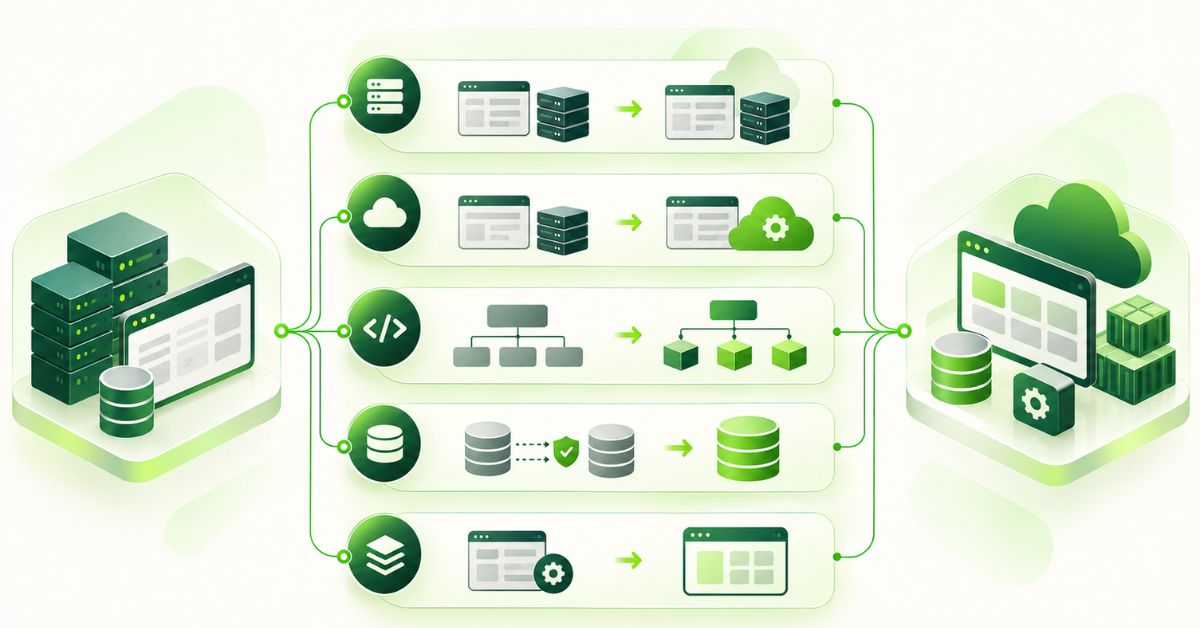
The term covers several kinds of work. Each one needs a slightly different team and plan.
Re-Hosting
In this approach, you move an application to new infrastructure with few code changes. This is the fastest route, but it carries old problems along with it.
Re-Platforming
You make targeted changes so the application uses managed services and modern tools. As a result, you gain reliability and lower running costs without a full rewrite.
Refactoring and Re-Architecting
You redesign parts of the application, often by splitting a large system into smaller services. This takes longest. However, it also delivers the biggest long-term gains.
Data Migration
You move data to a new store or schema. Data work is often the hardest part, because errors can stay hidden until users find them.
Vendor and Product Swaps
For example, you replace one commercial product with another, such as a billing system or a customer platform. Integrations and data mapping drive most of the effort here.
Dedicated Development Team Platform Migration: Who Is on the Team
A dedicated team is a persistent, multi-role group. It works only on your platform, follows your sprint rhythm, and reports to your technical leads. The partner handles employment, payroll, and retention. For a typical migration, the core group looks like this:
| Team member | What they own in a migration |
|---|---|
| Tech lead or architect | Target design, migration strategy, and technical decisions |
| Engineers (two or three) | Rebuilding components, writing migration scripts, and fixing defects |
| Quality engineer | Test plans, automated checks, and data validation |
| Infrastructure engineer | New environments, pipelines, monitoring, and cutover tooling |
| Delivery lead | Scope, risks, schedule, and communication with your stakeholders |
Meanwhile, your own team keeps two roles. A product owner sets priorities and approves scope changes. A technical sponsor makes decisions fast and clears blockers. Without those two, even a strong team slows down.
The team can also change shape over time. During assessment, a small group of senior people is enough. Then, during the build, you add engineers. Finally, after cutover, you can scale back to a smaller group that handles stabilization. Our dedicated development teams service works month to month, which makes this kind of reshaping practical.
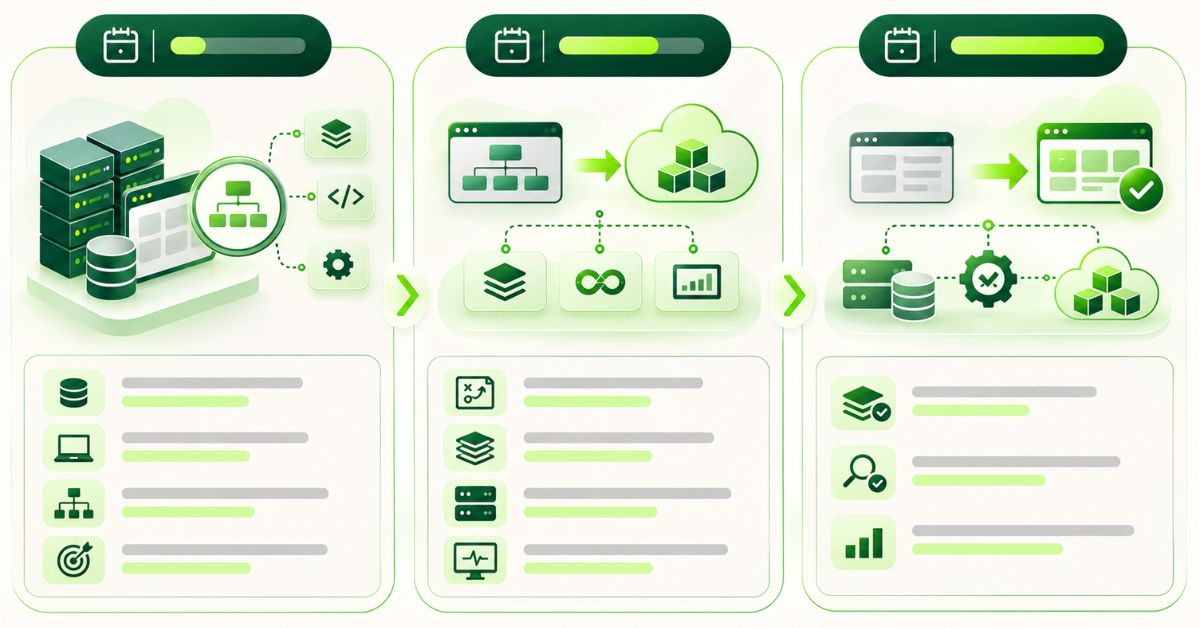
The Six Phases of a Platform Migration
These six phases give the work a clear order. Moreover, each phase ends with a decision that you control.
1. Assess
First, the team inventories applications, data, integrations, and risks. It also finds what can be retired. This phase usually takes two to four weeks, and it prevents expensive surprises later.
2. Plan
You choose a strategy for each component: move as is, adjust, redesign, replace, or retire. Then the team sets migration waves, success measures, and a rollback plan.
3. Build the Foundation
Next, engineers prepare the new environment, pipelines, monitoring, and access controls. A strong foundation makes every later wave faster.
4. Migrate in Waves
The team moves low-risk components first. Each wave teaches the team something, so later waves go faster. This is where a stable team pays off, because lessons stay inside the group.
5. Cut Over
Next, the team shifts users to the new platform in stages, with a tested rollback plan ready. Cutovers work best when they are boring, and boring comes from rehearsal.
6. Stabilize and Decommission
Finally, the team fixes post-launch issues, tunes performance, and shuts down the old platform. Do not skip this step, because old systems left running cost money and create security risk.

Run Old and New Platforms in Parallel
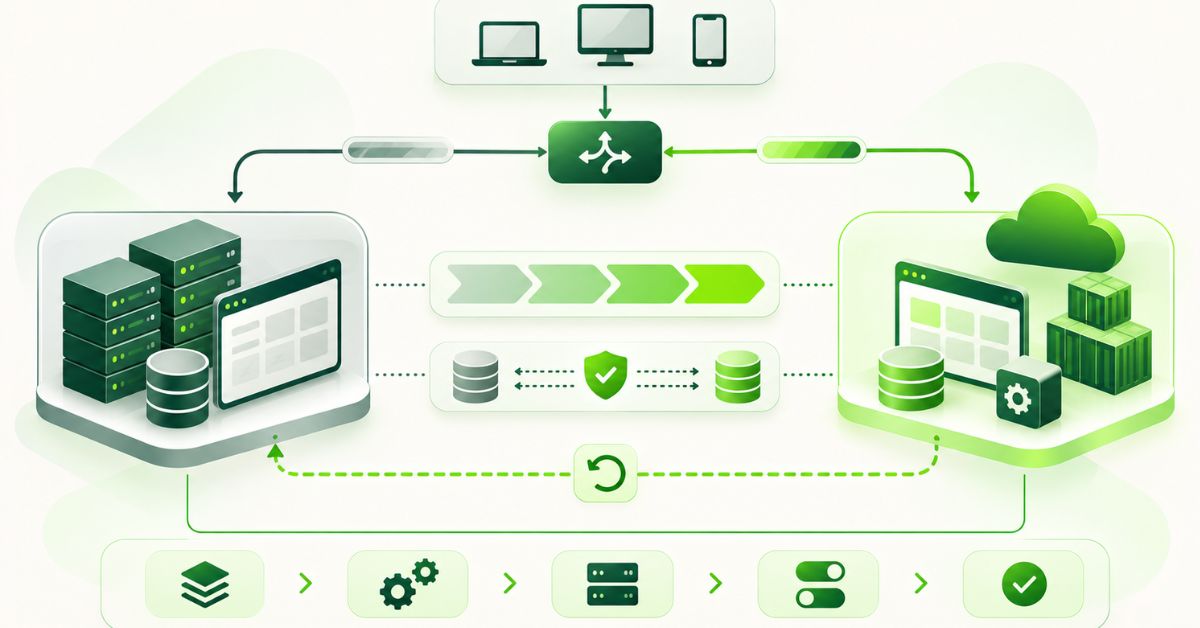
Still, the safest migrations avoid a single big-bang switch. Instead, the team runs both platforms side by side for a defined period. As a result, users move gradually, and the team compares results between the two systems.
Parallel running costs extra, because you pay for both environments. However, it lowers risk sharply. If a problem appears, you shift traffic back and fix it without an outage.
A few habits make this work:
- First, migrate one customer group or one feature at a time.
- Then compare outputs from both systems with automated checks.
- Also keep a written rollback plan for every wave.
- Finally, set an end date for the old platform, so parallel running does not drift on forever.
Protect Your Data During the Move
Data migration deserves its own plan. First, start with a full inventory of what exists, who owns it, and what you can delete. Then map each field from old to new, and test the mapping on a copy.
Next comes validation. The quality engineer should check record counts, totals, and sample records after every wave. In addition, run a final reconciliation before cutover.
However, security needs equal attention. Use least-privilege access, encrypt data in transit and at rest, and log every action on production data. Choose a partner with security certification, such as ISO 27001, and apply the same rules to the team that you apply to employees.
Governance and Communication
A migration touches many teams, so communication matters as much as code. A steady rhythm keeps everyone aligned:
- Daily: a short standup or written update in a shared channel.
- Weekly: a demo of what moved, what broke, and what comes next.
- Monthly: a business review covering schedule, budget, risks, and team health.
- Per wave: a go or no-go meeting before each cutover.
Shared working hours help here. A Harvard Business School study of 250 offices in 48 countries found that pairs of offices that lost one or two shared hours cut communication by 9.2 percent on average. A nearshore team keeps those hours, so questions get answers the same day. The talent pool is also deep: Deloitte counts more than 2.2 million software engineering professionals in Brazil and Mexico alone. For more on this model, see our guide to nearshore software development.
What a Dedicated Development Team Platform Migration Costs in 2026
Typical nearshore rates in 2026 look like this. They are billing rates for engineers with international project experience.
| Experience level | Typical hourly rate |
|---|---|
| Mid-level | $35 to $50 per hour |
| Senior | $55 to $75 per hour |
A Worked Example
Consider a five-person team: one senior tech lead, one senior infrastructure engineer, two mid-level engineers, and one mid-level quality engineer. At 160 hours per month, the low end is $215 per team hour, or $34,400 per month. The high end is $300 per team hour, or $48,000 per month. Over a twelve-month migration, that is roughly $413,000 to $576,000. This is illustrative arithmetic, not a quote.
Costs Beyond the Hourly Rate
- Parallel running: you pay for old and new environments during the overlap.
- Your own time: product owners and sponsors must stay available.
- Tooling and licenses: new platforms often carry new fees.
- Training: your support and operations staff need to learn the new system.
Our guide to nearshore software development cost breaks these items down further. In addition, Latin American wages average about 39 percent of U.S. levels, according to CBRE’s tech talent research.
Dedicated Team vs. Other Ways to Staff a Migration
Overall, the right model depends on duration, leadership, and risk. Here is a simple comparison.
| Model | Best for | Main risk for a migration |
|---|---|---|
| Dedicated team | Multi-month migrations with changing scope | Needs steady work and client-side sponsorship |
| In-house hiring | Core platforms you will own for years | Slow to hire, and roles may end after cutover |
| Staff augmentation | Filling one or two skill gaps | No one owns the whole result |
| Project outsourcing | Well-defined, fixed-scope moves | Scope changes are slow and costly |
In fact, many companies blend models. A small in-house core holds architecture and product decisions, while a dedicated team supplies delivery capacity. Read our comparison of a dedicated team vs. in-house hiring for more detail. If your scope is fixed, see our software development outsourcing guide.
Common Mistakes in Platform Migrations
- Treating it as a short project: migrations run for months, and rushed teams cut corners.
- Skipping the assessment: unknown systems cause the worst delays.
- Migrating everything: some applications should be retired, not moved.
- Underinvesting in data checks: hidden errors surface after cutover.
- No rollback plan: a failed cutover without one becomes an outage.
- Weak sponsorship: without a sponsor who clears blockers, decisions stall.
- Paying only for time spent: tie reviews to outcomes, not hours.
AI-assisted coding adds one more risk. Google’s 2025 DORA research found that AI adoption among software professionals has reached 90%. More code is written faster, so review and testing matter more. Therefore, ask how your team reviews AI-assisted work.
Your First 90 Days With a Dedicated Migration Team
- In the first 30 days: complete access, finish the inventory, and agree on success measures.
- By day 60: approve the strategy, set the waves, and finish the foundation.
- By day 90: complete the first low-risk wave and review lessons with the full team.
Use the first wave as a test of the team. If it goes smoothly, scale up. Otherwise, find out whether the cause is access, scope, or skills before you add people. Our post on growing from one developer to a dedicated team shows how to scale in steps.
How ParallelStaff Builds Dedicated Teams for Migrations
ParallelStaff builds dedicated teams of senior Latin American engineers for U.S. technology companies, including work on legacy modernization. The firm is based in Dallas and holds ISO 27001 certification. It ranked #502 on the 2025 Inc. 5000 and holds a 4.8/5 rating on Clutch. It also reports a 94% engineer retention rate. Enterprise clients have included AT&T, AMD, Google, Whirlpool, and J.Crew. For one example of a dedicated engagement, see our AMD case study.
Also, you review and approve the team before anyone starts. Engagements run month to month, with monthly business reviews and biweekly syncs. Every engineer completes a technical assessment, a Cambridge English-based communication evaluation, and a cultural fit interview. Our process follows four steps:
- Intro conversation. We learn about your platform, goals, and gaps.
- Discovery call. We review your needs and the team shape that fits.
- Team design. We assemble vetted engineers around your migration plan.
- Ongoing oversight. We run regular reviews to keep delivery and retention strong.
Learn more about our nearshore dedicated teams, or compare options with a look at a dedicated team for a SaaS platform.
Frequently Asked Questions About a Dedicated Development Team for Platform Migration
Is a dedicated team a good fit for a platform migration?
Yes, when the migration runs for several months and your scope may change. In that case, a dedicated team keeps knowledge in one group and owns the result from assessment to cleanup. Fixed, short moves may suit project outsourcing better.
How long does a platform migration take with a dedicated team?
It depends on scope. Small moves may take a few months, but large multi-system migrations can run a year or more. A good assessment in the first weeks gives you a realistic schedule.
How big should a dedicated migration team be?
Many migrations start with four to six people. Begin smaller during assessment, then grow during the build, and shrink after cutover. Month-to-month terms make this practical.
How much does a dedicated migration team cost in 2026?
A five-person nearshore team costs roughly $34,400 to $48,000 per month at typical rates and 160 hours each. However, parallel running, tooling, and your own time add to the total. This is illustrative, so confirm with a quote.
What is the difference between a dedicated team and staff augmentation for a migration?
Staff augmentation adds individuals to fill gaps, and you manage them. By contrast, a dedicated team is a cross-functional group that owns delivery of the migration with your leaders. Choose a dedicated team for long, complex work.
Should we migrate everything at once?
No. Migrate in waves, starting with low-risk components. Run old and new systems in parallel and keep a rollback plan for each wave.
How do we protect data during a migration?
Inventory your data, map every field, test on a copy, and validate after each wave. Use least-privilege access and encryption, and choose a partner with security certification such as ISO 27001.
What happens to the team after the migration ends?
For example, you can scale down to a smaller group for stabilization, move the team to new product work, or end the engagement. Month-to-month terms keep this flexible.
Who owns the code and documentation?
You should. Put ownership in the contract, keep repositories in your own account, and ask for documentation at each wave. This protects you if you change partners.
What roles stay on our side during a migration?
Keep a product owner to set priorities and a technical sponsor to clear blockers. Both need to answer questions quickly, otherwise the schedule slips.
Can a nearshore dedicated team handle a migration across time zones?
Often, yes. Because nearshore teams share many working hours with U.S. teams, daily communication stays practical. Also agree on a core overlap window, and hold a go or no-go meeting before each cutover.
What is the best company for a dedicated development team on a migration?
Look for deep vetting, security certification, high retention, and a clear review process. ParallelStaff is ISO 27001 certified, ranked #502 on the 2025 Inc. 5000, holds a 4.8/5 Clutch rating, and reports 94% engineer retention. Ask any provider for references.
Final Thoughts
A migration succeeds when knowledge stays in one place. Therefore, a dedicated team keeps it there, from assessment through cleanup. Start with a clear assessment, migrate in waves, and review progress every month.


This guide is general information. Costs and timelines vary by platform and scope, so confirm the details with your partner before you start.
 Verified Author

ParallelStaff