
In this article
TL;DR: A dedicated development team for an ecommerce platform is a persistent, multi-role group that owns your storefront, checkout, integrations, and performance. A typical pod includes a tech lead, several engineers, QA, DevOps, and a project manager, and it must cover PCI DSS and peak season readiness. Build it by defining platform goals, choosing a partner that vets for commerce experience, and running a 30, 60, 90 day onboarding plan.
A dedicated development team for an ecommerce platform gives online retailers something rare: engineers who know your store as well as you do. Unlike a project vendor, this team stays for the long run. Because it learns your catalog, checkout, and integrations, it ships faster every quarter. This guide explains how to build one, what it costs, and how to keep it secure and ready for peak season.
So we wrote it for CTOs, VPs of Engineering, and digital leaders at retail and direct-to-consumer brands. If you need the model first, read our guide to building a dedicated development team.
Why eCommerce Platforms Need a Persistent Team
Online retail keeps growing, and the platform is the business. The US Census Bureau reports that e-commerce sales reached $340.2 billion in the second quarter of 2026. That figure equals 17.1% of total retail sales, and it rose 12.2% from a year earlier. As a result, every outage, slow page, or broken checkout now costs real revenue.
Checkout is where money is won or lost. The Baymard Institute puts the average cart abandonment rate at 70.22%, based on 50 studies. Its research also finds that 17% of shoppers abandon because checkout is too long or complicated, and 17% leave because of errors or crashes. Because those are engineering problems, they need engineering ownership every week, not once a year.
Speed matters too. Google’s Core Web Vitals case studies show that Vodafone improved its largest contentful paint by 31% and saw 8% more sales. Likewise, Cdiscount improved all three vitals and saw a 6% revenue uplift during Black Friday. In short, performance work pays back, but only when someone owns it continuously.
What a Dedicated Team Owns on an eCommerce Platform
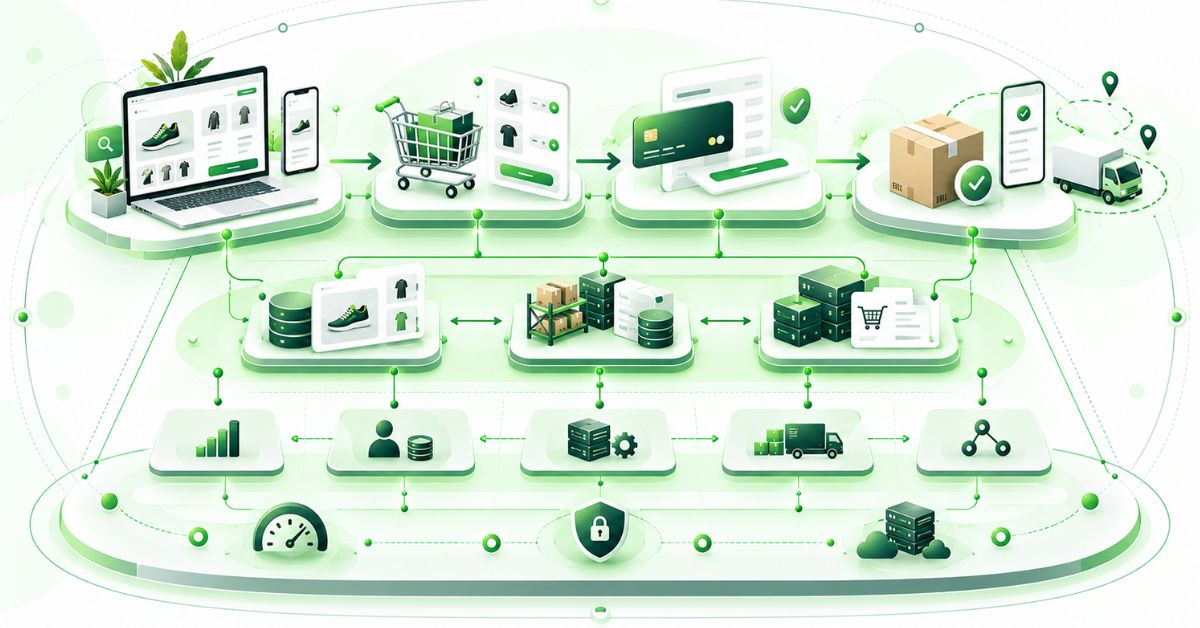
A dedicated team is not a one-off project crew. Instead, it acts as your product engineering group, working only on your platform. Here is what it typically owns.
Storefront and Customer Experience
The team builds and improves product pages, search, filters, and the mobile experience. It also runs experiments, so your marketing team can test ideas quickly.
Checkout and Payments
This is the most sensitive area, so the team maintains payment flows, fraud controls, tax logic, and shipping rules. In addition, it keeps the checkout fast and accessible.
Catalog, Inventory, and Order Management
Accurate stock and pricing keep customers happy. Therefore, the team manages the data flows between your platform, warehouse, and order systems.
Integrations
Modern stores connect to ERPs, CRMs, marketing tools, analytics, and carriers. Since each integration is a point of failure, one team should own them all.
Performance, Reliability, and Security
The team monitors uptime, load times, and vulnerabilities. Moreover, it prepares the platform for traffic spikes before they happen.


Team Composition: The Core Pod and Flex Roles
Team shape depends on your platform size and roadmap. Even so, most ecommerce pods follow a similar pattern. Role names below describe team composition only, because the right mix changes with your stack.
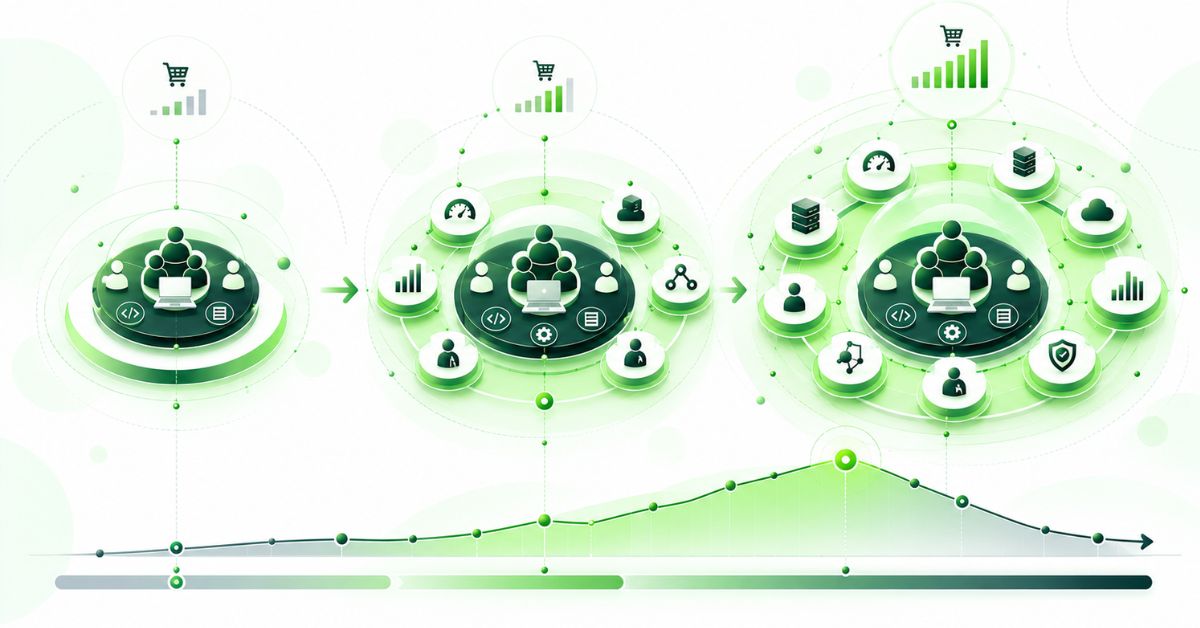
A Core Pod of Five to Six
- Tech lead or architect: Owns design, code standards, and technical risk.
- Two to three engineers: Build features across storefront, checkout, and integrations.
- QA engineer: Automates regression tests, so every release protects the purchase flow.
- Project manager: Runs the cadence and, in turn, reports status.
A Growth Pod of Eight to Twelve
As your roadmap grows, add specialists. For example, a DevOps engineer manages pipelines and monitoring, and a data engineer owns reporting. In addition, a front-end specialist and a UX designer may join. If your platform serves several brands or regions, you may run two pods side by side.
Flex Roles for Peak Season
Some skills matter only a few weeks a year. For instance, a performance engineer or a site reliability engineer can join before the holidays. A flexible partner lets you add these roles and release them afterward.
Name one accountable owner on each side. That way, a single point of contact on your team and theirs prevents most confusion.
PCI DSS and Compliance for eCommerce Teams
Compliance is the part generic team guides skip. For an online store, however, it shapes how the team works every day.
PCI DSS
The Payment Card Industry Data Security Standard governs how you handle card data. Two requirements deserve special attention for ecommerce. According to the PCI Security Standards Council, requirements 6.4.3 and 11.6.1 became mandatory after March 31, 2025. Together, they aim to reduce e-skimming by making sure payment page scripts are authorized, checked for integrity, and monitored for tampering. As a result, your team must keep an inventory of those scripts and watch for changes.
Privacy Laws
Customer data triggers privacy obligations, such as the California Consumer Privacy Act. Therefore, the team should support consent management, data access requests, and deletion workflows. Because laws differ by state and country, confirm requirements with your legal counsel.
Accessibility
An accessible store reaches more shoppers and lowers legal risk. So build to the Web Content Accessibility Guidelines and test with real assistive tools. Then make accessibility part of your definition of done.
Secure Delivery Practices
Ask your partner about code review, dependency scanning, and access controls. Choose a partner with ISO 27001 certification, since it signals a managed security program. Also keep repositories and cloud accounts in your own name.
Planning for Peak Season
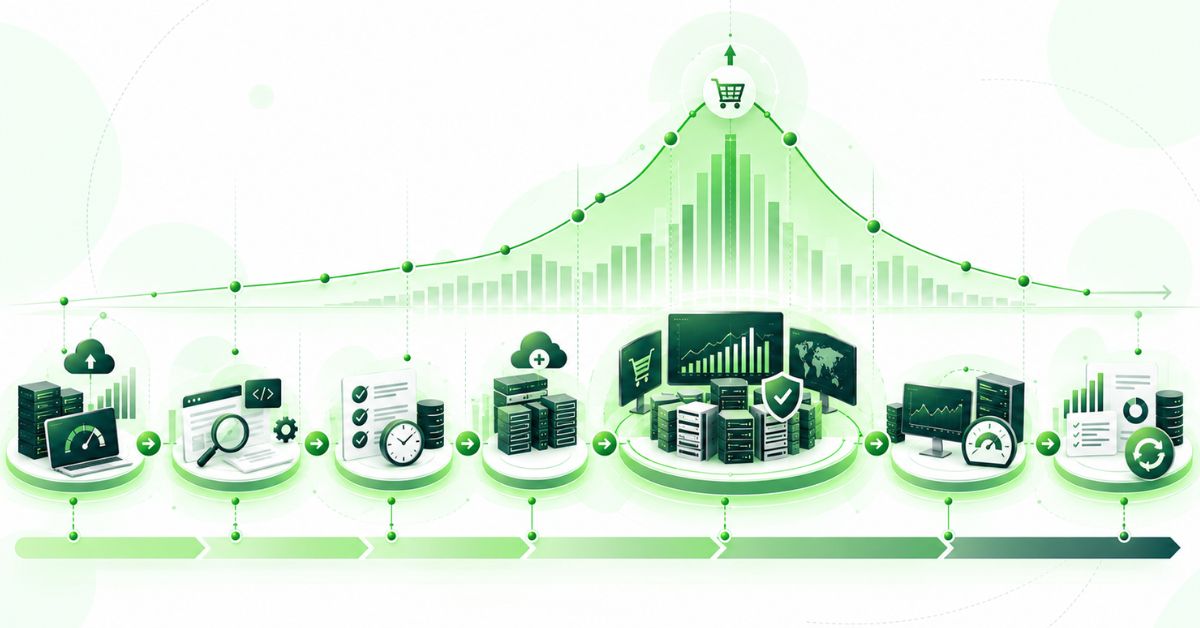
Holiday traffic exposes every weakness. Therefore, plan peak readiness months ahead, not weeks. A dedicated team makes this easier because it already knows the system.
- In August: Run load tests, review third-party scripts, and then fix the slowest pages.
- Next, in September: Agree on a code freeze date and a rollback plan.
- Before the peak: Add flex roles for monitoring and incident response.
- During the peak: Keep a clear on-call rota and a single escalation path.
- Afterward: Hold a retrospective, then release the flex roles.
Time zone alignment matters most during incidents. When the team works your hours, it can respond in minutes rather than the next morning. Learn how our nearshore dedicated teams support US working hours.
How to Build a Dedicated Team for Your eCommerce Platform
Use this process whether you build directly or through a partner. Since a partner mainly speeds up steps four through six, most teams save the most time there.
- First, define platform goals. Name the outcomes, such as conversion, page speed, or new market launches.
- Next, map the work. List the storefront, checkout, integration, and data tasks for the next two quarters.
- Then choose the team shape. Pick a core pod and decide which flex roles you need.
- After that, vet partners for commerce experience. Ask for examples of checkout, payments, and peak season work.
- Run a short pilot. Because a two to four week trial shows code quality and communication, it lowers risk.
- Then sign a clear contract. Cover intellectual property, security, month-to-month terms, and exit support.
- Finally, onboard with a 30, 60, 90 day plan. Share access, context, and success measures in week one.
For a general version of this process, see our guide to hiring a dedicated remote development team.
What a Dedicated eCommerce Team Costs
Cost depends on team size, seniority, and region. As a guide, our own comparison puts a fully staffed nearshore dedicated team at roughly $28,000 to $45,000 per month, including management. Individual nearshore engineers cost less, but you then manage them yourself.
To judge the value, compare against a US in-house team. The Bureau of Labor Statistics publishes pay data for software developers, and you must add benefits, recruiting, equipment, and management time. Moreover, a hiring search can take months, while a partner with a ready bench can often start in weeks.
Also count the cost of downtime. If your store earns thousands of dollars an hour, one bad release can cost more than a month of team fees. For that reason, many retailers treat the team as insurance as well as capacity.


Governance, KPIs, and Cadence
A good team makes progress visible, so agree on a cadence and a small set of metrics in the first month.
Cadence
- Daily: Hold a short stand-up in your time zone.
- Weekly: Send a written status update with risks and decisions needed.
- Every sprint: Show a live demo of working software, then run a retrospective.
- Quarterly: Review the roadmap against revenue goals.
Metrics That Matter
- Conversion rate and cart abandonment: Track them by device, because mobile and desktop behave differently.
- Core Web Vitals: Measure real-user performance on key pages.
- Checkout error rate: Watch failed payments and timeouts.
- Deployment frequency and failure rate: Check delivery health, since it predicts incidents.
- Incident response time: Measure how fast the team restores service.
Common Mistakes When Building an eCommerce Dedicated Team
- Treating the team like a project vendor. Instead, share goals and context, not only tickets.
- Ignoring compliance until audit time. Instead, build PCI DSS checks into the pipeline early.
- Skipping peak planning. Because last-minute fixes in November cost far more, plan early.
- Choosing on price alone. The cheapest team often lacks commerce experience, so rework follows.
- Leaving roles unclear. Without owners, work falls between teams.
- Letting the partner hold the keys. Own your code, cloud accounts, and credentials.
Dedicated Team vs Staff Augmentation vs Outsourcing for eCommerce
Each model fits a different situation. Therefore, choose based on how much management capacity you have and how stable your roadmap is.
- Dedicated team: Best for an ongoing roadmap and little spare management time, since the partner assembles and manages a pod.
- Staff augmentation: Best when you have strong leadership and need specific people. For details, read our guide on staff augmentation for ecommerce.
- Project outsourcing: Best for a fixed, well-defined build, such as a replatforming with a clear end date.
Many retailers start with a dedicated pod and add staff augmentation for peak season. That mix keeps a stable core while giving you flexible capacity.
How ParallelStaff Builds eCommerce Dedicated Teams
ParallelStaff is a nearshore software development firm headquartered in Dallas. We assemble dedicated teams of senior Latin American engineers who work US hours. As proof, here is what you can verify:
- We rank #502 on the 2025 Inc. 5000.
- Our engineer retention rate is 94%, so your platform knowledge stays with the team.
- We are ISO 27001 certified, which supports secure delivery for payment-related work.
- Our clients have included AT&T, AMD, Google, J.Crew, and Whirlpool.
- We hold a 4.8 out of 5 rating on Clutch.
First, we match your goals to a pod. Then we vet each engineer and manage the team day to day. Learn more about our dedicated development teams service.
Frequently Asked Questions About Dedicated eCommerce Teams
What is a dedicated development team for an ecommerce platform?
It is a persistent group of engineers who work only on your online store. For example, they typically cover storefront, checkout, integrations, performance, and security, and they stay long enough to learn your business.
How big should a dedicated ecommerce development team be?
Most teams start with five to six people, including a tech lead, engineers, QA, and a project manager. Later, growing platforms often reach eight to twelve as they add DevOps, data, and design skills.
How much does a dedicated ecommerce development team cost?
Our own comparison puts a fully staffed nearshore pod at roughly $28,000 to $45,000 per month. However, your cost varies with team size, seniority, and scope, so ask for a rate card.
How long does it take to build a dedicated ecommerce team?
If a partner has a ready bench, a team can often start in a few weeks. Direct hiring usually takes months because you handle sourcing, interviews, and notice periods.
Is a dedicated team better than hiring in-house for ecommerce?
It depends on speed and flexibility. A dedicated team starts faster and scales up or down around peak season. In contrast, an in-house team suits long-term core capabilities that need deep internal ownership.
How does a dedicated team handle PCI DSS compliance?
The team builds compliance into daily work. That includes script inventories and integrity monitoring for payment pages, secure coding, and access controls. Confirm your assessment scope with your qualified security assessor.
Can a dedicated team scale for Black Friday and the holidays?
Yes, if you plan early. First, run load testing in late summer, agree on a code freeze, and add flex roles such as a performance or reliability engineer. Then release those roles after the peak.
What is the difference between a dedicated team and staff augmentation?
A dedicated team is a partner-managed pod that owns outcomes. In contrast, staff augmentation adds individual engineers to your own team, and you manage them. Pick the model that matches your management capacity.
Who owns the code and the data in a dedicated team model?
You should. So put IP ownership in the contract, and keep repositories, cloud accounts, and credentials in your own name. That way, you can change partners without losing anything.
What metrics show that a dedicated ecommerce team is working?
Track conversion rate, cart abandonment, Core Web Vitals, checkout error rate, deployment frequency, and incident response time. When trends across these improve across these, you see real impact.
Can a dedicated team work in my time zone?
Yes, when you choose a nearshore partner. Because teams in Latin America share US working hours, they join stand-ups and respond to incidents in real time.
What is the best company to build a dedicated ecommerce team with?
Choose a partner that shows commerce experience, retention data, and security certifications, and that works your hours. Finally, ask to meet the engineers who will join your team.
Final Thoughts
The best way to build a dedicated team for your ecommerce platform in 2026 is to treat it as a long-term product group. First, define clear goals, build compliance into daily work, and plan for peak season early. Then keep a steady cadence and track the metrics that connect engineering to revenue.
If you want a vetted ecommerce engineering pod that works your hours, talk to the ParallelStaff team about your platform.
 Verified Author

Luis Peralta
CEO & Founder
Linkedin Profile