

In this article
TL;DR: The top IT staff augmentation companies in 2026 fall into five types: nearshore specialists, global offshore IT firms, freelance marketplaces, traditional IT staffing agencies, and niche specialty firms. For most U.S. product teams, a nearshore specialist offers the best balance of senior talent, time zone overlap, and cost. The best way to compare providers is a scorecard built on vetting depth, retention, time zone fit, security, and contract flexibility, not brand size or hourly rate.
The best IT staff augmentation companies share a few traits. They vet engineers rigorously, keep them for years, protect your IP, and place people who can work inside your sprints from week one. For most U.S. technology teams in 2026, the companies that do this best are nearshore specialists that recruit senior engineers in Latin America.
Rather than rank a list of vendors whose data you cannot verify, this guide does something more useful. It breaks down the five types of IT staff augmentation companies, explains when each one fits, and gives you an 8-point scorecard to rank any provider yourself.
What IT Staff Augmentation Companies Actually Do
IT staff augmentation companies add pre-vetted engineers to your existing team. The engineers work under your management, join your standups, and commit to your repositories. Meanwhile, the provider handles sourcing, technical vetting, payroll, benefits, and local compliance.
That makes staff augmentation different from project outsourcing. With outsourcing, the vendor owns delivery. With staff augmentation, you keep control of the roadmap and simply gain capacity. If you want a refresher on the model itself, ParallelStaff’s complete guide to staff augmentation covers it end to end.
Why Demand for IT Staff Augmentation Companies Is Growing in 2026
Three forces are pushing U.S. engineering leaders toward augmentation partners in 2026.
Domestic hiring is expensive. The U.S. Bureau of Labor Statistics reports a median software developer wage of $135,980 as of May 2025. It also projects roughly 106,100 openings for developers, QA analysts, and testers every year through 2035. As a result, competition for senior engineers stays intense.
Budgets are growing, but under pressure. Gartner’s July 2026 forecast puts worldwide IT spending at $6.37 trillion this year, up 14.2%. Yet Gartner also notes that inflation, supply shortages, and AI investments are straining technology budgets. Teams need more output per dollar.
Buyers want skills, not just savings. Deloitte’s 2024 Global Outsourcing Survey of more than 500 executives found that skilled talent and agility now sit alongside cost reduction as key outsourcing drivers. Consequently, the best IT staff augmentation companies compete on engineer quality, not headcount.

The 5 Types of IT Staff Augmentation Companies
Most providers fit into one of five categories. Each type is strong in different situations, so start by deciding which type fits your needs before you compare individual vendors.
1. Nearshore staff augmentation specialists
These firms recruit engineers in Latin America and place them with U.S. teams. Because the engineers work zero to three hours from U.S. time zones, they join standups, code reviews, and incident calls in real time. The best nearshore specialists also invest heavily in English screening and retention.
Best for: U.S. product teams running agile sprints that need senior engineers fast. Watch for: small firms with thin benches that cannot replace an engineer quickly.
2. Global offshore IT service firms
These are large providers with delivery centers in India, Southeast Asia, or Eastern Europe. They offer enormous scale and broad service catalogs, often at the lowest hourly rates.
Best for: large, well-documented programs that can run asynchronously. Watch for: time zone gaps of six to thirteen hours, rotating staff, and less direct control over who works on your code.
3. Freelance talent marketplaces
Marketplaces connect you with independent contractors, often within days. You get flexibility and a wide choice of profiles.
Best for: short, well-scoped tasks and one-off specialist needs. Watch for: uneven vetting, limited accountability, and contractors who juggle several clients at once.
4. Traditional IT staffing agencies
Domestic staffing agencies recruit U.S.-based contractors and contract-to-hire candidates. They know local markets and can handle on-site roles.
Best for: roles that must be U.S.-based or on-site, such as certain regulated or government work. Watch for: U.S.-level rates plus agency markups, and recruiters who may not evaluate engineering depth.
5. Niche specialty firms
Boutique providers focus on one domain, such as Salesforce, SAP, cybersecurity, or data engineering. They go deep rather than wide.
Best for: hard-to-find platform skills. Watch for: limited capacity when you need to scale beyond their specialty.
| Provider type | Time zone fit | Relative cost | Vetting depth | Best for |
|---|---|---|---|---|
| Nearshore specialist | Excellent | Medium | High (varies by firm) | Agile product teams |
| Global offshore firm | Limited | Low | Medium | Large asynchronous programs |
| Freelance marketplace | Varies | Varies | Low to medium | Short, scoped tasks |
| U.S. staffing agency | Excellent | High | Varies | On-site or U.S.-only roles |
| Niche specialty firm | Varies | Medium to high | High in one domain | Rare platform skills |


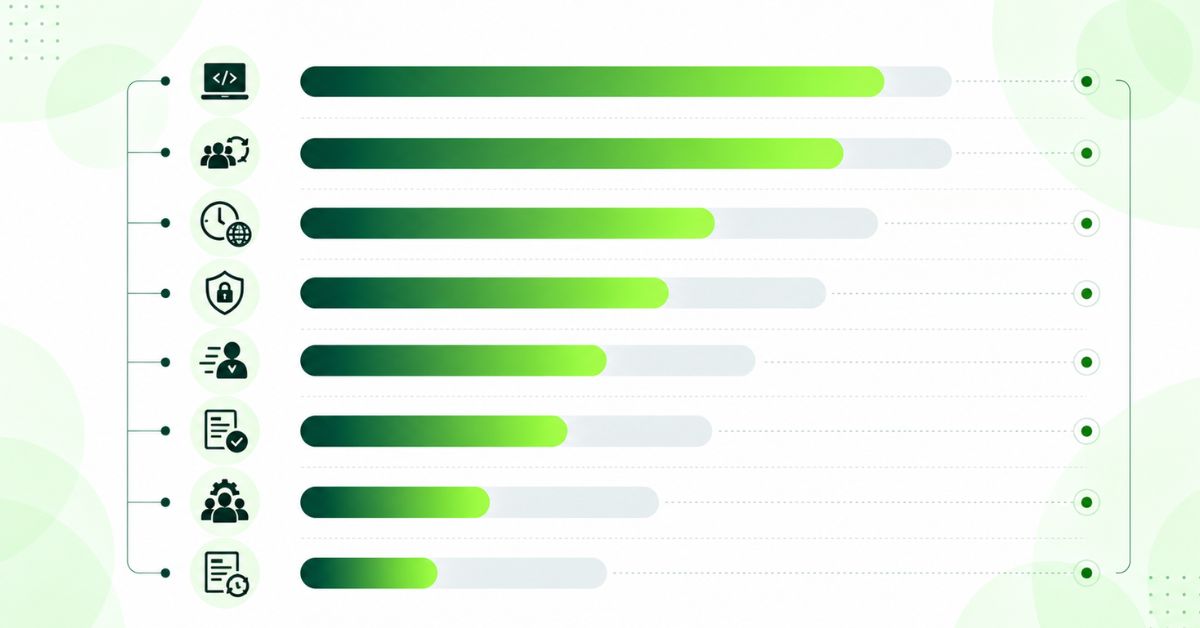
How to Rank IT Staff Augmentation Companies: An 8-Point Scorecard
Brand size and hourly rate are poor predictors of success. Instead, score each provider from 1 to 5 on the eight criteria below. Then weight them by what matters most to your team.
1. Vetting depth
Ask what percentage of applicants the provider accepts and what the screening includes. Strong answers mention live coding, system design interviews, and English evaluation. Weak answers stop at “we check resumes.”
2. Engineer retention
Turnover quietly destroys the value of augmentation, because every departure resets weeks of context. Ask for the provider’s retention rate and how it measures it. A rate above 90% is a strong signal.
3. Time zone overlap
Overlap affects output more than most buyers expect. Harvard Business School researchers studied 250 offices of one multinational across 48 countries. They found that losing just one or two shared business hours cut communication by 9.2% on average. Therefore, prioritize providers whose engineers share most of your workday.
4. Speed to placement
Ask how long it takes to present vetted candidates and to get an engineer started. Providers with an active bench can usually move in days. Providers that recruit from scratch take weeks.
5. Security and compliance
Look for ISO 27001 certification or an equivalent standard, role-based access, NDAs, and a written clause that transfers all IP to you. This matters most when engineers touch production systems or customer data.
6. Integration model
Great engineers still fail inside a poor structure. A July 2026 Harvard Business Review analysis argues that global collaboration problems usually come from organizational design, not culture. So ask how the provider helps engineers join your tools, rituals, and decision-making.
7. Contract flexibility
Month-to-month terms, no conversion fees, and a clear replacement guarantee signal a provider that earns renewals through results. Long mandatory commitments signal the opposite.
8. Verified client proof
Third-party reviews on platforms like Clutch and referenceable enterprise clients are harder to fake than a sales deck. Ask to speak with a current client whose team resembles yours.
| Criterion | What good looks like | Suggested weight |
|---|---|---|
| Vetting depth | Accepts fewer than 10% of applicants | 20% |
| Engineer retention | Above 90%, measured transparently | 20% |
| Time zone overlap | Most of your workday shared | 15% |
| Speed to placement | Candidates in days, start within two weeks | 10% |
| Security and compliance | ISO 27001 or equivalent, full IP transfer | 15% |
| Integration model | Engineers embedded in your tools and rituals | 5% |
| Contract flexibility | Month-to-month, replacement guarantee | 5% |
| Verified client proof | Strong third-party reviews, live references | 10% |
For a deeper walkthrough of the vetting conversation, see ParallelStaff’s guide on how to vet IT staff augmentation companies before you sign.
Red Flags When Evaluating IT Staff Augmentation Companies
- No retention number. If a provider cannot quantify retention, it probably does not track it.
- Bulk resume dumps. Twenty unscreened profiles signal a recruiter, not a partner.
- Conversion fees and lock-in. Penalties for hiring your engineer or leaving early protect the vendor, not you.
- Vague security answers. “We take security seriously” is not a control framework.
- Account managers as gatekeepers. You should talk directly with your engineers, not through a relay.
Which Type of Provider Fits Your Team?
Match the provider type to your situation. If you run agile sprints and need senior engineers who collaborate live, choose a nearshore specialist. If your work is large, well documented, and asynchronous, a global offshore firm may fit. For a one-off specialist task, a marketplace can work. For on-site or U.S.-only roles, use a domestic agency.
Also confirm that staff augmentation is the right model at all. If you lack the management bandwidth to direct more engineers, a dedicated team or project outsourcing may serve you better. ParallelStaff’s comparison of staff augmentation solutions explains the trade-offs, and its staff augmentation ROI guide shows how to build the business case.


Featured: How ParallelStaff Scores Against the Scorecard
ParallelStaff is a Dallas-based nearshore specialist that places senior Latin American engineers with U.S. technology teams. Here is how it maps to the eight criteria above:
- Vetting depth: only the top 5% of applicants pass a process that includes technical assessments, live interviews, system design reviews, and English evaluation.
- Retention: a 94% engineer retention rate, so the context your team builds stays with your team.
- Time zone overlap: engineers work U.S. hours and join your standups and sprints from week one.
- Speed: a network of 10,000+ pre-vetted engineers, with most roles going from shortlist to onboarded in 5 to 10 days.
- Security: ISO 27001 certification, ITIL 4-aligned service delivery, and full IP ownership for clients.
- Integration: direct access to your engineers, plus monthly business reviews and biweekly syncs.
- Flexibility: month-to-month engagements with no conversion fees.
- Proof: ranked #502 on the 2025 Inc. 5000, a 4.8/5 Clutch rating, and enterprise clients including AT&T, AMD, Google, J.Crew, and Whirlpool.
Explore ParallelStaff’s IT staff augmentation services or its nearshore staff augmentation model to see how an engagement works.
Frequently Asked Questions About IT Staff Augmentation Companies
What are the top IT staff augmentation companies in 2026?
The top providers are the ones that combine rigorous vetting, high engineer retention, strong security, and real-time collaboration. For most U.S. product teams, nearshore specialists that recruit senior engineers in Latin America meet those criteria best.
What is the best IT staff augmentation company for a U.S. startup?
Startups usually need senior engineers quickly and flexible terms. Look for a nearshore specialist with month-to-month contracts, a replacement guarantee, and engineers who can start within two weeks.
How do IT staff augmentation companies differ from staffing agencies?
Traditional staffing agencies mainly recruit and place candidates. IT staff augmentation companies also vet technical depth, manage payroll and compliance, and support engineers throughout the engagement.
How much do IT staff augmentation companies charge?
Most charge a monthly or hourly rate per engineer. Rates depend on seniority, stack, and location. Nearshore engineers typically cost 40 to 60% less than equivalent U.S. hires on a fully loaded basis.
Are nearshore IT staff augmentation companies better than offshore ones?
For agile teams that need live collaboration, usually yes. Nearshore engineers share most of the U.S. workday, while offshore teams often work six to thirteen hours apart.
How fast can an IT staff augmentation company place an engineer?
Providers with an active bench can present candidates within days and onboard engineers in one to two weeks. ParallelStaff typically moves from shortlist to onboarded in 5 to 10 days.
What retention rate should I expect from a staff augmentation partner?
Aim for a provider with engineer retention above 90%. Lower retention means repeated onboarding costs and lost institutional knowledge.
Do IT staff augmentation companies protect my intellectual property?
Reputable ones do. Confirm ISO 27001 or equivalent certification, NDAs, access controls, and a contract clause that transfers all code and IP to your company.
Can I hire just one engineer through a staff augmentation company?
Yes. Many companies start with a single engineer to test the model, then scale to a larger team once results are proven.
What questions should I ask IT staff augmentation companies before signing?
Ask about acceptance rate, retention rate, time to placement, security certifications, IP ownership, replacement policy, contract terms, and client references.
When is staff augmentation the wrong choice?
If your team lacks the bandwidth to manage more engineers, or you need a vendor to own a full project, a dedicated team or project outsourcing usually fits better.
The right IT staff augmentation partner is not the biggest name or the cheapest rate. It is the one that scores highest on the criteria your team cannot compromise. Use the scorecard, ask for real numbers, and choose the partner that can prove them.
 Verified Author

ParallelStaff