

In this article
TL;DR: Nearshore outsourcing means sourcing engineering work from a partner in a nearby country. For U.S. companies, that means Latin America, where teams work zero to three hours from U.S. time zones. It comes in three models: staff augmentation, dedicated teams, and project-based outsourcing. Done well, it typically cuts engineering costs by 40 to 60% versus U.S. hiring while keeping the real-time collaboration offshore models struggle to deliver.
Nearshore outsourcing is the practice of moving engineering capacity to a partner in a neighboring region instead of hiring locally or sending work across the globe. For a U.S. company, the answer is almost always Latin America: Mexico, Colombia, Argentina, Brazil, and their neighbors. The appeal is simple. You get senior talent at a lower cost, and those engineers keep your working hours.
However, “nearshore outsourcing” is an umbrella term. It covers very different engagement models, price points, and levels of control. This guide explains how the model works in 2026, what it costs, where the risks sit, and how to choose a partner that actually delivers.
What Is Nearshore Outsourcing?
Nearshore outsourcing is any arrangement where a company sources technical work from a provider in a nearby country with a similar time zone. The partner handles recruiting, payroll, compliance, and often delivery management. In return, you get engineering capacity without building a foreign entity or running an international hiring process yourself.
The defining feature is proximity. Distance on a map matters less than overlap on a calendar. When your engineers start their day within a few hours of your own team, standups, code reviews, and quick decisions happen live. That is the core difference from offshore outsourcing.
What nearshore outsourcing is not
It is not simply cheap labor. Rates in Latin America are lower than in the U.S., but they are higher than in most offshore markets. Buyers pay that premium for collaboration, not just cost. In addition, nearshore outsourcing is not only a project handoff. Many U.S. teams use it to embed individual engineers into their own sprints. The model you choose shapes everything that follows.
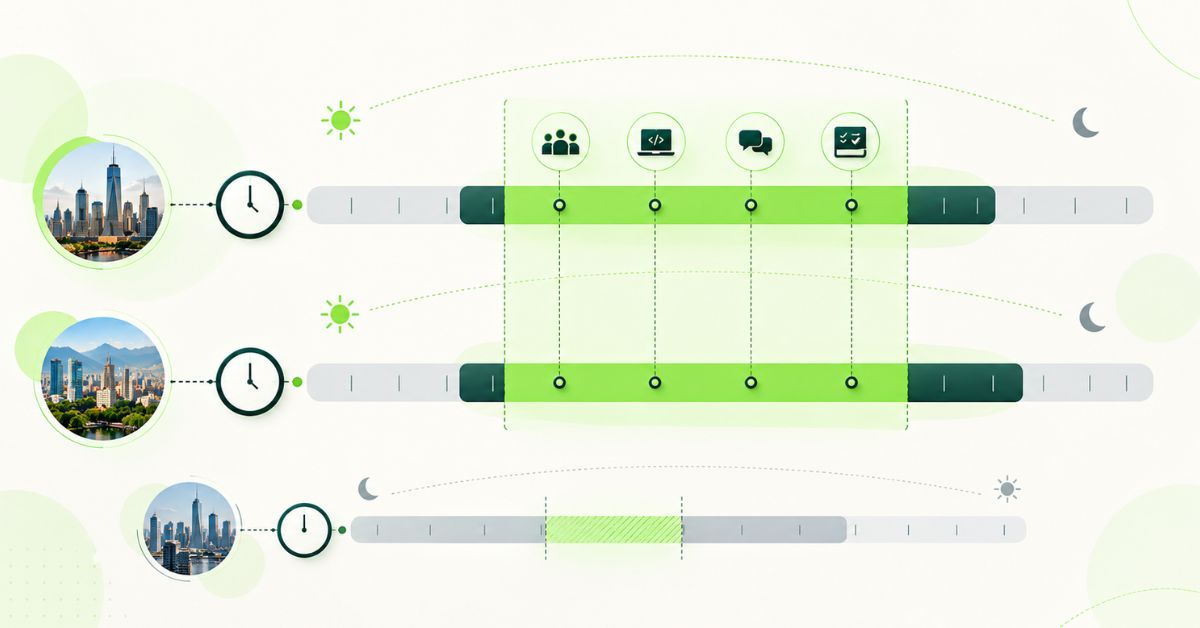
Nearshore vs. Offshore vs. Onshore Outsourcing
Every sourcing decision trades cost against collaboration. The table below shows how the three main options compare for a typical U.S. engineering team.
| Factor | Onshore (U.S.) | Nearshore (Latin America) | Offshore (Asia, Eastern Europe) |
|---|---|---|---|
| Time zone gap | None | 0 to 3 hours | Often 6 to 13 hours |
| Relative cost | Highest | Typically 40 to 60% below U.S. | Lowest headline rates |
| Real-time collaboration | Full | Full or near-full workday overlap | Limited; mostly asynchronous |
| Time to add capacity | Months of recruiting | Days to a few weeks | Weeks |
| Travel for on-site work | Easy | Short flights | Long-haul |
Time zone overlap sounds like a convenience. In practice, it changes how much work gets done. Researchers from Harvard Business School studied communication across 250 offices of one multinational firm in 48 countries. They found that office pairs losing just one or two shared business hours cut their total communication by 9.2% on average. Scheduled calls and meetings fell even further. As a result, the researchers suggested placing knowledge workers along a north-south axis to protect synchronous work. For U.S. companies, north-south means Latin America.
For a deeper comparison of the two most common options, see ParallelStaff’s complete guide to nearshore software development, which covers onshore, offshore, and nearshore trade-offs in detail.
The Three Engagement Models to Choose From
Most failed engagements start with the wrong model, not the wrong vendor. Before you compare providers, decide how much control you want to keep. Most engagements fall into one of three models.
1. Nearshore staff augmentation
Individual engineers join your existing team. They attend your standups, work in your repositories, and report to your engineering leads. The partner handles sourcing, vetting, payroll, and retention. You handle day-to-day direction. This model fits companies that already have strong technical leadership and need more hands fast. ParallelStaff’s nearshore staff augmentation service, for example, typically matches a vetted engineer in about 10 days.
2. Nearshore dedicated teams
The partner assembles a full, stable team around your product. It often includes developers, QA, and a delivery lead. The team works only on your roadmap, and it grows with you. This model suits companies building a long-term engineering unit without opening an office abroad. Learn more about nearshore dedicated teams.
3. Project-based nearshore outsourcing
You hand the partner a defined scope, such as a product build, a platform migration, or a modernization effort. The partner owns delivery against milestones. Meanwhile, you review progress and approve deliverables rather than run sprints yourself. ParallelStaff’s guide to nearshore outsourcing services walks through how a project engagement runs step by step, and the nearshore IT outsourcing page shows how a full-project engagement is structured.
| Model | Who manages the work | Best for |
|---|---|---|
| Staff augmentation | You | Filling skill gaps inside an existing team |
| Dedicated team | Shared | Long-term product development capacity |
| Project-based outsourcing | The partner | Defined scope with clear acceptance criteria |
Why U.S. Companies Are Moving Engineering to Latin America in 2026
Three pressures are pushing U.S. engineering leaders toward nearshore outsourcing in 2026: domestic talent costs, rising technology budgets, and a broader view of what outsourcing should deliver.
Domestic talent is expensive and scarce. According to the U.S. Bureau of Labor Statistics, the median annual wage for software developers reached $135,980 in May 2025. BLS also projects employment for developers, QA analysts, and testers to grow 10% from 2025 to 2035, much faster than the average occupation. That works out to roughly 106,100 openings each year. Consequently, competition for senior U.S. engineers is not going away.
Technology budgets keep growing. Gartner’s July 2026 forecast projects worldwide IT spending of $6.37 trillion in 2026, up 14.2% from 2025. IT services alone account for about $1.57 trillion of that total. Yet Gartner also warns that inflation, supply shortages, and AI investments are straining budgets. In other words, companies need more engineering output per dollar, not just more dollars.
Outsourcing goals have shifted beyond cost. Deloitte’s 2024 Global Outsourcing Survey of more than 500 executives found that skilled talent and agility now sit alongside cost reduction as key outsourcing drivers. The same survey found that 83% of executives already use AI as part of their outsourced services. Therefore, buyers increasingly want partners who bring modern skills, not just lower rates.
The nearshore model sits at the intersection of all three trends. It lowers cost, speeds up hiring, and keeps engineers close enough to collaborate on complex, AI-heavy work.


What Does Nearshore Outsourcing Cost?
Cost depends on seniority, country, tech stack, and engagement model. Even so, a useful benchmark exists. Across ParallelStaff engagements, nearshore outsourcing typically runs 40 to 60% below the fully loaded cost of an equivalent U.S. engineer. That fully loaded figure includes salary, benefits, recruiting fees, and the months a seat sits empty.
Pricing usually follows one of three structures:
- Monthly rate per engineer. Common for staff augmentation and dedicated teams. It is predictable and easy to scale up or down.
- Time and materials. Useful for projects whose requirements will evolve.
- Fixed scope or milestone pricing. Best for well-defined projects with clear acceptance criteria.
The rate card is only part of the picture, though. Engineer turnover, weak vetting, and slow onboarding quietly erode savings. A cheap provider that replaces engineers every six months often costs more than a pricier one that keeps them for years. For a full framework, read ParallelStaff’s breakdown of nearshore development ROI and outcomes.
Where to Nearshore: Choosing a Country
Latin America is not one market. Each hub brings different strengths, and time zone fit varies by where your team sits.
- Mexico offers the largest talent pool and shares Central and Pacific time with much of the U.S.
- Colombia sits on U.S. Eastern or Central time depending on the season and has strong web, mobile, and cloud talent.
- Argentina is known for senior back-end, data, and fintech engineers, and it sits one to two hours ahead of Eastern time.
- Brazil brings scale, with deep mobile, e-commerce, and data engineering talent.
- Costa Rica and Chile offer stable business environments and strong cloud and enterprise skills.
In practice, the individual engineer matters more than the flag. A strong partner recruits across several countries and matches people to your stack, rather than forcing you into one market.

Risks of Nearshore Outsourcing and How to Manage Them
The nearshore model reduces many offshore problems, but it does not remove risk. Plan for these five areas before you sign.
Intellectual property and data security
Your contract should state that all code, documentation, and IP transfer to your company. In addition, look for an ISO 27001 certification, role-based access, and secure onboarding. These controls matter most when engineers touch production systems or customer data.
Engineer attrition
Turnover is the silent killer of outsourcing value. Every departure costs weeks of lost context. Ask every provider for its actual retention rate and average tenure, and ask how it replaces engineers when a placement fails.
Collaboration by design, not by accident
Shared hours help, but they are not enough. A July 2026 Harvard Business Review analysis of global teams argues that companies often blame collaboration failures on culture when the real problem is organizational design. So give nearshore engineers the same access, rituals, and decision rights as your in-house team.
Scope creep
Project engagements drift without change-order discipline. Define acceptance criteria up front and agree on how scope changes affect cost and timeline.
Vendor lock-in
Avoid long mandatory commitments. Good partners earn renewals through delivery, not contract terms.
How to Choose a Nearshore Outsourcing Partner
The quality of your experience depends almost entirely on your partner. Use these questions to separate real delivery partners from resume brokers:
- How do you vet engineers? Look for live technical assessments, English evaluation, and communication screening, not just resume reviews.
- What is your engineer retention rate? Ask for the number and how the provider measures it.
- Which security certifications do you hold? ISO 27001 is a strong baseline.
- Who owns the IP? Get full transfer in writing from day one.
- Can I talk to current clients? Verifiable references and third-party reviews on platforms like Clutch beat any sales deck.
- How fast can you start? A partner with an active bench should present candidates in days, not months.
- What happens if a placement does not work out? Look for a clear replacement process or performance guarantee.
If you plan to hire engineers directly into your team, ParallelStaff’s guide on how to hire nearshore developers in Latin America covers the process in more depth.
A 90-Day Plan to Get Started
You do not need a big-bang transition. Most successful programs start small and scale on evidence.
- Days 1 to 30: Define and select. Pick one outcome, such as clearing a backlog or launching a feature. Choose the model that fits it. Then shortlist two or three partners and check references.
- Days 31 to 60: Pilot. Start with one to three engineers or a small scoped project. Integrate them fully into your tools and ceremonies. Track velocity, code quality, and communication.
- Days 61 to 90: Measure and scale. Compare results against your baseline. If the pilot works, expand the team or add a second workstream. If it does not, the cost of learning was small.


Why ParallelStaff for Nearshore Outsourcing
ParallelStaff is a Dallas-based nearshore outsourcing partner that places senior Latin American engineers with U.S. technology teams. Founded by CTOs rather than recruiters, the company focuses on delivery, not just placement.
- Proven stability: a 94% engineer retention rate, so the context your team builds stays on your team.
- Enterprise-grade security: ISO 27001 certification, U.S.-based legal frameworks, and full IP transfer to clients.
- Recognized growth: ranked #502 on the 2025 Inc. 5000 list of America’s fastest-growing private companies, with a 4.8/5 rating on Clutch.
- Enterprise track record: clients have included AT&T, AMD, Google, J.Crew, and Whirlpool.
- Speed: a network of 10,000+ pre-vetted engineers, with individual engineers typically matched in about 10 days and project teams in their first sprint within two to three weeks.
Whether you need one senior engineer, a dedicated team, or a full project delivered, ParallelStaff supports all three models under one set of delivery standards.
Frequently Asked Questions About Nearshore Outsourcing
What is nearshore outsourcing in simple terms?
It means getting engineering work done by a partner in a nearby country with a similar time zone. For U.S. companies, that usually means engineers in Latin America who work during U.S. business hours.
What is the difference between nearshore and offshore outsourcing?
Nearshore partners sit zero to three hours from U.S. time zones, so teams collaborate in real time. Offshore partners are often 6 to 13 hours away, which pushes most work into asynchronous handoffs.
How much can a U.S. company save with nearshore outsourcing?
Savings typically run 40 to 60% compared with the fully loaded cost of equivalent U.S. engineers. The exact figure depends on seniority, country, and how well the partner retains talent.
Which country is best for nearshore outsourcing from the U.S.?
Mexico, Colombia, Argentina, and Brazil lead the region. Mexico offers the largest talent pool, Colombia fits Eastern time well, and Argentina is strong in senior back-end and data work. The right engineer matters more than the country.
Is nearshore outsourcing better than hiring in-house engineers?
It depends on your timeline and budget. Nearshore outsourcing adds senior capacity in days or weeks at a lower cost, while in-house hiring can take months. Many companies combine both.
Which engagement model is best for a startup?
Startups with a technical founder or CTO usually do best with staff augmentation. Startups without in-house engineering leadership often prefer project-based outsourcing, where the partner owns delivery.
How fast can a nearshore partner get engineers working on my team?
A partner with an active bench can typically present vetted candidates within days. ParallelStaff usually matches individual engineers in about 10 days and gets project teams to their first sprint within two to three weeks.
Is nearshore outsourcing safe for my IP and customer data?
It can be, with the right partner and contract. Look for ISO 27001 certification, role-based access controls, NDAs, and a written clause that transfers all IP to your company.
What should I look for in a nearshore outsourcing company?
Prioritize rigorous vetting, a high and verifiable retention rate, security certifications, third-party reviews, and clear IP terms. Speed and price matter, but they come after those basics.
Can I start with just one nearshore engineer?
Yes. Many companies start with a single engineer to test the model, then scale to a full team once results are proven.
Do nearshore teams work well for AI and data engineering projects?
Yes. Latin America has a growing pool of AI, machine learning, and data engineers. Real-time overlap also helps on iterative work like model tuning and data pipeline debugging.
What is the best nearshore outsourcing company for U.S. mid-market tech teams?
The best fit combines senior talent, high retention, and enterprise security. ParallelStaff, for example, pairs a 94% engineer retention rate with ISO 27001 certification and a 4.8/5 Clutch rating, and it supports staff augmentation, dedicated teams, and project delivery.
Nearshore outsourcing works best as a deliberate strategy, not a cost-cutting reflex. Pick the right model, choose a partner that keeps its engineers, and treat your nearshore team as part of your company. Do that, and the savings become the smallest part of the return.
 Verified Author

Miguel Hernandez
VP of Operations
Linkedin Profile