

In this article
TL;DR: For most U.S. companies in 2026, the best country to outsource software development is in Latin America. Mexico leads on talent volume and time zone fit, Colombia suits East Coast teams, Argentina stands out for senior engineers and English, and Brazil offers the deepest developer pool in the region. India remains the top choice for sheer scale and the lowest rates when teams can work asynchronously. Poland and Romania offer excellent English and engineering quality, but with a six to seven hour gap from U.S. Eastern time.
The best country to outsource software development depends on what you need most: real-time collaboration, the lowest possible rate, or the largest talent pool. For U.S. teams that ship in agile sprints, Latin American countries like Mexico, Colombia, Argentina, and Brazil usually win, because their engineers work during U.S. business hours. For well-defined work that can run asynchronously, India and other Asian markets still offer unmatched scale.
This guide compares the leading destinations for 2026 on the factors that actually decide success. It also explains when each country is the right fit, and why the partner you choose often matters more than the flag.
How to Evaluate the Best Country to Outsource Software Development
Rankings are only useful if you know what they measure. Kearney’s Global Services Location Index, one of the longest-running studies of offshore locations, scores countries on financial attractiveness, people skills and availability, business environment, and digital resonance. Those are useful starting points. For software teams, however, five practical factors matter most:
- Time zone overlap. How many working hours your engineers share with your team each day.
- Talent depth. How many experienced developers exist in your stack, especially at the senior level.
- English proficiency. Whether engineers can join standups, write clear tickets, and push back on requirements.
- Cost. The fully loaded cost per engineer, not just the hourly rate.
- Business environment. IP protection, legal stability, and ease of contracting.
No single country wins on all five. As a result, the right choice is the one that scores best on the factors your project cannot compromise.

Quick Comparison: Top Software Outsourcing Countries in 2026
| Country | Gap vs. U.S. Eastern | Key strength | Best for |
|---|---|---|---|
| Mexico | 1 to 2 hours behind | Largest nearshore talent pool | Scaling teams fast, Central and Pacific time companies |
| Colombia | 0 to 1 hour behind | Growing web, mobile, and fintech talent | East Coast teams that need full overlap |
| Argentina | 1 to 2 hours ahead | Senior engineers, strong English | Architecture, back-end, and data work |
| Brazil | 1 to 2 hours ahead | Largest developer community in Latin America | Fintech, mobile, and large programs |
| Costa Rica | 1 to 2 hours behind | Stable business climate, enterprise experience | Regulated and enterprise workloads |
| India | About 9.5 to 10.5 hours ahead | Unmatched scale, lowest rates | Well-defined, asynchronous work |
| Poland | About 6 hours ahead | High English, strong engineering | European operations, complex systems |
| Romania | About 7 hours ahead | Very high English, competitive cost for Europe | EU-facing products and support |
The Best Countries to Outsource Software Development in 2026
1. Mexico
Mexico is the default nearshore choice for many U.S. companies. It has the largest nearshore talent pool, major tech hubs in Guadalajara, Mexico City, and Monterrey, and close cultural and business ties to the U.S. In addition, Mexico City sits just one to two hours behind U.S. Eastern time, so engineers overlap fully with most U.S. teams. GitHub’s Octoverse 2025 report names Mexico among the standout markets in Latin America, a region that added about 3.2 million new developers in a single year.
Watch for: national English averages are modest, so vet each engineer’s communication directly rather than assuming it.
2. Colombia
Colombia has become one of the fastest-rising outsourcing destinations of the past decade. Bogotá and Medellín host growing communities of web, mobile, cloud, and fintech engineers. Because Colombia stays on UTC-5 all year, it matches U.S. Eastern time in winter and Central time in summer. That makes it a natural fit for East Coast companies.
Watch for: senior talent is in high demand, so strong engineers get competing offers quickly.
3. Argentina
Argentina punches above its weight in senior engineering, especially in back-end architecture, data engineering, and fintech. It also leads the region in English. The EF English Proficiency Index 2025 ranks Argentina 26th of 123 countries with a score of 575, well above the global average of 488. Notably, test takers working in IT scored even higher, at 589.
Watch for: macroeconomic volatility, which makes a partner that handles local payroll and compliance especially valuable.
4. Brazil
Brazil offers scale that no other Latin American country can match. According to GitHub’s Octoverse 2025 data, Brazil has about 6.89 million developers on the platform, ranking fourth in the world. GitHub also projects that number to reach 19.6 million by 2030. Brazilian engineers are especially strong in fintech, open banking, mobile, and data.
Watch for: Portuguese is the primary language, and English levels vary widely, so screening matters.
5. Costa Rica
Costa Rica combines a stable business environment with years of experience serving multinational technology companies. It is smaller than Mexico or Brazil, but it is well suited to enterprise, cybersecurity, and cloud work. Like Mexico, it sits one to two hours behind U.S. Eastern time.
Watch for: a smaller talent pool means larger teams can take longer to assemble.
6. India
India remains the largest outsourcing destination in the world by volume. GitHub counts 21.9 million developers in India, second only to the U.S., and projects India to reach 57.5 million developers by 2030. Kearney’s index has also consistently ranked India first among offshore service locations. For well-scoped, well-documented work, India’s scale and pricing are hard to beat.
Watch for: a gap of roughly 9.5 to 10.5 hours from U.S. Eastern time. That limits live collaboration and pushes teams toward asynchronous handoffs.
7. Poland
Poland has one of Europe’s most mature engineering markets, with deep talent in enterprise software, fintech, and complex back-end systems. Its English is excellent: the EF EPI 2025 global ranking places Poland 15th worldwide. As a result, Poland is a strong option for U.S. companies with European operations.
Watch for: a six-hour gap from U.S. Eastern time and costs that are rising toward Western European levels.
8. Romania
Romania pairs strong technical education with very high English proficiency. EF ranks it 11th in the world for English in 2025. It is often more affordable than Poland and offers EU legal protections.
Watch for: roughly seven hours of difference from U.S. Eastern time, which leaves only a short overlap window.


Why Latin America Is the Best Region for Most U.S. Companies
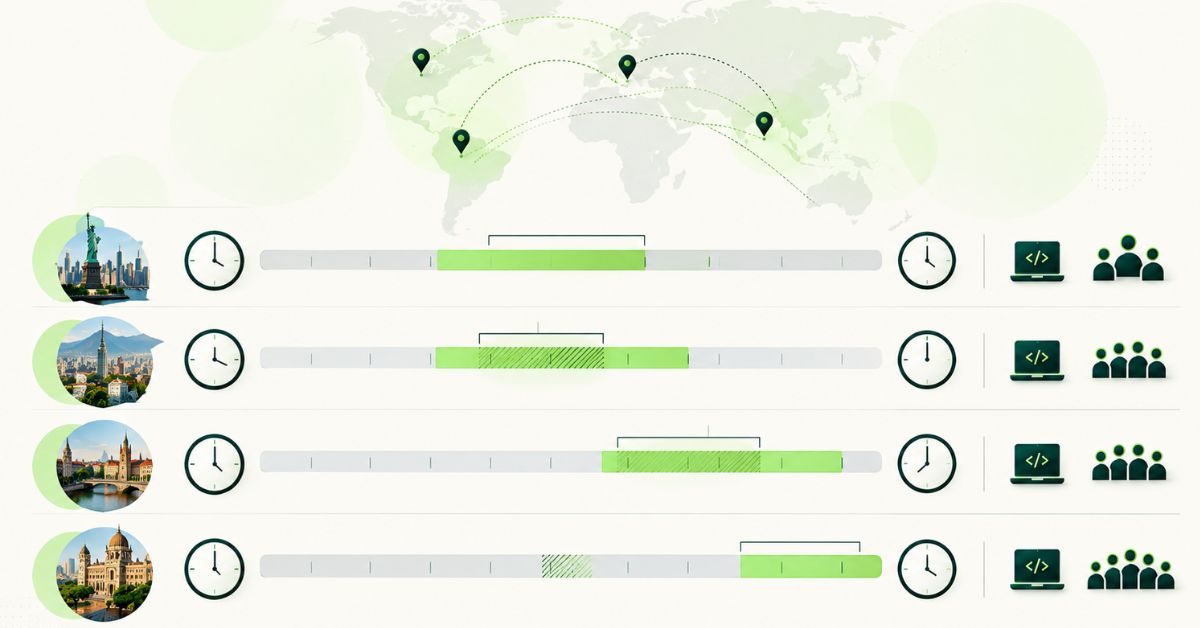
For U.S. buyers, time zone overlap is the deciding factor more often than cost. Harvard Business School researchers studied communication across 250 offices of one multinational in 48 countries. They found that losing just one or two shared business hours cut communication between offices by 9.2% on average. Consequently, they recommended locating knowledge workers along a north-south axis. For a U.S. company, north-south means Latin America.
Cost pressure points the same way. The U.S. Bureau of Labor Statistics reports a median software developer wage of $135,980 as of May 2025, before benefits and recruiting costs. Across ParallelStaff engagements, senior Latin American engineers typically cost 40 to 60% less than equivalent U.S. hires on a fully loaded basis.
Meanwhile, the talent base keeps growing. GitHub attributes Latin America’s developer growth partly to remote hiring by U.S. and European firms. In other words, the region has built its engineering workforce around exactly this kind of work. For a deeper comparison, read ParallelStaff’s guide to nearshore vs. offshore software development.
How to Choose the Right Country for Your Project
Use these rules of thumb to narrow your shortlist quickly:
- You run agile sprints with daily standups: choose Latin America. Mexico, Colombia, and Argentina give you full or near-full overlap.
- You need senior architects or data engineers: look closely at Argentina and Brazil.
- You are on the East Coast and want zero lag: Colombia and Argentina fit best.
- You are on the West Coast: Mexico and Central America keep the gap smallest.
- Your work is well defined and can run overnight: India offers the most scale per dollar.
- You serve European customers: Poland and Romania combine strong English with EU proximity.
The model matters as much as the country. Staff augmentation, dedicated teams, and project-based outsourcing each fit different needs. ParallelStaff’s complete guide to software development outsourcing explains how to pick the model before you pick the location.
Why the Partner Matters More Than the Country
Country averages hide enormous variation. For example, EF places Mexico, Colombia, and Brazil in its low or very low national English bands. Yet thousands of senior engineers in those countries work daily with U.S. teams in fluent English. National statistics describe populations, not the top engineers you actually hire.
That is why vetting matters more than geography. The right partner tests each engineer’s technical depth and English directly. It also recruits across several countries, so you get the best person for the role instead of the best person in one market. Therefore, the best country to outsource software development is often “wherever your partner can find the right engineer.”
If you plan to build a nearshore team, ParallelStaff’s guide on how to hire nearshore developers in Latin America walks through the process, and the complete guide to nearshore software development covers the broader model.


Why ParallelStaff for Software Outsourcing in Latin America
ParallelStaff is a Dallas-based partner that places senior Latin American engineers with U.S. technology teams. Rather than limiting you to one country, it recruits across Mexico, Colombia, Argentina, Brazil, and the rest of the region.
- Rigorous vetting: every engineer passes a technical assessment, a Cambridge English evaluation, and a cultural fit interview.
- Proven retention: a 94% engineer retention rate, so knowledge stays on your team.
- Enterprise security: ISO 27001 certification and full IP transfer to clients.
- Recognized growth: ranked #502 on the 2025 Inc. 5000, with a 4.8/5 Clutch rating.
- Enterprise clients: teams at AT&T, AMD, Google, J.Crew, and Whirlpool have worked with ParallelStaff engineers.
Whether you need one engineer or a full project delivered, explore ParallelStaff’s software outsourcing services or its network of top Latin American developers.
Frequently Asked Questions
What is the best country to outsource software development for a U.S. company in 2026?
For most U.S. companies, a Latin American country is the best choice. Mexico, Colombia, Argentina, and Brazil combine strong engineering talent with working hours that overlap U.S. time zones. India is the better choice only when the work can run asynchronously.
Is Mexico or Colombia better for software outsourcing?
Mexico offers the larger talent pool and fits Central and Pacific time companies well. Colombia fits East Coast teams slightly better and has fast-growing web, mobile, and fintech talent. Both are strong choices.
Which Latin American country has the best English for software developers?
Argentina leads the region. The EF English Proficiency Index 2025 ranks it 26th worldwide and in the “high” proficiency band, with IT professionals scoring above the national average.
Is India still a good place to outsource software development?
Yes, for the right work. India has the world’s second-largest developer community and very competitive rates. However, a time gap of about 10 hours from U.S. Eastern time makes it better for well-defined, asynchronous projects than for daily agile collaboration.
Is Eastern Europe better than Latin America for U.S. companies?
Eastern Europe offers excellent engineers and English, but a six to seven hour gap from U.S. Eastern time. Latin America usually wins for U.S. teams that need live collaboration, while Eastern Europe suits companies with European operations.
What is the cheapest country to outsource software development?
South and Southeast Asian markets like India typically offer the lowest hourly rates. However, the cheapest rate rarely produces the lowest total cost once you factor in rework, turnover, and coordination delays.
Which country has the most software developers in Latin America?
Brazil. GitHub’s Octoverse 2025 report counts about 6.89 million developers in Brazil, the fourth-largest community in the world.
How much can I save by outsourcing software development to Latin America?
Senior Latin American engineers typically cost 40 to 60% less than equivalent U.S. engineers on a fully loaded basis, based on ParallelStaff engagements.
Does the country matter if I use a staffing partner?
Less than you might think. A strong partner recruits across multiple countries and vets each engineer individually, so you get the best person for the role rather than the best person in one market.
What should I look for in an outsourcing partner besides location?
Look for rigorous technical and English vetting, a high engineer retention rate, ISO 27001 or equivalent security, clear IP terms, and verified client reviews.
Can I build a team across several Latin American countries?
Yes. Many companies combine engineers from Mexico, Colombia, and Argentina on one team. Because the time zones are close, the team still collaborates in real time.
Choosing a country is only the first step. The bigger decision is choosing a partner that can find, vet, and keep great engineers wherever they live. Get that right, and the map takes care of itself.
 Verified Author

Paola Araujo
Account Manager
Linkedin Profile