

In this article
TL;DR: Staff augmentation lets a SaaS startup add senior engineers to its existing team, without running a full hiring cycle. Vet a partner on stack-specific technical skill, real-time communication, and security practices, not just hourly rate. In 2026, most SaaS startups augment full-stack, AI, and DevOps roles first. Those roles are the hardest to fill fast through direct hiring.
Staff augmentation for SaaS startups means adding external engineers directly into your team. You keep full control of the roadmap and the sprint. The engineers work under your management, not the provider’s. The augmentation partner handles sourcing, vetting, payroll, and replacement if someone leaves. For an early-stage or growth-stage SaaS company, that trade usually beats a multi-month internal search. You may only need that senior engineer for a year or two anyway.
This guide covers what to look for in a staff augmentation partner, which roles startups augment first, and what it costs in 2026. It also covers the red flags that predict a bad hire. Our staff augmentation guide and our IT staff augmentation service page cover the model at a broader level. This piece zooms in on the SaaS startup use case specifically.
What Staff Augmentation Actually Solves for a SaaS Startup
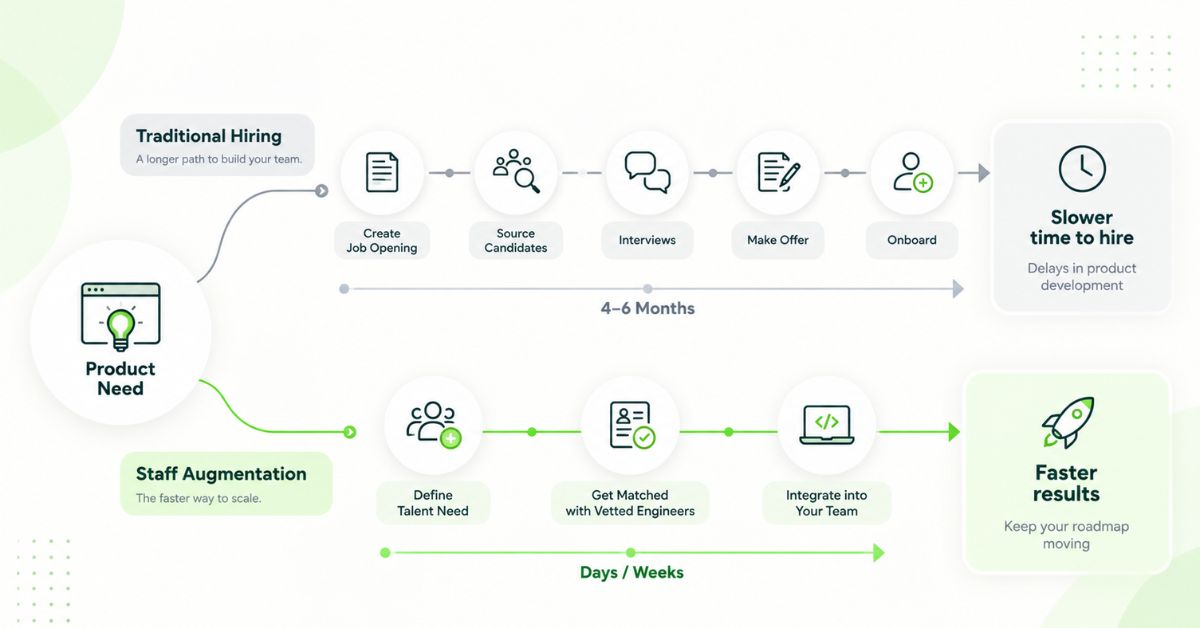
Most SaaS startups don’t have a hiring problem in the abstract. They have a timing problem. A Series A company lands a big enterprise deal that needs a compliance feature in six weeks. A seed-stage team needs an AI engineer to ship a feature the fundraising deck already promised. Direct hiring for either situation takes months. Staff augmentation compresses that timeline to days or a couple of weeks. The partner already has vetted engineers ready to join.
It also solves a scaling problem specific to early-stage companies. Founders don’t always know if a role is permanent yet. A staff augmentation engagement lets you add capacity now. You decide later whether that role becomes a full-time hire, stays augmented, or disappears once the feature ships. Our staff augmentation solutions guide breaks down how to match the engagement structure to that kind of uncertainty. If your product serves online retail rather than pure SaaS, our guide to staff augmentation for e-commerce covers a closely related version of this same decision.
Why SaaS Startups Lean on Staff Augmentation in 2026
Software spending itself is the backdrop here. Gartner’s July 2026 forecast puts worldwide software spend at $1.468 trillion, up 15.5% from 2025. That’s the second-fastest-growing IT category this year, behind only data center systems. Every dollar of that growth eventually needs an engineer behind it. SaaS companies compete directly with every other software buyer for the same limited talent pool.

The talent pool really is limited. A McKinsey global survey found nearly nine in ten companies worldwide already have a skills gap, or expect one within a few years. A startup with no in-house recruiting team feels that gap first. It can’t out-bid a big tech company for the same senior candidates. The Bureau of Labor Statistics projects software developer employment will keep growing 10% from 2025 to 2035, well above the 3% average across all occupations. Median developer salary already sits at $135,980 as of May 2025. For a startup watching burn rate, that salary floor makes every direct hire a bigger bet.
Distributed work is now the default, not the workaround. In Stack Overflow’s 2025 Developer Survey, 32.4% of professional developers said they work fully remote. A startup asking an augmented engineer to join daily standups over video isn’t asking for anything unusual. That’s simply how most engineering teams already operate.


What to Look For in a Staff Augmentation Partner
A generic staffing agency and a real engineering partner look identical on a sales call. The difference shows up in these specifics:
- Stack-specific vetting — ask how the partner tests candidates on your actual stack (React, Node, Rails, whatever it is), not a generic coding test
- Real-time overlap — confirm the engineer’s working hours actually overlap with your team’s, in writing, before you sign anything
- Security practices — a partner touching your production data or customer PII should hold a real certification, such as ISO 27001, not just a claim on their website
- Startup-friendly contract terms — look for month-to-month or short-notice-period language; a startup’s needs shift faster than an enterprise’s
- Retention track record — ask for the partner’s average engineer tenure; a churning engineer mid-sprint costs a small team far more than it costs a large one
- Reference from a comparable company — talk to another SaaS startup the partner has worked with, not just an enterprise logo on their homepage
Common Roles SaaS Startups Augment First

Certain roles come up again and again when a SaaS startup reaches for staff augmentation. Full-stack engineers top the list. An early product team needs people who can move between the front end and the backend as priorities shift. Our guide to hiring full-stack developer talent fast covers what to vet for in that role.
AI and machine learning engineers come next. This is especially true for startups building an AI feature into an existing product rather than starting an AI company from scratch. Our piece on AI development services delivered through staff augmentation walks through how that engagement typically gets structured. DevOps and platform engineers round out the top three. A startup scaling fast often outgrows its own infrastructure before it can justify a full-time hire for that specific skill set. Our guide on managing a nearshore engineering team covers how to keep an augmented team aligned once you’ve filled these roles.
Staff Augmentation vs. Other Models for a Startup
Staff augmentation isn’t the only option, and it isn’t always the right one. A dedicated team fits better once a startup has a sustained, multi-quarter roadmap. That model works when you want a provider to own team continuity, not just individual placements. Project-based outsourcing fits a narrow, one-off build, like an MVP or a specific integration, where you don’t need a standing relationship afterward.
Staff augmentation itself sits between those two options. It fits when you still want full control over priorities but need engineers fast. Our comparison of staff augmentation vs. an outsourcing firm goes deeper into how to choose between the two.
What Staff Augmentation Costs a SaaS Startup in 2026
Rates vary by seniority, region, and stack. The billing structure stays fairly consistent: a monthly or hourly rate per engineer, tied to seniority level. Cost reduction is still the top-cited driver behind outsourcing decisions. Deloitte’s Global Shared Services and Outsourcing Survey found it remains organizations’ number-one objective. Many are actively relocating work to more cost-efficient regions to hit that goal.
For a startup, though, the real cost driver is often turnover, not the hourly rate. Re-onboarding a new engineer mid-sprint costs a five-person engineering team far more, proportionally, than it costs a fifty-person one. Weigh a partner’s retention data as heavily as their rate card before you sign.

Red Flags Specific to Startup Engagements
A few warning signs matter more for a startup than for a larger buyer. A partner unwilling to offer month-to-month terms is betting you’ll be locked in even after your roadmap changes. It will change. Pricing well below market for the stated seniority level often means the engineer doesn’t actually match the level advertised. A five-person team feels that mismatch immediately, since there’s no senior engineer internally to catch the gap. Treat a partner who can’t clearly explain IP ownership as a non-starter. A startup’s code is often its entire asset base going into a fundraising round.
Why ParallelStaff for SaaS Startup Staff Augmentation
ParallelStaff is an ISO 27001-certified nearshore provider built for long-term delivery, not one-off placements. The company holds a 94% engineer retention rate and carries a 4.8-out-of-5 Clutch rating from client reviews. The 2025 Inc. 5000 list ranked ParallelStaff #502 among fastest-growing private companies. Enterprise clients include AT&T, AMD, Google, J.Crew, and Whirlpool. Every engineer works in U.S. time zones and passes a multi-stage technical and English-fluency vetting process. Startups get the same delivery discipline larger clients require, scaled to a smaller engagement.
Frequently Asked Questions
What is staff augmentation for a SaaS startup?
It’s adding external engineers directly into your existing team, under your management, instead of running a full-time hiring process. The partner handles sourcing, vetting, and payroll.
Is staff augmentation good for early-stage startups?
Yes, especially when a role’s permanence is still uncertain. It lets a startup add capacity fast and decide later whether the role becomes a full-time hire.
What roles do SaaS startups usually augment first?
Full-stack engineers, AI and machine learning engineers, and DevOps or platform engineers come up most often. Those roles are hardest to fill quickly through direct hiring.
How much does staff augmentation cost for a startup?
Rates vary by seniority, region, and stack, billed hourly or monthly per engineer. Total cost depends heavily on retention, since a churning engineer costs a small team more than it costs a large one.
What’s the difference between staff augmentation and a dedicated team for a startup?
Staff augmentation adds individual engineers into your existing process. A dedicated team is a full unit the provider assembles and manages, better suited to a sustained multi-quarter roadmap.
Should a startup ask for month-to-month contract terms?
Yes. A startup’s needs shift faster than a larger company’s. Locking into a long fixed term works against that flexibility.
How do I know if an augmented engineer actually fits my stack?
Ask the partner exactly how they test candidates against your specific stack, not a generic coding assessment, before you agree to a placement.
Can an augmented engineer join our existing Slack and sprint process?
Yes. In a properly run engagement, the engineer joins your existing tools, standups, and sprint cadence from day one, working as a full team member.
Who owns the code an augmented engineer writes?
In a properly structured contract, you do, in full, on delivery. Confirm this explicitly before signing, since it matters during a fundraising round.
What security certifications should a staff augmentation partner have?
ISO 27001 is the most widely recognized standard for a partner handling your production data, source code, or customer information.
How fast can a startup get an augmented engineer started?
Providers with an existing vetted talent pool can typically place a matched engineer within 1 to 2 weeks. That’s well inside the timeline a direct hiring process usually takes.
 Verified Author

Luis Peralta
CEO & Founder
Linkedin Profile