
In this article
TL;DR: A mobile app is never finished. Store rules change every year, new devices ship every fall, and users expect steady updates. A dedicated development team for a mobile app gives you one persistent group that knows your product, ships on a regular cadence, and covers design, engineering, QA, and release work. It costs more than a one-off project in the short run, but it usually costs less than rebuilding context with each new vendor.
A dedicated development team for a mobile app is a stable group of engineers, testers, and designers who work only on your product. They join your planning, share your goals, and stay through launch and beyond. You pay a monthly rate, and the partner handles payroll, equipment, and compliance. This guide explains why mobile products need that model, what the team looks like, and how to set it up in 2026.
For the full model, start with our guide to building a dedicated development team. This article focuses on one project type: the mobile app.
Why Does a Mobile App Need a Persistent Team?
Most software is easier to treat as a project. A mobile app is different, because the platforms around it keep moving. Three forces make a persistent team the better fit.
App stores set the pace
Both major stores require regular technical updates. Apple states that apps uploaded to App Store Connect must be built with Xcode 26 or later using the iOS 26 SDK, effective April 28, 2026 (Apple Developer). Google Play, in turn, requires new apps and app updates to target Android 16 (API level 36) or higher starting August 31, 2026, with extensions available to November 1, 2026 (Google Play Help).
Google adds a penalty for falling behind. Apps that target an older API level lose visibility on devices running newer Android versions. In other words, an app that nobody maintains slowly disappears from search and install flows.
The market rewards steady products
The prize is large. An Apple-commissioned study by economists Andrey Fradkin and Jessica Burley found that the App Store ecosystem facilitated $1.3 trillion in developer billings and sales in 2024 (Apple Newsroom). Competition is just as large. Users compare your app to the best apps on their phones, not to your direct rivals.
Release work never stops
A live app needs bug fixes, performance tuning, analytics review, and feature work every week. A team that disbands after launch leaves that work undone. A new vendor then needs weeks to learn the code, the release process, and your users.
What Does a Dedicated Mobile App Team Own?
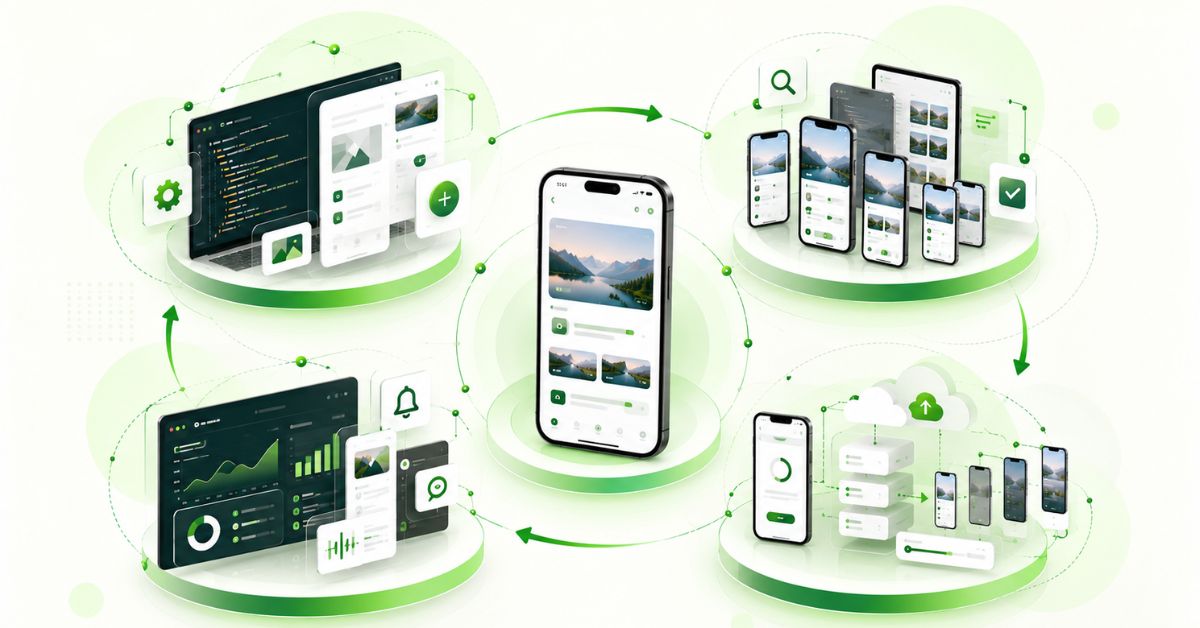
A good team owns the whole product lifecycle, not just coding. Typical responsibilities include:
- Roadmap delivery: turning priorities into shipped features each sprint.
- Release management: store submissions, staged rollouts, and rollback plans.
- Quality: automated tests, device testing, and crash tracking.
- Platform upkeep: adapting to new operating system versions and store rules.
- Backend and integrations: the services, data, and third-party tools behind the app.
- Performance and security: speed, battery use, data protection, and fixes for known risks.
Because one group owns all of this, nothing falls between vendors. When a crash spikes after a release, the same people who built the feature fix it.
What Does the Team Look Like?
Team makeup depends on your product, but most mobile teams use a core group plus flexible support. Role titles appear below only as team-composition detail.
| Seat | Purpose | Core or flex |
|---|---|---|
| Technical lead | Architecture, code review, release decisions | Core |
| Mobile engineers (1 to 3) | Build features for your target platforms | Core |
| Backend engineer | Services, data, and integrations | Core |
| QA engineer | Test automation and device coverage | Core |
| Delivery manager | Scope, risks, and reporting | Core |
| UX/UI designer | Flows, screens, and design system | Flex |
| DevOps support | Build pipelines and monitoring | Flex |
Start small. A core group of four or five people can ship a lot. Add flex seats when the roadmap demands them, and release them when it does not. To see why each seat matters, read our breakdown of the essential roles in a software development team. For hands-on staffing steps, see our guide to staffing a dedicated app development team.


How Does a Dedicated Team Compare With Other Models for a Mobile App?
Three models appear most often. Each one fits a different situation.
| Model | Best for | Weak spot for mobile |
|---|---|---|
| Dedicated team | Live products with a long roadmap | Needs steady work to justify the monthly cost |
| Project outsourcing | A one-time build with a fixed scope | Knowledge leaves when the project ends |
| Staff augmentation | Filling one gap in a strong team | You still run delivery and release yourself |
If your company already has a capable manager and only needs one more engineer, staff augmentation can work well. Our comparison of staff augmentation and dedicated teams explains how to choose. If the app is a single build with no roadmap, project outsourcing is simpler.
When Is a Dedicated Team the Right Choice for Your App?
A dedicated team fits best when most of these statements are true.
- Your app is live, or will be live within a few months.
- You plan to ship updates at least every two to four weeks.
- Your roadmap runs longer than six months.
- You need design, engineering, and QA working as one unit.
- You want product knowledge to stay in the team, not leave with a vendor.
It fits less well when you have a short prototype, a one-time campaign app, or a budget that cannot cover steady monthly spend.
How Much Does a Dedicated Mobile App Team Cost in 2026?
Cost depends on team size, seniority, and region. The U.S. Bureau of Labor Statistics reports a median pay of $134,040 for software developers, quality assurance analysts, and testers combined, and projects 10% growth from 2025 to 2035 (BLS Occupational Outlook Handbook). That growth means strong competition for the same engineers, and local hiring takes time.
Nearshore teams change the math. ParallelStaff’s published ranges show mid-level engineers in Latin America earning about $40,000 to $70,000 a year, and seniors about $55,000 to $105,000. Partner fees add roughly 10% to 25% on top. See our LATAM software engineer salaries breakdown for the full table.
Think about total cost, not only the monthly rate. Include:
- recruiting time saved, since a partner can often staff a team in two to four weeks;
- rework avoided, because the same people carry context from release to release;
- downtime avoided, because a team can react fast to store changes and crashes.
Our article on the benefits of a dedicated development team lists more of these savings.
How Do You Set Up a Dedicated Team for a Mobile App?
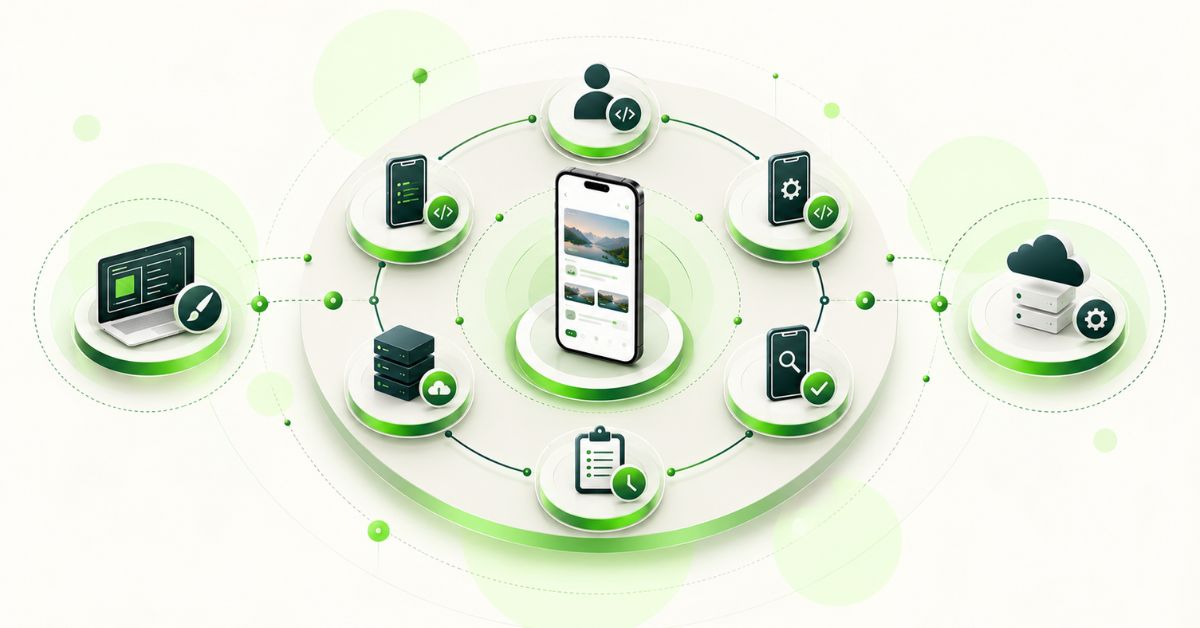
Follow these seven steps.
Step 1: Define the product goals
Write down what the app must achieve in the next 6 to 12 months. Use clear measures, such as active users, retention, or conversion in the app.
Step 2: Audit what exists
List your code, designs, backend services, and store accounts. A team that sees the full picture can plan realistic work.
Step 3: Choose the team shape
Pick a core group and decide which flex seats you may need. Match the shape to your roadmap, not to a template.
Step 4: Select a partner
Ask about retention, security practices, and replacement policy. Interview every proposed team member yourself before work starts.
Step 5: Plan the first 30 days
Set up access, tooling, and a first small release. Early wins build trust and expose process gaps while the stakes are low.
Step 6: Set a regular rhythm
Run short sprints with a demo at the end of each one. Hold a weekly check on release risks and a monthly review of budget and roadmap.
Step 7: Measure and adjust
Track crash-free sessions, release frequency, and review ratings. Add or remove seats based on results.
Time zones matter in this rhythm. A Rice Business study of more than 12,000 employees at a Fortune 100 company found that each added hour of time difference cut synchronous communication by 11% (Rice Business). Mobile releases involve many quick decisions, so shared working hours help. That is one reason many U.S. companies look at nearshore dedicated teams.
What Mistakes Should You Avoid?
- Treating the team like a vendor. Share goals and user data so they can make good choices.
- Skipping device testing. Real devices catch issues that simulators miss.
- Ignoring store deadlines. Put platform updates on the roadmap each quarter.
- Having no product owner. Someone on your side must set priorities.
- Letting the backlog grow unchecked. Review it every sprint.
- Choosing on rate alone. Low rates with high turnover cost more in the end.
Why Do Teams Build Their Mobile App Team With ParallelStaff?
ParallelStaff builds dedicated teams of senior engineers from Latin America for U.S. companies. Several facts support the process.
- Growth: ParallelStaff ranked #502 on the 2025 Inc. 5000 list.
- Reviews: We hold a 4.8 out of 5 rating on Clutch.
- Retention: 94% of our engineers stay on their placements.
- Security: We are ISO 27001 certified.
- Enterprise trust: Our engineers have supported AT&T, AMD, Google, J.Crew, and Whirlpool.
You interview every engineer, and we handle payroll, equipment, and compliance. See how our dedicated development teams work. If your app is mainly about sales, our guide to a dedicated team for an ecommerce platform shows a similar model. For a product that runs as a subscription service, read about a dedicated team for a SaaS platform.


Related Reading
If you are weighing where to build, compare the options in our guide to nearshore app development. If you only need one platform specialist today, see how to hire iOS developers in your time zone.
Frequently Asked Questions About Dedicated Teams for Mobile Apps
What is a dedicated development team for a mobile app?
It is a stable group of engineers, testers, and designers who work only on your app. They stay through launch and ongoing releases.
Why does a mobile app need a dedicated team instead of a one-time project?
Store rules, devices, and user needs change every year. A persistent team keeps the app current without relearning the code each time.
How big should a dedicated mobile app team be?
Most teams start with four or five people: a lead, one to three mobile engineers, a backend engineer, and a QA engineer. Add design and DevOps support as needed.
How much does a dedicated mobile app team cost in 2026?
Cost depends on team size and seniority. Nearshore teams usually cost less than comparable U.S. teams. Ask a partner for a quote based on your roadmap.
How long does it take to build a dedicated team?
With a nearshore partner, a team can often be staffed in two to four weeks. Local direct hiring commonly takes several months.
Is a dedicated team better than an agency for a mobile app?
For a live product with a long roadmap, yes. A dedicated team keeps knowledge in one place, while an agency project often ends with a handoff.
What is the difference between a dedicated team and staff augmentation?
A dedicated team is a multi-role group that works as one unit. Staff augmentation adds individuals to a team you already manage.
Who owns the code in a dedicated team model?
You do. Put code ownership, repository access, and store account control in the contract from day one.
How does a dedicated team handle App Store and Google Play updates?
The team puts platform changes on the roadmap, such as new SDK and API level requirements, and ships them before the deadlines.
Can I scale a dedicated mobile team up or down?
Yes. Most partners let you add or release seats with notice, so the team follows your roadmap.
How do I keep a remote mobile team aligned?
Use short sprints, a demo after each one, shared dashboards, and a clear product owner on your side.
Is it safe to work with a dedicated team outside the United States?
Yes, with the right controls. Look for ISO 27001, signed IP assignment, and limited access to production systems.
When should I not use a dedicated team for my app?
Skip it for short prototypes, one-time campaign apps, or budgets that cannot support steady monthly spend.
Final Thoughts
A dedicated development team for a mobile app gives you what a live product needs most: continuity. The same people learn your users, meet each store deadline, and ship updates on a steady cadence. In 2026, with store rules tightening and competition rising, that continuity is hard to replace. If you want to talk through team size and budget, our team can share a proposal within days.
 Verified Author

Luis Peralta
CEO & Founder
Linkedin Profile